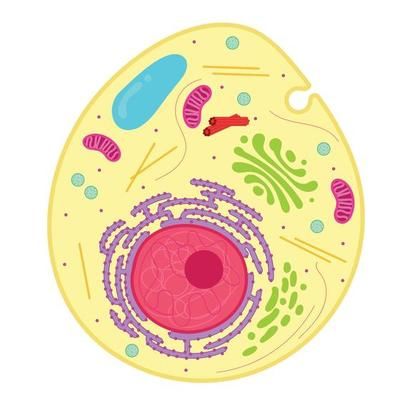
Ribosome biogenesis refers to the biosynthesis of ribosomes. In eukaryotes, the sites of ribosome formation are the cytoplasm and the nucleus. The ribosome of eukaryotes is the 80S as opposed to the ribosome of prokaryotes, which is 70S. The 80S ribosome consists of a large subunit (60S) and a small subunit (40S). Each of these subunits is composed of ribosomal protein and rRNA(s). The ribosomal proteins are synthesized in the same manner as other proteins are produced, i.e. first by transcription within the nucleus and then moved into the cytoplasm for translation and maturation.
Mature ribosomal proteins are moved back into the nucleus, particularly in the nucleolus for ribosomal subunit assemblies, i.e. 60S or 40S assembly. As for the rRNA components of the 60S or 40S, they are produced in the nucleus.
In mammals, the rRNAs 18S, 28S, and 5.8S are transcribed in the nucleolus organizer region into a single unit pre-rRNA (referred to specifically as 45S pre-RNA) by the catalytic action of RNA polymerase I. The result is a large pre-rRNA made up of 18S, 28S, and 5.8S, which after processing would be released individually. As for the 5S rRNA, the genes encoding for it are transcribed into pre-5S rRNA by the RNA polymerase III. However, the pre-5S rRNA transcript is produced in the nucleoplasm, outside the nucleolus. Nevertheless, it finds its way to the nucleolus for the assembly.
- To form the large subunit (i.e. 60S) of the ribosomal complex, 5S rRNA combines with 28S and 5.8S rRNA. 18S, in turn, forms the small subunit (i.e. 40S) by combining with the ribosomal proteins. These subunits would then be moved from the nucleolus into the cytoplasm for the assembly of a complete and functional 80S ribosome.
Leave a Reply