
In a steady flow process, thermodynamic properties at any section remain constant with respect to time; it can vary only with respect to space. A schematic diagram of steady flow process is shown in Figure 1.7.

Figure 1.7 Schematic Diagram of Steady Flow Process


Energy balance equation:

This is known as steady flow energy equation (SFEE) for single stream.
Variable Flow Process
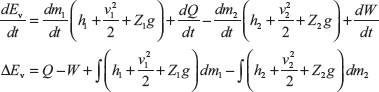
In some flow process, mass flow rate is not steady but varies with respect to time. In such a case, the difference in energy flow is stored in system as ΔEv.
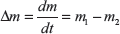
Rate of energy increase = Rate of energy inflow − Rate of energy outflow
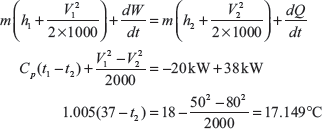
Example 1.14: An air conditioning system, as shown in Figure 1.8, handling 1 kg/s of air at 37°C and consumes a power of 20 kW and rejects heat of 38 kW. The inlet and outlet velocities of air are 50 and 80 m/s, respectively. Find the exit air temperature, assuming adiabatic conditions. Take Cp of air as 1.005 kJ/kg.
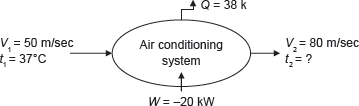
Figure 1.8 Air Conditioning System
Solution:
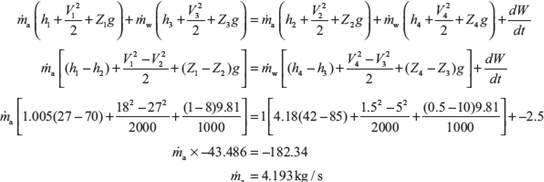
Example 1.15: In a cooling tower of a power plant (Figure 1.9), air enters at a height of 1 m above the ground and leaves at 8 m. The inlet and outlet velocities are 18 and 27 m/s, respectively. Water enters at a height of 10 m and leaves at a height of 0.5 m. The velocity of water at entry and exit are 5 and 1.5 m/s, respectively. Water temperatures are 85 and 42°C at inlet and exit, respectively. Air temperatures are 27 and 70°C at entry and exit, respectively. The cooling tower is fully insulated and a fan of 2.5 kW drives air through the cooler. Find the air per second required for 1 kg/s of water flow. The values of Cp of air and water are 1.005 and 4.18 kJ/kg K, respectively.
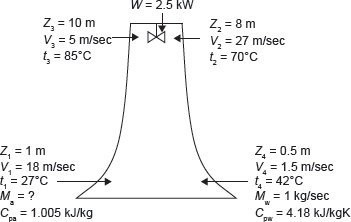
Figure 1.9 Cooling Tower
Solution:
Example 1.16: In a centrifugal air compressor, initial pressure, and specific volume are 1 bar and 1 m3/kg, respectively. The air flow rate is 30 kg/min. Heat liberated to atmosphere from compressor is 100 kW and inlet velocity of air = 10 m/s, outlet velocity of air = 5 m/s. Find
- Compressor work.
- Ratio of inlet and outlet area, if internal energy at outlet is 100 kJ more than that of inlet. Solve the problem using SFEE.


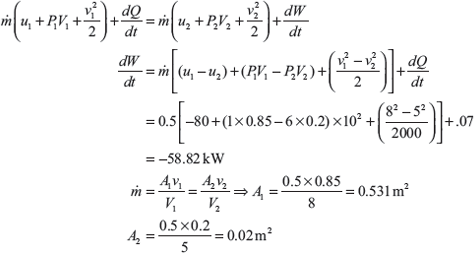
Example 1.17: Air enters in a compressor at the rate of 0.5 kg/s, at 8 m/s with a pressure of 1 bar and a specific volume of 0.85 m3/kg, and leaving at 5 m/s with a pressure of 6 bar and a specific volume of 0.2 m3/kg (Figure 1.10). The internal energy of the air leaving is 80 kJ/kg greater than that of the air entering. Cooling water in a jacket surrounding the cylinder absorbs heat from the air at the rate of 70 W. Calculate the power required to drive the compressor and the inlet, and outlet cross-sectional areas.
Solution:
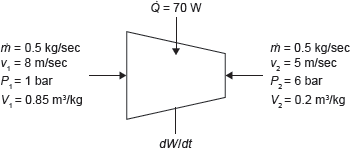
Figure 1.10 Compressor
1.4.7 Limitations of First Law of Thermodynamics
First law of thermodynamics does not tell about the following:
- How much of the given quantity of heat is changed into work?
- In which direction is changing take place (heat to work or work to heat)?
- Under which condition the changing will take place?
Leave a Reply