
compression ignition engine.
6.4.1 Four-stroke Spark Ignition Engine
The working of all the four strokes of a spark ignition engine is shown in Figure 6.4. In this engine, the cycle of operations is completed in four strokes of the piston or two revolutions of the crankshaft. During the four strokes, there are five processes to be completed, viz., suction, compression, combustion, expansion and exhaust. Each stroke consists of 180° rotation of crankshaft and hence a four strokes cycle is completed in two revolutions of crankshaft. The pressure–volume diagram (P−V diagram) diagram is shown in Figure 6.5.
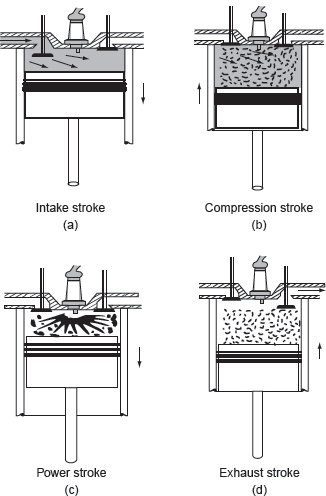
Figure 6.4 All the Four Thermodynamic Processes in Four Strokes SI Engine
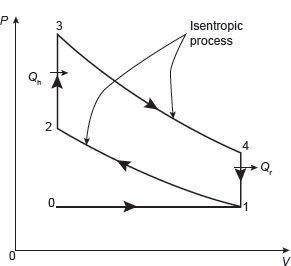
Figure 6.5 ρ−V Diagram for Otto Cycle
Suction Stroke (0−1): It starts when piston is at TDC and about to move downward, inlet valve is open and exhaust valve is closed as shown in Figure 6.4a. Due to suction created by the piston movement towards BDC, air–fuel mixture enters into the cylinder. Suction ends when piston reaches at BDC.
Compression Stroke (1−2): At the end of suction stroke, inlet valve is closed and piston moves towards TDC. In this stroke, both valves inlet and exhaust are closed; compression of the air–fuel mixture filled in the cylinder starts from BDC and ends at TDC as shown in Figure 6.4b. At the end of compression and at constant volume (2−3), sparking starts at spark plug and instantaneously burning takes place in the compressed air–fuel mixture. Pressure and temperature are increased to maximum limit.
Power Stroke (3−4): The high pressure developed due to combustion of fuel forces the piston towards BDC. The power is transferred to the crankshaft. Pressure and temperature decrease during the stroke. In this stroke, both the valves are closed as shown in
Exhaust Stroke (4−1): At the end of expansion or power stroke, the exhaust valve opens and the inlet valve remains closed as shown in. Piston moves towards TDC and exhaust gas is forced to escape into atmosphere through exhaust valve.
Leave a Reply