
When an electric potential difference is applied across the metallic wire, the loosely attached free electrons, as shown in Figure 1.3, start drifting towards the positive terminal of the cell (see Fig. 1.4). This continuous drifting of electrons constitutes the electric current. Therefore, a continuous drifting of electrons in an electric circuit is called electric current.
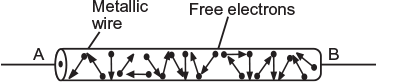
Fig. 1.3 Random movement of free electrons in metals
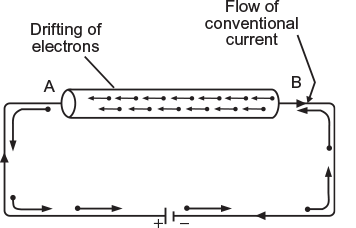
Fig. 1.4 Continuous drifting of free electrons constituting electric current
The drifting of electrons in the wire is from B to A, that is, from negative terminal of the cell to the positive terminal through external circuit.
1.10.1 Conventional Direction of Flow of Current
Prior to electron theory, it was believed that some matter flows through the circuit when a potential difference is applied, which constitutes electric current. It was considered that this matter flows from higher potential to lower potential, that is, positive terminal to negative terminal of the cell through external circuit. This convention flow of current is so firmly established that it is still in use. Therefore, the conventional direction of flow of current is from A to B, that is, from positive terminal of the cell to the negative terminal through the external circuit.
The magnitude of flow of current at any section of the conductor is the rate of flow of electrons, that is, charge flowing per second. It can be expressed mathematically as follows:
Current,

Unit: Since charge is measured in coulomb and time in second, the unit of electric current is coulomb/second (C/s) or ampere (A).
1.11 RESISTANCE
The opposition offered to the flow of electric current or free electrons, as shown in Figure 1.5, is called resistance.
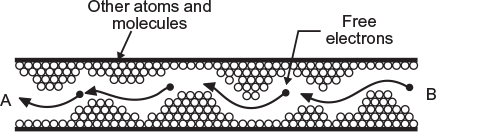
Fig. 1.5 Opposition offered to electric current
Unit: Resistance is measured in ohm (or kilo ohm) and is denoted by symbol Ω or kΩ.
A wire is said to have a resistance of one ohm if one ampere current passing through it produces a heat of 0.24 calorie (or one joule).
1.11.1 Laws of Resistance
The resistance (R) of a wire depends upon the following factors:
- It is directly proportional to its length, l, that is, R ∝ l.
- It is inversely proportional to its area of cross section, α, that is,

- It depends upon the nature (i.e., atomic structure) of the material of which the wire is made.
- It also depends upon the temperature of the wire.
Neglecting the last factor for the time being 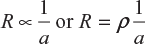
where ρ (‘Rho’ a Greek letter) is a constant of proportionality called resistivity of the wire material. Its value depends upon the nature (i.e., atomic structure) of the wire material representing the third factor earlier.
1.12 RESISTIVITY
The resistivity of a wire is given by the relation: 
If l = 1 m and α = 1 m2 (Fig. 1.6(a)), then R = ρ
Hence, the resistance offered by one- metre length of wire of given material having an area of cross-section of one square metre is called the resistivity of the wire material.
In place of wire, if a cube of one metre side of a given material is taken as shown in Figure 1.6(b), then consider opposite two faces of the cube.
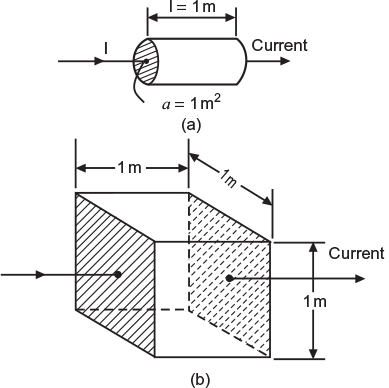
Fig. 1.6 Conductor size to determine specific resistance (a) Wire (b) Cube of 1 m side
l = 1 m; a = 1 × 1 = 1 m2 and R = ρ
Hence, the resistance offered between the opposite two faces of one-metre cube of the given material is called the resistivity of that material.
Unit: We know that 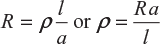
Substituting the units of various quantities as per SI units, we get
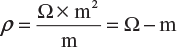
Hence, the unit of resistivity is ohm metre in SI units.
1.13 SPECIFIC RESISTANCE
Specific resistance of a material is defined as the resistance of the material having specific dimensions, that is, one-metre length and one square metre as area of cross-section.
1.14 CONDUCTANCE
The ease to the flow of current is called conductance. It is generally denoted by letter G.
We know that the opposition to the flow of current is called resistance. Hence, conductance is just reciprocal of resistance, that is,
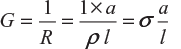
Unit: The unit of conductance is mho (i.e., ohm spelt backward). The symbol for its unit is Ʊ
1.14.1 Conductivity
From the expression given earlier, σ (‘Sigma’ a Greek letter) is called the conductivity or specific conductance of the material. It is basically the property or nature (i.e., atomic structure) of the material due to which it allows the current to flow (conduct) through it.
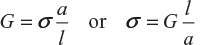
Substituting the units of various quantities, we get
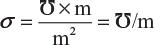
Hence, the unit of conductivity in SI units is mho/metre.
Leave a Reply