Ohm’s law states that the current flowing between any two points of a conductor (or circuit) is directly proportional to the potential difference across them, as shown in Figure 1.8, provided physical conditions i.e. temperature etc. do not change.
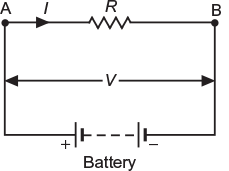
Fig. 1.8 Potential difference (voltage) applied across a wire having resistance R ohm
Mathematically I ∝ V
or

In other words, Ohm’s law can also be stated as follows:
The ratio of potential difference across any two points of a conductor to the current flowing between them is always constant, provided the physical conditions,that is, temperature, etc., do not change.
This constant is called the resistance (R) of the conductor (or circuit).
∴

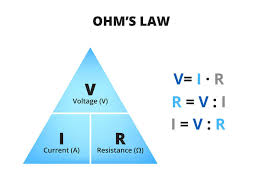
It can also be written as V = IR and 
In a circuit, when current flows through a resistor, the potential difference across the resistor is known as voltage drop across it, that is, V = IR.
Leave a Reply