
Consider a metallic resistor having a resistance of R0 and 0°C and Rt at t°C. The increase in resistance (Rt − R0) is directly proportional to its initial resistance, that is,
(Rt − R0) ∝ R0
(Rt − R0) is directly proportional to rise in temperature, that is
(Rt − R0) ∝ t
(Rt − R0) depends on the nature of its material.
Thus,
(Rt − R0) ∝ R0t
or
(Rt − R0) = α0R0t (1.1)
where α0 is a constant called temperature coefficient of resistance at 0°C. Its value depends upon the nature of resistor material.
By rearranging the equation (1.1), we get
Rt = R0 (1 + α0t) (1.2)
and
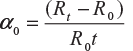 (1.3)
(1.3)
If R0 = 1 ohm; t = 1°C; then, α0 = (Rt − R0)
Hence, temperature coefficient of resistance at 0°C may be defined as the change in resistance per ohm original resistance per °C change in temperature.
Unit: We know that, α0 = (Rt − R0)/R0 t
Substituting the units of various quantities, we get,
Unit of 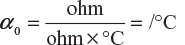
Hence, the unit of temperature coefficient is per °C.
1.20 TEMPERATURE CO-EFFICIENT OF COPPER AT 0°C
It has been seen that Rt = R0 (1 + α0t)
The above equation holds good for both rise and fall in temperature. The temperature verses resistance graph of copper material is a straight line as shown in Figure 1.9.
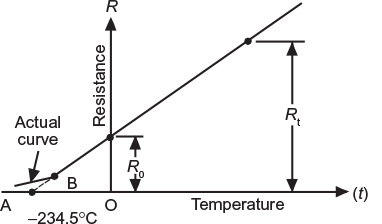
Fig. 1.9 Graph between temperature and resistance
If this line is extended in the backward direction, it would cut the temperature axis at point A where temperature is −234.5°C.
Putting the value of Rt = 0 and t = −234.5°C in the above equation, we get,
0 = R0 [1 + α0 (−234.5)]
or
234.5 α0 = 1
or
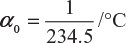
where α0 is the temperature coefficient of resistance of copper at 0°C.
However, in practice, the curve departs (at point B) from a straight line at very low temperature and the resistance never becomes zero.
1.21 EFFECT OF TEMPERATURE ON α
The value of temperature coefficient of resistance (α ) is not constant. Its value depends upon the initial temperature on which the increment in resistance is based. If the initial temperature is 0°C, the value of α is α0. Similarly, if the initial temperature is t1°C, the value of α is α1.
Relation between α0 and α1.
Consider a conductor of resistance R0 at 0°C. When its temperature is raised to t1°C, its resistance increases to say R1.
∴
(R1 − R0) = R0α0t1 (1.4)
or
R1 = R0 (1 + α0t1) (1.5)
Let us suppose that the conductor of resistance R1 at t1°C be now cooled down to 0°C to give a resistance of final value R0.
R0 = R1 (1 + α1 (−t1)) = R1 − t1R1α1
or
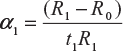
Substituting the value of (R1 − R0) from equation (1.4) and the value of R1 from equation (1.5), we get,

or

Relation between α1 and α2.
Rearranging the equation (1.6), we get,

Similarly, if the initial temperature is t2°C and, the value of α is α2, then

Subtracting equation (1.7) from (1.8), we get,

or

The following conclusions were drawn from the discussion
- From equation (1.10), it is clear that with the rise in temperature, the value of α decreases. Thus, α0 has the maximum value.
- If the initial resistance at 0°C is R0 and the final resistance at t1 °C is R1, then R1 = R0 (1 + α0t1)
- If the initial resistance at t1 °C is R1 and the final resistance at t2 °C is R2, then R2 = R1 (1 + α1 (t2 − t1))
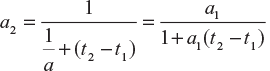
- If the value of α at t1°C is α1, then its value at t2°C will be
Leave a Reply