To operate electrical or electronic circuits, a source of electrical power is required. The basic purpose of a source is to supply power to a load. Therefore, a load is connected to the source as shown in Figure 2.2. The source may be either a DC (direct current) source or an AC (alternating current) source.
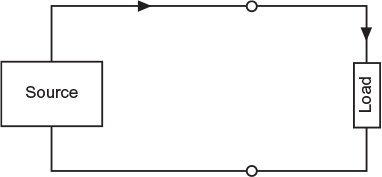
Fig. 2.2 Transfer of energy from source to load
- DC source: Any device that produces direct voltage output continuously is called a DC source. Some of the commonly used DC sources are batteries, generators, and DC power supplies (regulated power supplies).
- Battery: A battery is the most common DC voltage source used for the operation of electronic circuits. A battery is just a series, parallel, or series–parallel combination of primary or secondary cells. The secondary cells are rechargeable, whereas primary cells are not. The battery used in an automobile (car) contains number of secondary cells in series (see Fig. 2.3(a)), whereas the dry cells used in a torch are primary cells (see Fig. 2.3(b)). Both of them are used for the operation of electrical or electronic circuits.
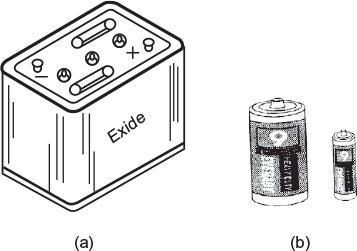 Fig. 2.3 (a) Secondary battery and (b) Primary cellsSolar cells (which convert light energy into electrical energy) are also used for the operation of electronic circuits, for example, in calculators, satellites, etc. Batteries or cells are used where small power (voltage and current) is required.
 - Generator: A DC generator is an electrical machine that converts mechanical energy into electrical energy. When armature is rotated by a prime-mover (water turbine, steam turbine, diesel engine, etc.) in the stationary magnetic field, the required DC voltage appears across its terminals (see Fig. 2.4). DC Generators are used where large power (voltage and current) is required.
- Rectifier-type supply: It consists of a step-down transformer and a rectifier to obtain required DC output voltage. This DC supply is used most frequently in the electronic circuits. A rectifier-type supply is shown in Figure 2.5.
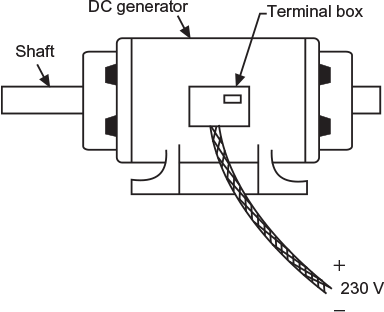 Fig. 2.4 DC Generator
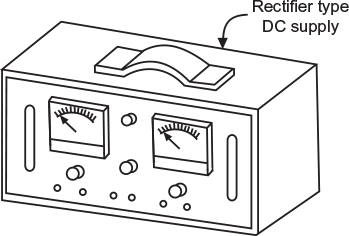 Fig. 2.5 DC Power supply
- Battery: A battery is the most common DC voltage source used for the operation of electronic circuits. A battery is just a series, parallel, or series–parallel combination of primary or secondary cells. The secondary cells are rechargeable, whereas primary cells are not. The battery used in an automobile (car) contains number of secondary cells in series (see Fig. 2.3(a)), whereas the dry cells used in a torch are primary cells (see Fig. 2.3(b)). Both of them are used for the operation of electrical or electronic circuits.
- AC Source: Any device that produces alternating voltage output continuously is called an AC source. Some of the commonly used AC sources are alternators and oscillators or signal generators.
- Alternators: An AC generator is known as an alternator. It is a similar machine as that of DC generator, the only difference is that its output is AC voltage instead of DC voltage. These machines are installed at the generating stations, where power is generated at 50 Hz. This power is applied to various electrical or electronic circuits.
- Oscillators or signal generators: An oscillator or signal generator is the equipment that supplies (output) AC voltages at different frequencies. Its output is used to test the working of various electrical or electronic circuits (e.g., amplifier, etc.).Some signal generators are capable of supplying different types of waveforms such as triangular wave and square wave in addition to the sinusoidal. A signal generator used in the laboratory is shown in Figure 2.6.
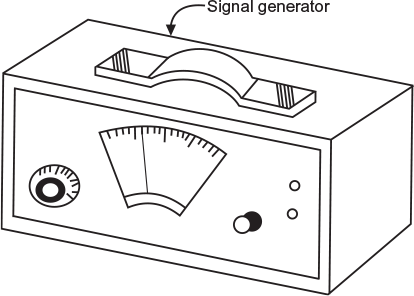 Fig. 2.6 Signal generator
Leave a Reply