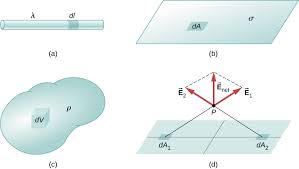
On a conductor or body, charge can be distributed in three ways:
3.11.1 Linear Charge Distribution
When the charge is uniformly distributed over a line (straight or circular), the distribution is called linear charge distribution. If a charge Q is distributed over the length l of the conductor, then its linear charge density ( λ) is given by the relation:
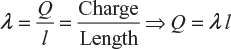
Hence, linear charge density λ can be defined as the charge per unit length of conductor and its SI unit is Cm−1.
3.11.2 Surface Charge Distribution
When the charge is uniformly distributed over the surface of a body, the distribution is called surface charge distribution. If Q is charge distributed over a surface area S, then its surface charge density ( σ) is given by the relation:
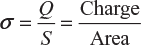
Q = σS
Hence , surface charge density ( σ) is defined as the charge distributed per unit area of the surface and its SI unit is Cm−2.
3.11.3 Volume Charge Distribution
When the charge is distributed uniformly over the volume of a body, the distribution is called volume charge distribution. If Q is charge distributed over volume V, then its volume charge density ( ρ) is given by the relation:
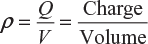
Q = ρ V
Hence, volume charge density ( ρ) is defined as the charge distributed per unit volume of the conductor and its SI unit in Cm−3
Leave a Reply