Whenever terminal voltage of a battery falls below 1.8 V per cell, it is put under recharging. The following points must be kept in mind while charging a battery:
- Only a DC voltage source is applied for recharging.
- Ensure that positive terminal of the source is connected with positive terminal of the battery and negative with negative.
- The charging voltage of the source should be approximately 2.5 V per cell.
- The charging current should be maintained approximately 1 A per positive plate of the battery per cell. For instant, if a cell of the battery contains 17 plates, it will have eight positive plates. Thus, the charging current for such a battery will be 8 A.
Note: An over current may produce excessive heat and damage the battery.
Generally, the following two methods are employed for charging a battery:
- Constant current method: In this method, the charging current supplied to the battery is kept constant throughout the charging period by adjusting the value of variable resistor R form R1 to R2 as shown in Figure 4.8(a).At the beginning of the charging, current supplied to the battery,
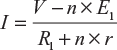 Where n = No. of cells in series;E1 = emf of each cell in the beginning;r = internal resistance of each cell;R1 = initial value of series resistor.
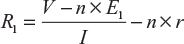 As charging starts, the emf developed in each cell starts increasing which decreases the circuit current. To maintain the current constant, the value of series resistor is decreased gradually. Finally, when the battery is fully charged, let the emf developed per cell be E2 and the value of series resistance be R2.Then,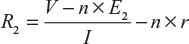
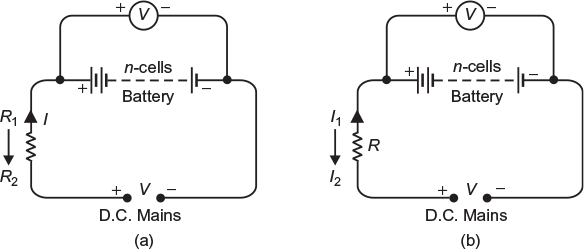 Fig. 4.8 Recharging of a battery (a) Constant current method (b) Constant voltage method
 - Constant voltage method: In this method, the supply voltage for charging the battery is kept constant. A fixed resistance R is connected in series with the battery, as shown in Figure 4.8(b) to limit the current supplied to the battery in the beginning. In this case, the battery draws heavy current I1 in the beginning which reduces to I2 finally when the battery is fully charged.
 This method of battery charging is applied commercially as total time required for complete charging is far less (nearly half) than that for constant current method. Moreover, no attendant is required to vary the series resistance.
Example 4.7
A battery of 50 cells in series is charged through a resistance of 4 Ω−from a 230 V supply. If the terminal voltage per cell is 2 V and 2.7 V, respectively, at the beginning and at the end of the charge, calculate the charging current at the beginning and at the end of the charge.
Solution:
Charging current at the beginning,

Where V = 230 V, n = 50; E1 = 2 V; R = 4 Ω;

Charging current at the end,

or
I2 = 95/4 = 23.75 A
most appropriate charging if each cell of the battery contains 63 plates. If the cells contain less than 63 plates, they will be overheated in the beginning while changing and the life of the battery reduces.
Example 4.8
A secondary battery consists of six cells in series, each having an emf of 1.8 V at discharge and 2.5 V when fully charged. The internal resistance of each cell is 0.1 Ω. If a charging supply of 24 V is available, calculate the value of variable series resistance required to maintain the charging current at a constant value of 10 A throughout the charging period.
Solution:
Value of series resistance in the beginning.
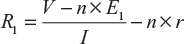
Where V = 24 V; n = 6; E1 = 1.8 V; I = 10 A; r = 0.1 Ω

Value of series resistance when the battery is fully charged.
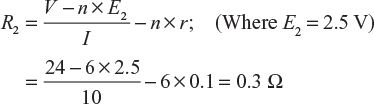
Learning outcome: The value of series resistor has to be regulated from 0.72 Ω to 0.3 Ω to maintain the charging current at 10 A.
Example 4.9
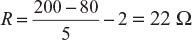
A battery of emf 80 V having an internal resistance of 2 Ω is to be charged from 200 V mains. What is the value of series resistance for a charging current of 5 A? If the battery is charged for 10 hours, calculate the cost of energy consumed if the rate of energy is  4.75 per unit.
Solution:
The value of series resistance 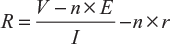
Where V = 200 V; I = 5 A; n × E = 80 V; n × r = 2 Ω;
∴
Energy supplied during charging = V × I × t/1000 = 200 × 5 × 10/1000 = 10 kWh
Energy charges = 4.75 × 10 = 47.50
Leave a Reply