
When current flows through one coil, it produces flux (f1). The whole of this flux may not be linking with the other coil coupled to it, as shown in Figure 5.32. It may be reduced because of leakage flux fl by a fraction k known as co-efficient of coupling.
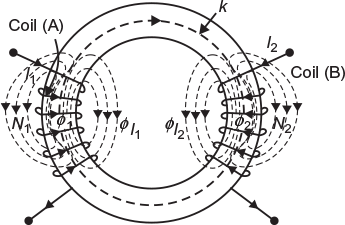
Fig. 5.32 Magnetic circuit for co-efficient of coupling
Thus, the fraction of magnetic flux produced by the current in one coil that links with the other is known as co-efficient of coupling (k) between the two coils. If the flux produced by one coil completely links with the other, then the value of k is 1 and the coils are said to be magnetically tightly coupled. However, if the flux produced by one coil does not link at all with the other, then the value of k is zero and the coils are said to be magnetically isolated.
5.22.1 Mathematical Expression
Consider the magnetic circuit shown in Figure 5.32. When current I1 flows through coil 1,

(Θɸ12 = kɸ1)
Now, considering coil 2 carrying current I2;

(Θɸ21 = kɸ2)
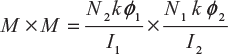
Multiplying Equations (5.3) and (5.4), we get
or

or

The abovementioned expression gives a relation between mutual inductance between the two coils and their respective self-inductances.
Expression (5.5) can also be written as

Leave a Reply