
Consider two coils magnetically coupled having self-inductance of L1 and L2, respectively, and a mutual inductance of M H. The two coils, in an electrical circuit, may be connected in different ways giving different values of resultant inductance as the following.
5.23.1 Inductances in Series
The two coils may be connected in series in two ways: when their fields (or mmfs) are additive, that is, their fluxes are set up in the same direction as shown in Figure 5.33. In this case, the inductance of each coil is increasedby M, that is,
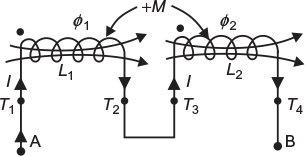
Fig. 5.33 Inductances in series, fields are additive
inductance, LT = (L1 + M) + (L2 + M) = L1 + L2 + 2 M
When their fields (or mmfs) are subtractive, that is, their fluxes are set up in opposite direction, as shown in Figure 5.34. In this case, the inductance of each coil is decreased by M, that is,
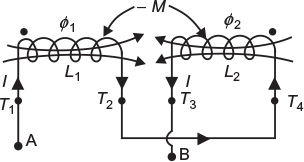
Fig. 5.34 Inductances in series, fields are subtractive
Total inductance, LT = (L1 − M) + (L2 − M) = L1 + L2− 2 M
Note: It may be noted that direction of field produced by a coil is denoted by a dot placing it at the side of which the current enters (or flux enters the core) (see Figs. 5.33 and 5.34).
5.23.2 Inductances in Parallel
The two coils may be connected in parallel in two ways:
when the fields (or mmfs) produced by them are in the same direction, as shown in Figure 5.35, then
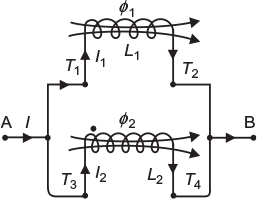
Fig. 5.35 Inductance connected in parallel with addition fields
Total inductance, 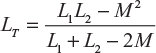
When the fields (or mmfs) produced by them are in the opposite direction, as shown Figure 5.36:
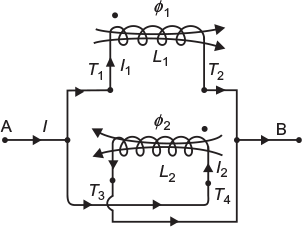
Fig. 5.36 Inductance connected in parallel with subtractive fields
Total inductance, 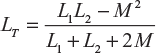
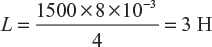
A coil has 1,500 turns. A current of 4 A causes a flux of 8 mWb to link the coil. Find the self-inductance of the coil.
Solution:
Inductance of the coil, 
where N = 1,500; ɸ = 8 × 10⁻³ Wb and I = 4 A.
∴
Example 5.24
Calculate the value of emf induced in circuit having an inductance of 700 µH if the current flowing through it varies at a rate of 5,000 A/s.
Solution:
Inductance of the coil, L = 700 × 10−6 H
Rate of change of current, 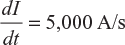
Magnitude of emf induced in the coil,

Example 5.25
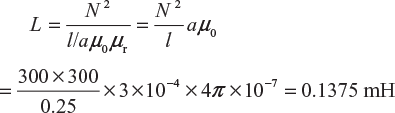
An air-cored solenoid has 300 turns; its length is 25 cm and its cross section is 3 cm2. Calculate the self-inductance in Henry.
Solution:
Number of turns of the solenoid, N = 300
Length of solenoid, l = 25 cm = 0.25 m
Area of cross section, a = 3 cm2 = 3 × 10⁻⁴ m2
For air core, µr = 1
Inductance of the solenoid,
Example 5.26
Calculate the inductance of toroid, 25 cm mean diameter and 6.25 cm2 circular cross section wound uniformly with 1,000 turns of wire. Hence, calculate the emf induced when current in it increases at the rate of 100 A/s.
Solution:
Inductance of the toroid, 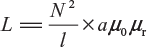
where number of turns, N = 1,000 turns
Mean length l = π D = 0.25 π m;
Area of x-section, a = 6.25 × 10⁻⁴ m2 and
Relative permeability, µ r = 1
L = (1,000)2 × 6.25 × 10−4 × 4π× 10−7 × 1/0.25π = 1 mH
Induced emf, 
Example 5.27
The iron core of a choke has mean length 25 cm with an air gap of 1 mm. The choke is designed for an inductance of 15 H when operating at a flux density of 1 Wb/m2. The iron core has a relative permeability of 3,000 and 8 cm2 area of cross section. Determine the required number of turns of the coil.
Solution:
Inductance of the coil, L = N2/ST
where ST = total reluctance of the magnetic circuit

Now,

Example 5.28
Two coils have a mutual inductance of 0.6 H. If current in one coil is varied from 4 A to 1 A in 0.2 s, calculate the average emf induced in the other coil and the change of flux linking the latter, assuming that it is wound with 150 turns.
Solution:
Mutually induced emf, 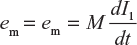
where M = 0.6 H; dI1 = 4 − 1 = 3 A and dt = 0.2 s
em = 0.6 × 3/0.2 = 9 V
Now,
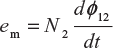
Therefore, change of flux with second coil,

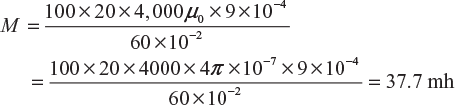
Two coils having 100 and 50 turns, respectively, are wound on a core with µ = 4,000 µ0. Effective core length = 60 cm and core area = 9 cm2.Find the mutual inductance between the coils.
(UPTU 2004–2005)
Solution:
We know that mutual Inductance
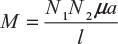
where N1 = 100; N2 = 50; µ = 4,000 µ0; l = 60 cm = 60 × 10−2 m; a = 9 cm2 = 9 × 10⁻⁴ m2
Example 5.30
A wooden ring has a mean diameter of 150 mm and a cross-sectional area of 250 mm2. It is wound with 1,500 turns of insulated wire. A second coil of 900 turns is wound on the top of the first. Assuming that all flux produced by the first coil links with the second, calculate the mutual inductance.
(UPTU)
Solution:
Mutual inductance,
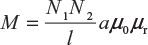
where N1 = 1,500; N2 = 900; l = π D = 0.15 π m; a = 250 × 10−6 m2; µr = 1

Example 5.31
Two coils A and B of 600 and 1,000 turns, respectively, are connected in series on the same magnetic circuit of reluctance 2 × 10⁶AT/Wb. Assuming that there is no flux leakage, calculate self-inductance of each coil and mutual inductance between the two coils. What would be the mutual inductance if the co-efficient of coupling is 75%?
Solution:
Self-inductance of coil A,

where
N1 = 600 and S = 2 × 10⁶ AT/Wb
L1 = (600)2/2 × 106 = 0.18 H
Similarly,
L2 = (1,000)2/2 × 106 = 0.5 H
Mutual inductance,
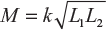
When k = 1; M = 1 
and k = 0.75; M = 0.75 
Two air-cored coils are placed close to each other so that 80% of the flux of one coil links with the other. Each coil has mean diameter of 2 cm and a mean length of 50 cm. If there are 1,800 turns of wire on one coil, calculate the number of turns on the other coil to give a mutual inductance of 15 mH.
Solution:
Reluctance,

Now,

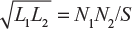
Futrher, 
where M = 15 × 10−3 H; N1 = 1,800; k = 0.8;
15 × 10−3 = 0.8 × 1,800 × N2/1.2665 × 109
or

Example 5.33
Two coils with negligible resistance and of self-inductance of 0.2 H and 0.1 H, respectively, are connected in series. If their mutual inductance is 0.1 H, determine the effective inductance of the combination.
Solution:
Total inductance of the two coils when connected in series;
L = L1 + L2 ± 2 M = 0.2 + 0.1 ± 2 × 0.1 = 0.5 H or0.1 H
Example 5.34
The combined inductance of two coils connected in series is 0.6 H and 0.1 H depending upon the relative direction of currents in the coils. If one of the coils when isolated has a self-inductance of 0.2 H, calculate the mutual inductance of the coils and the self-inductance of the other coil.
Solution:
The combined inductance of the two coils when connected in series having their
field additive = L1 + L2 + 2M = 0.6 (5.6)
fields subtractive = L1 + L2 − 2M = 0.1 (5.7)
Subtracting equation (5.7) from (5.6), we get,
4M = 0.5 or M = 0.125 H
From equation (5.7), L1 + L2 − 2 × 0.125 = 0.1 or L1 + L2 = 0.35 H
Self-inductance of one coil, L1 = 0.2 H
Therefore, self-inductance of second coil, L2 = 0.25 − 0.2 = 0.15 H
Example 5.35
Two coils of self-inductance 120 mH and 250 mH and mutual inductance of 100 mH are connected in parallel. Determine the equivalent inductance of combination if mutual flux helps the individual fluxes and mutual flux opposes the individual fluxes.
Solution:
When mutual flux helps the individual fluxes:

When mutual flux opposes the individual fluxes:

Leave a Reply