
The steady current when flows through a resistor of known resistance for a given time produces the same amount of heat as produced by an alternating current when flows through the same resistor for the same time is called effective or rms value of an alternating current.
Let i be an alternating current flowing through a resistor of resistance R for time t seconds which produces the same amount of heat as produced by Ieff (direct current). The base of one alternation is divided into n equal parts, as shown in Figure 6.10, so that interval is of  second. Let i1, i2, i3, …, in be the mid-ordinate.
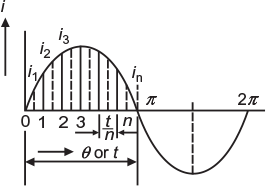
Fig. 6.10 Positive half cycle divided into n equal parts
First interval =  Rt/Jn calorie
Second interval =  Rt/Jn calorie
Third interval =  Rt/Jn calorie
nth interval =  Rt/Jn calorie
Total heat produced 
Since Ieff is considered as the effective value of this current.
Then, total heat produced by this current = calorie (6.4)
Equating equation (6.3) and (6.4), we get,
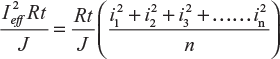
or

or
Ieff = Square root of mean of squares of instantaneous values
= root-mean-square (rms) value
It is the actual value of an alternating quantity which tells us the energy transfer capability of an AC source. For example, if we say that 5 A AC is flowing through a circuit, it means the rms value of an AC which flows through the circuit is 5 A. It transfers the same amount of energy as is transferred by 5 A DC.
The ammeters and voltmeters record the rms values of alternating currents and voltages, respectively. The domestic single-phase AC supply is 230 V, 50 Hz. Where 230 V is the rms value of an alternating voltage.
Leave a Reply