The power that is actually consumed or utilised in an AC circuit is called true power or active power or real power. It has already been seen that power is consumed only in resistance. A pure inductor and a pure capacitor do not consume any power, since in a half cycle whatever power is received from the source by these components, the same is returned to the source. This power that flows back and forth (i.e., in both directions in the circuit) or reacts upon itself is called reactive power. It does not do any useful work in the circuit. It has been seen that in pure resistive circuit, current is in phase with the applied voltage, whereas in pure inductive and capacitive circuit, current is 90° out of phase. Therefore, it is concluded that the current in phase with the voltage produces true or active power, whereas the current 90° out of the phase with the voltage contributes to reactive power. Hence,
true power = voltage × current in phase with voltage
reactive power = voltage × current 90° out of phase with voltage.
The phasor diagram for an inductive circuit is shown in Figure 7.12, where current I lags behind the voltage V by an angle ɸ °. Current I can be resolved into two rectangular components, that is, (i) I cos ɸ, which is in phase with voltage V and (ii) I sin ɸ, which is 90° out of phase with voltage V.
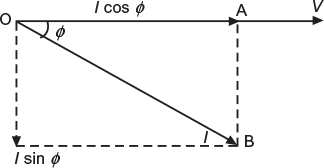
Fig. 7.12 Phasor diagram representing active, reactive and apparent current
∴ True power, P = V × I cos ɸ = VI cos ɸ W
Reactive power, Pr = V × I sin ɸ = VI sin ɸ VAR
Apparent power, Pa = V × I = VI VA
The bigger units of true power, reactive power, and apparent power are kW (or MW), kVAR (or MVAR), and kVA (or MVA), respectively.
7.8.1 Active Component of Current
The current component that is in phase with circuit voltage (i.e., I cos ɸ) and contributes to active or true power of the circuit is called active component or watt−full component or in−phase component of current.
7.8.2 Reactive Component of Current
The current component that is in quadrature (or 90° out of phase) to circuit voltage (i.e., I sin ɸ) and contributes to reactive power of the circuit is called reactive component of current.
7.8.3 Power Triangle
When each component of current, in Figure 7.12, is multiplied by voltage V, a power triangle is obtained, as shown in Figure 7.13. This right−angled triangle indicates the relation among true power, reactive power, and apparent power.
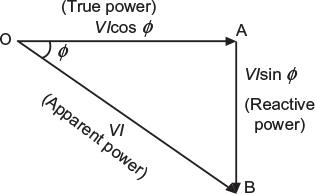
Fig. 7.13 Power triangle
In the abovementioned discussion, the following points are worth noting:
- When an active component of current is multiplied with circuit voltage, it results in active or true power. It is this power that produces torque in motors, heat in heaters, light in lamps, etc. Further, watt-meter indicates this power.
- When the reactive component of current is multiplied with circuit voltage, it results in reactive power. It is this power that merely flows back and forth without doing any work. This power determines the power factor of the circuit.
- When the circuit current is multiplied with circuit voltage, it results in apparent power. It is so called because it appears that product of voltage and current is power. However, in AC circuits (except pure resistive circuit), there is usually phase difference between voltage and current so that VI does not give real power. To avoid confusion, it is measured in volt-ampere.
- From power triangle shown in Figure 7.13, the power factor may also be determined by taking ratio of true power to apparent power, that is, power factor, cos ɸ = true power/ apparent power.
Leave a Reply