
Measurement is essentially an act by which a comparison is made between a given quantity and a quantity of the same kind chosen as a unit of measurement, that is, standard quantity. To make this comparison, a device is used called measuring instrument. When an unknown quantity is measured, the value thus obtained is considered to be a true value but it is seldom true. There is always some difference between the measured value and the true or exact value of the unknown quantity.
The difference between the measured value (Am) and the actual or true value A of the unknown quantity is called absolute error of measurement (δA).
i.e.,
ε0 = δ A = Am – A
The absolute value of error δA does not indicate precisely the accuracy of measurement. For example, while measuring the circumference of earth if the absolute error is 1 cm, it is considered to be negligible; however, if this error occurs while measuring the circumference of a cricket ball, then it is quite significant. Therefore, it is preferred to represent the error in terms of relative error than to represent in absolute form.
9.6.1 Relative Error
The ratio of absolute error to the true value of quantity to be measured is termed as relative error.
i.e.,

When the absolute error ε0 or δA is negligible, that is, when the difference between measured value Am and true value A is negligible, then relative error may be expressed as

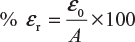
The relative error may be represented as a fraction or as a percentage.
i.e.,
Leave a Reply