
Consider a stator on which three different windings represented by three concentric coils a1a2, b1b2, and c1c2, respectively, are placed 120° electrically apart.
Let a three-phase supply, as shown in Figure 12.5, is applied to the stator. Three-phase currents will flow through the three coils and produce their own magnetic fields. The positive half cycle of the alternating current (AC) is considered as inward flow of current in the start terminals and negative half cycle is considered as outward flow of current in the start terminals. The direction of flow of current is opposite in the finish terminals of the same coil.
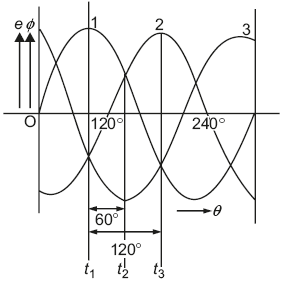
Fig. 12.5 Wave diagram of 3-phase AC supply with instants t1,t2 and t3
Let at any instant t1, current in coil side a1 be inward and in b1 and c1 outward, whereas the current in the other sides of the same coils is opposite, that is,in coil side a2 is outward and b2 and c2 is inward. The resultant field and its direction (Fm) are marked in Figure 12.6.
At instant t2, when θ is 60°, current in coil sides a1 and b1 is inward and in c1 is outward, whereas the current in the opposite sides is opposite. The resultant field and its direction is shown in Figure 12.7, which is rotated through an angle θ = 60° from its previous position.
At instant t3 when θ is 120°, current in coil side b1 is inward and in c1 and a1 is outward. The resultant field and its direction is shown in Figure 12.8, which is rotated through an angle θ = 120° electrical from its first position.
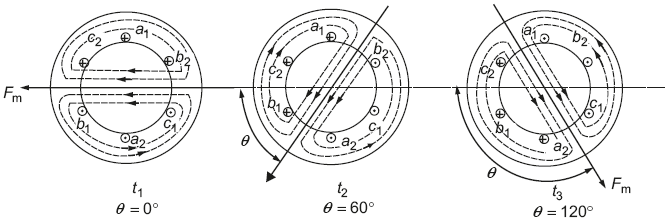
Fig. 12.6 Position of resultant field at instant t1
Fig. 12.7 Position of resultant field at instant t2
Fig. 12.8 Position of resultant field at instant t3
Thus, in one cycle, the resultant field completes one revolution. Hence, we conclude that when three-phase supply is given to a three-phase wound stator, a resultant field is produced which revolves at a constant speed, called synchronous speed (Ns = 120° f / P).
In this case, we have observed that when supply from phase 1, 2, and 3 is given to coil a1a2, b1b2, and c1c2, respectively, an anticlockwise rotating field is produced. If the supply to coil a1a2, b1b2, and c1c2 is given from phase 1, 3, and 2, respectively, the direction of rotating field is reversed. Therefore, to reverse the direction of rotation of rotating field, the connections of any two supply terminals are inter changed.
Leave a Reply