
When three-phase supply is given to the stator of a three-phase wound induction motor, a revolving field is set up in the stator. At any instant, the magnetic field set-up by the stator is shown in Figure 12.9. The direction of resultant field is marked by an arrow head Fm. Let this field is rotating in an anticlockwise direction at an angular speed of ωs radians per second, that is, synchronous speed.
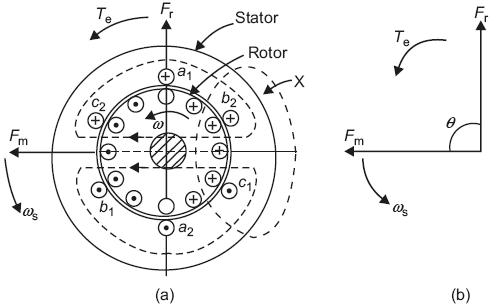
Fig. 12.9 (a) Induced emf/current in rotor conductors at an instant (b) Phasor representation of stator and rotor field at an instant
The stationary rotor conductors cut the revolving field and due to electromagnetic induction an emf is induced in the rotor conductors. As the rotor conductors are short circuited, current flows through them in the direction as marked in the figure. Rotor current carrying conductors set up a resultant field Fr. This field tries to come in line with the stator main field Fm. Due to this, an electromagnetic torque Te is developed in the anticlockwise direction. Therefore, rotor starts rotating in same direction in which stator field is revolving.
12.4.1 Alternate Explanation
Reproducing section X of Figure 12.9(a) as shown in Figure 12.10, when the revolving stator field (refer Figure 12.10(a)) cuts the stationary rotor conductors, an emf is induced in the conductors by induction. As rotor conductors are short circuited, current flows through them, as marked in Figure 12.10(b) which sets up field around them. A resultant field is set up, as shown in Figure 12.10(c) which exerts force on the rotor conductors. Therefore, the rotor starts rotating in the same direction in which stator field is revolving.
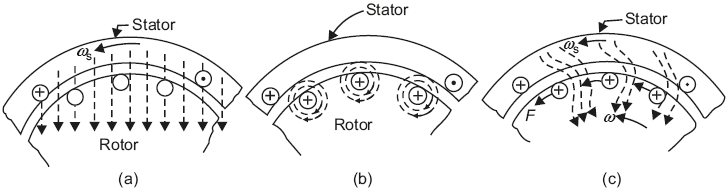
Fig. 12.10 (a) Field produced by stator winding at an instant (b) Field produced around rotor conductors at that instant (c) Resultant field around rotor conductors
The rotor picks up speed and tries to attain the synchronous speed but fails to do so. It is because if the rotor attains the synchronous speed, then the relative speed between revolving stator field and rotor will be zero, no emf will be induced in rotor conductors. No emf means no current, no rotor field Fr,and hence, no torque is produced. Therefore, an induction motors never runs at synchronous speed. It always seems at a speed less than synchronous speed.
Since the principle of operation of this motor depends upon electromagnetic induction, hence the name induction motor.
Leave a Reply