
In the following sections, we shall take a look at the departures from the ideal op-amp parameters that are found in practical devices, and survey the trade-offs—including cost and availability, as well as technical factors—that have to be made in real designs. Some instances of anomalous behavior will also be examined.
But first we will examine the “ideal” op-amp. The following set of characteristics (in no particular order, since they are all unattainable) defines the ideal voltage gain block:
• infinite input impedance, no bias current
• arbitrarily large input and output voltage range
• arbitrarily small supply current and/or voltage
• infinite operating bandwidth
• zero input offset voltage and current
• absolute insensitivity to temperature, power rail and common mode input fluctuations
• off-the-shelf availability in any package
• compatibility between different manufacturers
Since none of these features is achievable, you have to select a practical op-amp from the multitude of imperfect types on the market to suit a given application. Some basic examples of trade-offs are:
• a high-frequency AC amplifier will need maximum gain-bandwidth product but won’t be interested in bias current or offset voltage,
• a battery-powered circuit will want the best of all the parameters but at minimum supply current and voltage,
• a consumer design will need to minimize the cost at the expense of technical performance,
• a precision instrumentation amplifier will need minimum input offsets and noise but can sacrifice speed and cheapness.
Device data sheets contain some but not all of the necessary information to make these trade-offs (most crucially, they say nothing about cost and availability, which you must get from the distributor). The functional characteristics often need some interpretation and critical parameters can be hidden or even absent. In general, if a particular parameter you are interested in is not given in the data sheet, it is safest to assume a pessimistic figure. It means that the manufacturer is not prepared to test his devices for that parameter or to certify a minimum or maximum value.
11.10.1 Applications Categories
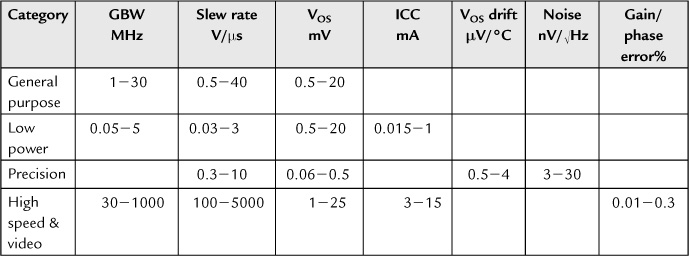
In fact, although there is a bewildering variety of devices available, op-amps are divided into a few broad categories based on their application, in which the above trade-offs are altered in different directions. Table 11.4 suggests a reasonable range over which you might expect to find a spread of certain critical parameters for op-amps in each category.
Table 11.4
Parameters for applications categories
Leave a Reply