
Power electronic systems employ a large variety of resistor types and ratings. At the low-power end, they are used in R/C snubber circuits, in voltage dividers, and as damping elements for various resonant circuits. The two general resistor classes in the lower power ranges are wirewound and metallized film. Wirewound resistors are wound from a resistance alloy wire, usually on a cylindrical ceramic body. Terminal connections are welded at each end of a solenoidal winding. Noninductive wirewound resistors are made with two paralleled windings wound in opposite directions around the body so that their magnetic fields tend to cancel. Another construction technique is to wind the resistor from an elongated hairpin with the loop anchored to one end of the body and the leads brought out at the other end, the two wires being insulated from each other. There are many variations on these basic construction techniques. Resistors for snubber use, especially with fast switching semiconductors, must have an inductance as low as possible to minimize transient voltages. Metallized film resistors utilize a vacuum deposited resistance metal film on a ceramic substrate. Such metal film resistors have little transient heat storage capacity and are not generally recommended for snubber use. The same is true for carbon film resistors. Carbon composition types are preferred for low-power snubbers. These are made from a bulk carbon cylinder within a ceramic tube.
Ceramic resistors are formed in various configurations from any of a number of conductive ceramics. Metallized sections made by spraying a conductive metal onto the ceramic allow for terminal connections. These resistors tend to have a low inherent inductance that makes them useful for snubbers. Some are housed in cast metal bodies that provide an insulated heat sink for power dissipation.
High-power resistors take on several forms, all of which are designed to permit efficient cooling (see Figure 15.5). Some in the power ranges up to a few kilowatts are made with rectangular conductors of resistance alloy wound into an air core cylinder with appropriate insulators and supports. Resistors with still higher power ratings are made from stamped sheet metal resistance alloys, sometimes stainless steel, assembled into stacks with series, parallel, or series/parallel connections for the desired resistance. The general description is grid resistor. Iron grid castings preceded this type of construction, and such resistors were often used for starting DC motors on trolley cars.
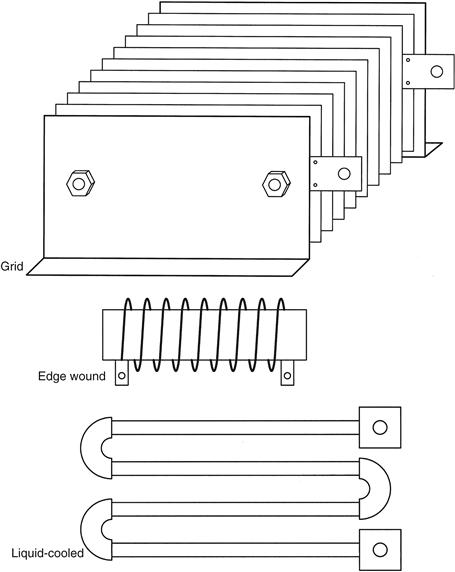
Figure 15.5 Power resistor types
Water-cooled resistors are useful in equipment with water-cooled semiconductors or for the manufacture of compact testing loads for power electronic systems. Many are made from stainless steel or monel tubing with water flowing inside. In going through such a resistor from end to end, the cooling water may be expected to rise 3.8 C for a dissipation of 1 kW with water flow at 1 gal/min. Exit water temperature should be kept below about 70 C to minimize leaching material from the resistor interior wall.
Resistors are also used for heating in many of the process industries. Globar® silicon carbide resistors are long cylindrical elements, operating at a few hundred volts, that can create temperatures in excess of 1200 C. Sheathed wires similar to an electric stove element with grounded surfaces are also used for annealing, drying, and similar processes. Although not a resistor per se, molten glass is highly conductive and is held at temperature electrically in melters to supply fiberglass nozzles, bottling lines, float glass, and many other glass fabrication industries. Connections are made with silicon carbide rods. Electric melters are more environmentally friendly than gas-fired units.
Leave a Reply