Today’s engineer faces a challenge in selecting the proper mix of analog and digital techniques to solve the signal processing task at hand. It is impossible to process real-world analog signals using purely digital techniques, since all sensors, including microphones, thermocouples, strain gages, piezoelectric crystals, and disk drive heads are analog sensors. Therefore, some sort of signal conditioning circuitry is required in order to prepare the sensor output for further signal processing, whether it be analog or digital. Signal conditioning circuits are, in reality, analog signal processors, performing such functions as multiplication (gain), isolation (instrumentation amplifiers and isolation amplifiers), detection in the presence of noise (high common-mode instrumentation amplifiers, line drivers, and line receivers), dynamic range compression (log amps, LOGDACs, and programmable gain amplifiers), and filtering (both passive and active).
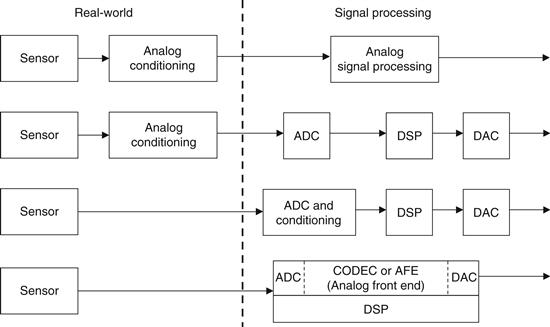
Several methods of accomplishing signal processing are shown in Figure 16.3. The top portion of the figure shows the purely analog approach. The latter parts of the figure show the DSP approach. Note that once the decision has been made to use DSP techniques, the next decision must be where to place the ADC in the signal path.
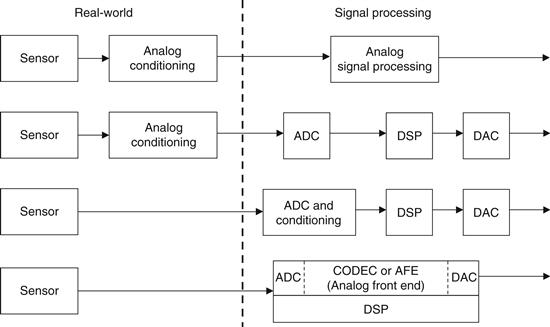
Figure 16.3 Analog and digital signal processing options
In general, as the ADC is moved closer to the actual sensor, more of the analog signal conditioning burden is now placed on the ADC. The added ADC complexity may take the form of increased sampling rate, wider dynamic range, higher resolution, input noise rejection, input filtering, programmable gain amplifiers (PGAs), and on-chip voltage references, all of which add functionality and simplify the system. With today’s high resolution/high sampling rate data converter technology, significant progress has been made in integrating more and more of the conditioning circuitry within the ADC/DAC itself. In the measurement area, for instance, 24-bit ADCs are available with built-in programmable gain amplifiers (PGAs) that allow full-scale bridge signals of 10 mV to be digitized directly with no further conditioning (e.g., AD773x series). At voice-band and audio frequencies, complete coder/decoders (codecs or analog front ends) are available with sufficient on-chip analog circuitry to minimize the requirements for external conditioning components (AD1819B and AD73322). At video speeds, analog front ends are also available for such applications as CCD image processing and others (e.g., AD9814, AD9816, and the AD984x series).
Leave a Reply