
In the case of an amplifier system we might have the output directly proportional to the input and, with a gain of 10, if we have an input of a 1 V signal we can calculate that the output will be ten times greater and so 10 V. In general, for such a system where the output is directly proportional to the input, we can write:

with G being the gain.
Example 18.1
A motor has an output speed which is directly proportional to the voltage applied to its armature. If the output is 5 rev/s when the input voltage is 2 V, what is the system gain?
Solution
With output=G×input, then G=5/2=2.5 (rev/s)/V.
18.9.1 Gain of Systems in Series
Consider two systems, such as amplifiers, in series with the first having a gain G1 and the second a gain G2 (Figure 18.80(a)). The first system has an input of x1 and an output of y2 and thus:

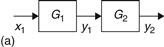

Figure 18.80 (a) Two systems in series; (b) the equivalent system with a gain equal to the product of the gains of the two constituent systems
The second system has an input of y1 and an output of y2 and thus:

The overall system has an input of x1 and an output of y2 and thus, if we represent the overall system as having a gain of G:

and so:

Thus:
For series-connected systems, the overall gain is the product of the gains of the constituent systems.
Example 18.2
A system consists of an amplifier with a gain of 10 providing the armature voltage for a motor which gives an output speed which is proportional to the armature voltage, the constant of proportionality being 5 (rev/s)/V. What is the relationship between the input voltage to the system and the output motor speed?
Solution
The overall gain G=G1×G2=10×5=50 rev/s)/V.
18.9.2 Feedback Loops
Consider a system with negative feedback (Figure 18.81). The output of the system is fed back via a measurement system with a gain H to subtract from the input to a system with gain G.
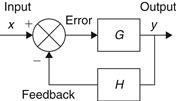
Figure 18.81 System with negative feedback: the fed back signal subtracts from the input
The input to the feedback system is y and thus its output, i.e., the feedback signal, is Hy. The error is x–Hy. Hence, the input to the G system is x–Hy and its output y. Thus:

and so:

The overall input of the system is y for an input x and so the overall gain G of the system is y/x. Hence:
system gain 
For a system with a negative feedback, the overall gain is the forward path gain divided by one plus the product of the forward path and feedback path gains.
For a system with positive feedback (Figure 18.82), i.e., the fed back signal adds to the input signal, the feedback signal is Hy and thus the input to the G system is x+Hy. Hence:

and so:

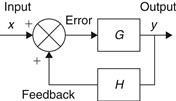
Figure 18.82 System with positive feedback: the fed back signal adds to the input

For a system with a positive feedback, the overall gain is the forward path gain divided by one minus the product of the forward path and feedback path gains.
Example 18.3
A negative feedback system has a forward path gain of 12 and a feedback path gain of 0.1. What is the overall gain of the system?
Solution
System gain 
18.9.3 The Feedback Amplifier
Figure 18.83 shows the circuit of a basic feedback amplifier. It consists of an operational amplifier with a potential divider of two resistors R1 and R2 connected across its output. The output from this potential divider is fed back to the inverting input of the amplifier. The input to the amplifier is via its noninverting input. Thus the sum of the inverted feedback input and the noninverted input is the error signal. The op-amp has a very high voltage gain G. Thus GH, H being the gain of the feedback loop, is very large compared with 1 and so the overall system gain is:
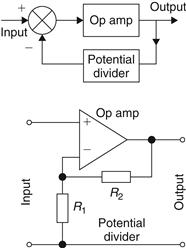
Figure 18.83 Feedback amplifier
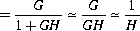
Since the gain G of the op-amp can be affected by changes in temperature, aging, etc. and thus can vary, the use of the op-amp with a feedback loop means that, since H is just made up of resistances which are likely to be more stable, a more stable amplifier system is produced. The feedback loop gain H is the fraction of the output signal fed back and so is R1/(R1+R2). Hence, the overall gain of the system is:
system gain 
Example 18.4
What is the overall gain of a noninverting feedback op-amp, connected as in Figure 18.83, if the op-amp has a voltage gain of 200,000, R1=1 kΩ and R2=49 kΩ?
Solution
The overall system gain is independent of the voltage gain of the op-amp and is given by (R1+R2)/R1=50/1=50.
Leave a Reply