

and 
Thus, 
and 

But j2=–1, thus,

For example,
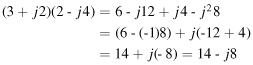
The complex conjugate of (a+jb) is (a –jb). For example, the conjugate of (3 –j2) is (3+j2). The product of a complex number and its complex conjugate is always a real number, and this is an important property used when dividing complex numbers. Thus,
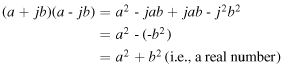
For example, 
and 
The expression of one complex number divided by another, in the form a+jb, is accomplished by multiplying the numerator and denominator by the complex conjugate of the denominator. This has the effect of making the denominator a real number. For example,
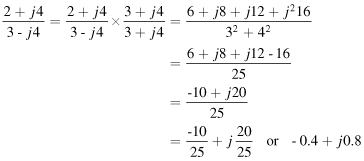
The elimination of the imaginary part of the denominator by multiplying both the numerator and denominator by the conjugate of the denominator is often termed rationalizing.
Example 7.1
In an electrical circuit the total impedance ZT is given by:
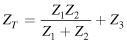
Determine ZT in (a+jb) form, correct to two decimal places, when Z1=5 –j3, Z2=4+j7 and Z3=3.9 –j6.7.
Solution
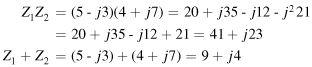
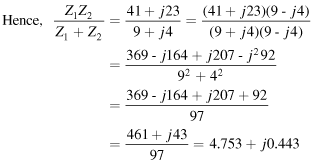
Thus, 
=8.65 –j6.26, correct to two decimal places.
Example 7.2
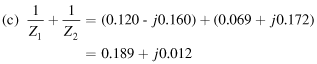
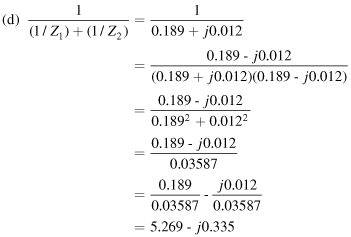
Given Z1=3+j4 and Z2=2 –j5 determine in Cartesian form correct to three decimal places:

Solution
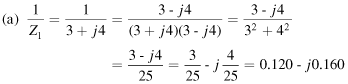
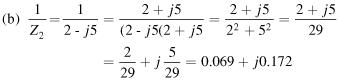
Leave a Reply