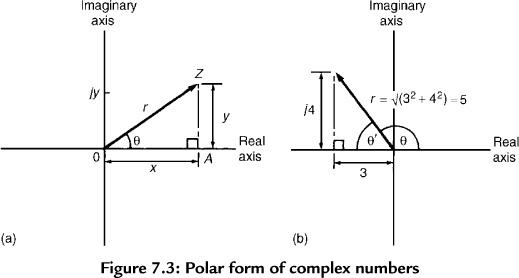
Figure 7.3 Polar form of complex numbers
This latter form is usually abbreviated to Z=r∠θ, and is called the polar form of a complex number.
r is called the modulus (or magnitude of Z) and is written as mod Z or |Z|. r is determined from Pythagoras’s theorem on triangle OAZ:

The modulus is represented on the Argand diagram by the distance OZ. θ is called the argument (or amplitude) of Z and is written as arg Z. θ is also deduced from triangle OAZ: arg Z=θ=tan-1y/x.
For example, the cartesian complex number (3+j4) is equal to r∠θ in polar form, where 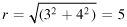 and,
and,
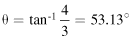
Hence, 
Similarly, (–3+j4) is shown in Figure 7.3(b),
where, 
and, 
Hence, (–3+j4)=5∠126.87
Leave a Reply