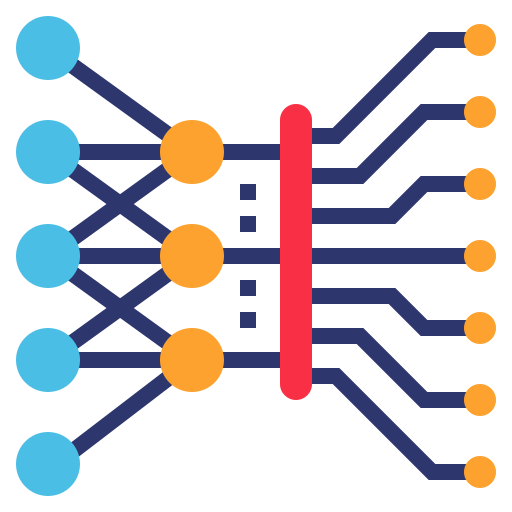
The most basic type of a neural network is a fully connected neural network. As the name implies, it is where all the neurons have connections from layer to layer. This network is actually quite popular since it means having to use little judgment when creating the model.
Then what are some of the other neural networks? The common ones include the recurrent neural network (RNN), the convolutional neural network (CNN), and the generative adversarial network (GAN ), which we’ll cover next.
Recurrent Neural Network
With a recurrent neural network (RNN), the function not only processes the input but also prior inputs across time. An example of this is what happens when you enter characters in a messaging app. As you begin to type, the system will predict the words. So if you tap out “He,” the computer will suggest “He,” “Hello,” and “Here’s.” The RNN is essentially a string of neural networks that feed on each other based on complex algorithms.
There are variations on the model. One is called LSTM, which stands for long short-term memory. This came about from a paper written by professors Sepp Hochreiter and Jürgen Schmidhuber in 1997.6 In it, they set forth a way to effectively use inputs that are separated from each other for long time periods, allowing the use of more datasets.
Of course, RNNs do have drawbacks. There is the vanishing gradient problem, which means that the accuracy decays as the models get larger. The models can also take longer to train.
To deal with this, Google developed a new model called the Transformer, which is much more efficient since it processes the inputs in parallel. It also results in more accurate results.
Google has gained much insight about RNNs through its Translate app, which handles over 100 languages and processes over 100 billion words a day.7 Launched in 2006, it initially used machine learning systems. But in 2016, Google switched to deep learning by creating Google Neural Machine Translation.8 All in all, it has resulted in much higher accuracy rates.9
Consider how Google Translate has helped out doctors who work with patients who speak other languages. According to a study from the University of California, San Francisco (UCSF), that was published in JAMA Internal Medicine, the app had a 92% accuracy rate with English-to-Spanish translations. This was up from 60% over the past couple years.10
Convolutional Neural Network (CNN)
Intuitively, it makes sense to have all the units in a neural network to be connected. This works well with many applications.
But there are scenarios where it is far from optimal, such as with image recognition. Just imagine how complex a model would be where every pixel is a unit! It could quickly become unmanageable. There would also be other complications like overfitting. This is where the data is not reflective of what is being tested or there is a focus on the wrong features.
To deal with all this, you can use a convolutional neural network (CNN). The origins of this go back to professor Yann LeCun in 1998, when he published a paper called “Gradient-Based Learning Applied to Document Recognition.”11 Despite its strong insights and breakthroughs, it got little traction. But as deep learning started to show significant progress in 2012, researchers revisited the model.
LeCun got his inspiration for the CNN from Nobel Prize winners David Hubel and Torsten Wiesel who studied neurons of the visual cortex. This system takes an image from the retina and processes it in different stages—from easy to more complex. Each of the stages is called a convolution. For example, the first level would be to identify lines and angles; next, the visual cortex will find the shapes; and then it will detect the objects.
This is analogous to how a computer-based CNN works. Let’s take an example: Suppose you want to build a model that can identify a letter. The CNN will have input in the form of an image that has 3,072 pixels. Each of the pixels will have a value that is from 0 to 255, which indicates the overall intensity. By using a CNN, the computer will go through multiple variations to identify the features.
The first is the convolutional layer, which is a filter that scans the image. In our example, this could be 5 × 5 pixels. The process will create a feature map, which is a long array of numbers. Next, the model will apply more filters to the image. By doing this, the CNN will identify the lines, edges and shapes—all expressed in numbers. With the various output layers, the model will use pooling, which combines them to generate a single output, and then create a fully connected neural network.
A CNN can definitely get complex. But it should be able to accurately identify the numbers that are input into the system.
Generative Adversarial Networks (GANs)
Ian Goodfellow, who got his masters in computer science at Stanford and his PhD in machine learning at the Université de Montréal, would go on to work at Google. In his 20s, he co-authored one of the top books in AI, called Deep Learning ,12 and also made innovations with Google Maps.
But it was in 2014 that he had his most impactful breakthrough. It actually happened in a pub in Montreal when he talked with some of his friends about how deep learning could create photos.13 At the time, the approach was to use generative models, but they were often blurry and nonsensical.
Goodfellow realized that there had to be a better why. So why not use game theory? That is, have two models compete against each other in a tight feedback loop. This could also be done with unlabeled data.
Here’s a basic workflow:
- Generator: This neural network creates a myriad of new creations, such as photos or sentences.
- Discriminator: This neural network looks at the creations to see which ones are real.
- Adjustments: With the two results, a new model would change the creations to make them as realistic as possible. Through many iterations, the discriminator will no longer need to be used.
He was so excited about the idea that after he left the pub he started to code his ideas. The result was a new deep learning model: the generative adversarial network or GAN. And the results were standout. He would soon become an AI rock star.
GAN research has already spurred over 500 academic papers.14 Companies like Facebook have also used this technology, such as for its photo analysis and processing. The company’s chief AI scientist, Yann LeCun, noted that GANs are the “the coolest idea in deep learning in the last 20 years.”15
GANs have also been shown to help with sophisticated scientific research. For example, they have helped improve the accuracy of detecting behavior of subatomic particles in the Large Hadron Collider at CERN in Switzerland.16
While still in the early innings, this technology could lead to such things as a computer that can develop new types of fashion items or maybe a new-fangled wearable. Perhaps a GAN could even come up with a hit rap song.
And it could be sooner than you think. As a teenager, Robbie Barrat taught himself how to use deep learning systems and built a model to rap in the style of Kanye West.
But this was just the beginning of his AI wizardry. As a researcher at Stanford, he developed his own GAN platform, which processed roughly 10,000 nude portraits. The system then would create truly mesmerizing new works of art (you can find them at his Twitter account at @DrBeef_).
Oh, and he also made his system open source at his GitHub account. This caught the attention of a collective of French artists, called Obvious, that used the technology to create portraits of an eighteenth-century fictional family. It was based on processing 15,000 portraits from the fourteenth to the twentieth centuries.
In 2018, Obvious put its artwork at a Christie’s auction, fetching a cool $432,000. 17
But unfortunately, when it comes to GANs, there have been uses that have been less than admirable. One example is to use them for deepfakes, which involve leveraging neural networks to create images or videos that are misleading. Some of this is just kind of playful. For example, one GAN makes it possible to have Barack Obama say anything you tell him!
Yet there are lots of risks. Researchers at New York University and the Michigan State University wrote a paper that focused on “DeepMasterPrints.”18 It showed how a GAN can develop fake fingerprints to unlock three types of smartphones!
Then there was the incident of a so-called deepfake video of actress Jennifer Lawrence at a Golden Globes press conference. Her face was merged with Steve Buscemi’s.19
Leave a Reply