In artificial intelligence as a service (AIAAS), companies use off-the-shelf AI tools to implement and scale AI techniques at a very low price as compared to building a complete in-house AI system.
When a software is provided as a service across the network, it usually uses cloud computing. Similarly, the idea of providing AI services using cloud computing has allowed even small business organizations to use cost effective solutions to improve their performance in a big way.
8.2.1 Factors Triggering Growth of AIaaS
In the last couple of years, AIaaS is growing fast as a business opportunity and many startups have joined to lead the AI revolution. Some major advancements in IT in the last few years have fostered the adoption of AIaaS. Some examples are as follows:
- Availability of cloud platform with a variety of affordable options for enterprise data management.
- Data storage technologies have improved and have become cheaper and reliable.
- Streaming devices and IoT technologies generate massive amounts of data which when analysed can render vital information required to gain competitive advantage.
- Availability of semi or fully automated data management, analytics and BI products changed the way business was analysed.
Moreover, some major factors that have motivated business to use AIaaS are listed below.
- Expensive infrastructure
- Lack of trained programmers
- Very high charges charged by programmers for implementing AI in a particular organization
- Many companies lacked sufficient data to analyse
8.2.2 The Growth of AIaaS
With cloud services becoming incredibly accessible, AI has seen a big boom. Now, AI can be made available to a greater number of companies and even those companies can collect and store any amount of data.
Previously, companies were hesitant to build their own clouds to develop, test and utilize their own AI systems. But now with AIaaS, every other company can take advantage of data insights without making huge investment in talent and resources. Moreover, AIaaS has been a lucrative option as business can now easily accomplish the following goals.
- Focus on its core area rather than getting involved in becoming an expert in machine learning.
- Reduce operational and infrastructural cost to a big extent. A complex AI system may require many parallel machines and speedy GPUs. Not many companies can afford such huge investment especially in its initial years. But with AIaaS, every small company can also harness the power of machine learning at significantly lower costs.
- Minimize the risk of investment.
- Time required to deploy a solution is short.
- Pre-built algorithms make complex data management accessible to even small business organizations.
- Availability of on-demand services empower business with a competitive edge.
- Increase the benefits obtained by analysing data trends.
- Develop cost effective, flexible and transparent solution. AIaaS provides a software to the organization that enables them to access machine learning capabilities using templates, pre-built models and drag-and-drop tools to assist developers in building a more customized machine learning framework. Companies no longer have to maintain a team with AI skilled professionals, train them, upgrade their knowledge and spend on areas that only partially support decision-making.
- Improve its strategic flexibility. Companies can only pay for what they actually use. Though machine learning requires a lot of computing power to run, small companies may actually be using only in short amounts that too in spurts. So, in such a scenario, AIaaS is a huge saving.
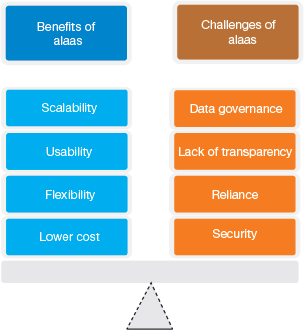 FIGURE 8.7
 - Scalability is another big advantage of AIaaS. Now companies can delve into AI technology with smaller projects. If they find it beneficial, then probably, they can experiment more services. At any point in time with the change in demands of the ongoing project, companies can scale up or down their demand for services.
Figure 8.7 summarizes the advantages and shortcomings of providing AI as a Service.
8.2.3 Challenges of AIaaS
- Reduced security: To avail services over cloud, companies have no option but to share their data with third-party vendors. Lot of data security techniques need to be incorporated to ensure that data is safe during storage and transmission and illegal access is strictly avoided.
- Reliance; When working with third parties, the organization becomes dependent on them to satisfy their information needs. This results in delay in getting response.
- Reduced transparency: In AIaaS, organizations are paying to get service, but not the access. Third party vendors take the input and give the output. The entire process works like a black box. The organization has no idea about the inner workings (like algorithms used). This may result in confusion or miscommunication regarding the stability of data or the output.
- Data governance: Every industry and organization has its own data policy. These policies may restrict data storage on a third-party cloud, thereby preventing a company from taking full advantage of AIaaS.
8.2.4 Vendors of AIaaS
There are multiple AI provider platforms offering various machine learning and AI services. Organizations can match their needs with the services and compare the cost at which those services can be accessed to select the offering that is best suited to their current requirements.
Cloud AI service providers allow users to use GPU-based processing for intensive workloads along with their staffing and maintenance staff as well as catering to the hardware changes for different tasks. Some major vendors of AIaaS are Amazon Web Services (AWS), Microsoft Azure and Google Cloud Platform (GCP). Each of these vendors offer different types of bots, APIs and machine learning frameworks to cater to the organization’s demands. Apart from these, countless start-ups are focusing on AIaaS. It is not uncommon for larger companies to purchase smaller companies to add the developed services to their portfolios.
An organization decides on an AI service based on its goals, business size, available budget, technical capabilities of its in-house teams and the amount of data that needs to be processed.
MonkeyLearn is an AI platform that simplifies text analysis through intuitive, no-code tools. Users can either use pre-trained model like survey analyzer to classify customer feedback by topic or build customized machine learning models to detect sentiment, keywords, and topics in the data. Once developed, these models can be integrated with apps through point-and-click integrations or via the API.
IBM Watson hosts a suite of AI tools and offers many pre-built applications, like Watson Assistant and Watson Natural Language Understand to build virtual assistants and to perform advanced text analysis tasks respectively. Similarly, IBM Watson Studio can be used to build, train and deploy machine learning models across any cloud. With these offerings even users with no expertise on machine learning or data science can make the most of their data.
Microsoft Azure is Microsoft’s public cloud computing platform that provides a range of AI and machine learning solutions for developers. For example, Azure Cognitive Services can be used to add computer vision or text extraction capabilities to apps using APIs. Similarly, Azure Bot Service can be used to incorporate any type of bot in the application.
Google Cloud ML is Google’s AI platform that basically facilitates data scientists and developers working with big data to create and deploy machine learning projects.
AutoML is being extensively used to train custom machine learning models for text analysis, image classification, translation and more. Data in the datasets can be visualized, ‘what-if tools’ can be used and metrics can be analysed to assess performance of the model.
AIPaaS or AI Platform-as-a-Service is an end-to-end solution like a cloud platform, using which business organizations can utilize required services on a pay-per-use or pay-per-service basis. With AIPaaS, users can use third-party APIs that provides a complete, intelligent data management platform.
Software-as-a-Service (SaaS) market is valued at $133 billion and the advanced technology platforms-as-a-service market globally is forecast to reach about $11 billion by 2023 and surpass ‘$88,500 million by the end of 2025.’
Leave a Reply