AIoT, or the combination of artificial intelligence (AI) technologies and the Internet of Things (IoT) infrastructure aims to make IoT operations more efficient, improve interactions between humans and machines and facilitates better data management and analytics.
We now clearly know that while AI simulates human intelligence processes by machines, IoT, on the other hand, is a system of interrelated computing devices with unique identifiers and the ability to transfer data over a network without requiring human-to-human or human-to-computer interaction. A thing or a computing device in IoT can be a person’s heart monitor implant, a self-driving car with built-in sensors, a door mat or any other object that can be assigned an Internet Protocol address and transfer data over a network.
AIoT enhances the capability of IoT by adding the power of machine learning algorithms to improve decision-making processes.
9.3.1 How Does AIoT Work?
In AIoT devices, AI is embedded into programs and infrastructure components, like chips, which are all connected using IoT networks. Efficient exchange of data amongst all hardware, software and platform components without human intervention is ensured using pre-written APIs.
Credit: monicaodo / Shutterstock
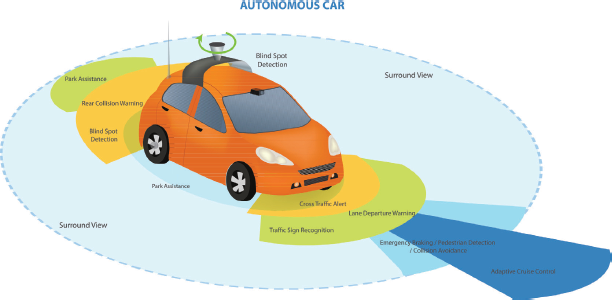
FIGURE 9.12 Autonomous Vehicle
IoT devices generate as well as collect data, that is then analysed using AI techniques to provide better insights into data. This improves efficiency and productivity. Figure 9.12 shows an autonomous vehicle in which AI is embedded into chipsets, which are all connected using IoT networks.
AIoT data when processed using Edge AI (discussed later in the chapter) minimizes the bandwidth needed to move data while avoiding possible delays to data analysis. This further adds to efficiency of IoT.
9.3.2 Where Does AI Unlock IoT?
IoT is all about implanting sensors into machines. These sensors collect streams of data through Internet connectivity. All IoT-related services follow five basic steps to perform the assigned task—Create, Communicate, Aggregate, Analyse and Act. Since Act depends on Analyse, the efficiency of any IoT system depends on the Analysis step. AI technology when used as the analysis stage, improves both efficiency and productivity manifold.
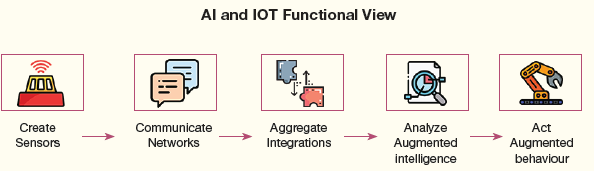
FIGURE 9.13 AI and IOT functional view
AIoT helps in achieving the following agile solutions:
- Manage, analyse and obtain meaningful insights from data (refer Fig. 9.13)
- Provide fast and accurate data analysis
- Maintain a balance between requirements for localized and centralized intelligence
- Protect data privacy and confidentiality
- Ensure security against cyber attack
9.3.3 Applications and Examples of AIoT
AIoT is extensively used in the following domains.
- Smart cities: Smart technology such as sensors, lights and meters collect data that is processed using AI to improve operational efficiency, drive economic growth and enhance quality of life for residents.
- Smart retail: Smart cameras are now being used at retail outlets by managers to identify faces of customers who have scanned their items at the self-checkout counter before leaving the store.Moreover, cameras and sensors installed at multiple places to observe customers’ movement and predict when they will reach the checkout line. This helps in maintaining dynamic staffing levels to enhance the productivity of the cashiers and reduce the customer’s checkout time.Major retailers can use AIoT solutions to grow sales through customer insights. Data such as mobile-based user behaviour and proximity detection offer valuable insights to deliver personalized marketing campaigns to customers while they shop, increasing traffic in brick-and-mortar locations.
- Smart home: In smart appliances installed at homes, data collected from human interaction with devices is analysed to understand user habits to provide customized support.
- Manufacturing: These days, manufacturers use smart chips to detect when a particular equipment is not functioning properly, or when it is the right time to replace.
- Hiring: AIoT technology when used to integrate data from social media and HR-related platforms can help to identify right talent without any bias.
- Autonomous vehicles: These vehicles collect real-time data about nearby vehicles, pedestrians and other objects using multiple video cameras and sensors. Data is also analysed to monitor driving conditions and take appropriate decision instantly.
- Robots: Autonomous robots have multiple sensors installed to gather data about the environment. AI is then used to make decisions that help robot to make smart and optimized moves.
- Healthcare: Medical devices and wearables collect and monitor real-time health data, such as heart rate. Moreover, healthcare facilities produce high volumes of data including patient information, imaging and test results. This information is valuable and necessary to take good care of the patient care. So, this data needs to accessed and processed quickly to suggest decision regarding patient’s diagnostic and treatment.IoT combined with AI not only improves diagnostic accuracy, enable telemedicine and remote patient care but also reduces the administrative burden of tracking patient health in the facility.
- Smart Thermostat Solution: The smartphone integration with smart thermostat solution can be used by users to check and manage the temperature from anywhere. Users can set the temperature based on their work schedule and temperature preferences. For example, Nest’s smart thermostat solution uses AI-powered IoT.
- Drone Traffic Monitoring: AIoT can be used by drones to monitor real-time traffic and make adjustments to the traffic flow to reduce congestion. While drones can collect and transmit traffic data, AI can be used to analyse that data and make decisions about how traffic can be regulated- make diversions, adjustments to speed limits and timing of traffic lights without human intervention.For example, the ET City Brain, a product of Alibaba Cloud, uses AIoT to optimize the use of urban resources. It can detect accidents, illegal parking and can alter traffic lights to help ambulances reach patients/ hospitals faster.
- Office Buildings: AIoT is used in smart office buildings. In such buildings, usually, a network of smart environmental sensors is installed that detect number of people present in the office and adjust temperatures and lighting accordingly to improve energy efficiency.These smart buildings are often accessed through facial recognition technology using a combination of connected cameras and AI to compare images taken in real-time against a database to determine who should be granted access. this technique is also used by employers to maintain attendance of employees for mandatory meetings.
- Fleet Management: AIoT is used in fleet management to monitor a fleet’s vehicles, reduce fuel costs, track vehicle maintenance and identify unsafe driver behaviour. Through IoT devices such as GPS and other sensors and an artificial intelligence system, companies are able to manage their fleet better thanks to AIoT.
9.3.4 Benefits and Challenges of AIoT
The benefits of AIoT include the following:
- With AI, operational efficiency of IoT is increased. AIoT devices analyse data to reveal patterns and insights and automatically adjusts system operations.
- On the fly decision-making: With AIoT and edge computing, vital decisions can be taken instantly. Therefore, data generated by the devices are analysed to identify points of failure/concerns to make appropriate adjustments as and when required.
- Reduced workload: Since data is analysed by AI and not humans, lot of time and money spent for this time is saved.
- Scalability: The number of devices connected to an IoT system can be increased anytime as per requirements to optimize existing processes or introduce new features. IoT devices range from mobile devices and high-end computers to low-end sensors. Low-end sensors offer most of the data. An AI-powered IoT ecosystem analyses and summarizes the data from one device before transferring it to other devices. This not only reduces large volumes of data to a handy level but also enables connecting a large number of IoT devices.
- Boosting Operational Efficiency: AIoT instantly analyses constant streams of data to predict the operational conditions and identify the parameters to be modified to obtain better results. Thus, intelligent IoT can deduce which processes are redundant and time-consuming, and which tasks can be fine-tuned to enhance efficiency. For example, Google uses AIoT to reduce its data centre cooling costs.
- Better Risks Management: Pairing AI with IoT facilitates businesses to understand as well as predict a wide variety of risks and automate process to provide a prompt response. This helps them to handle financial loss, ensure employee safety and prevent potential cyber threats. For example, Fujitsu ensures safety of the employees by using AI for analysing data coming from connected wearable devices.
- Triggering New and Enhanced Products and Services: With NLP, users can easily communicate with devices. With this human-machine interaction, IoT and AI can together be used to create new products and services. Even existing products and services can be enhanced by quickly processing and analyzing real-time data. For example, Rolls Royce uses AI technologies in the implementation of IoT-enabled airplane engine maintenance to identify patterns and gain useful operational insights.
- Eliminates Costly Unplanned Downtime: In industrial manufacturing and in some fields like offshore oil and gas exploration, equipment breakdown can result in costly unplanned downtime. Predictive maintenance with AI enabled IoT predicts equipment failure well in advance and schedule orderly maintenance procedures. This reduces the side effects of downtime. For example, Deloitte, integrates AI and IoT for the following:
- Reducing 20%–50% of their time spent in maintenance planning
- Increasing 10%–20% of equipment availability and uptime
- Reducing 5%–10% amount spent as maintenance costs
All this portrays a rosy picture but do not forget that there are always two faces of the same coin. AIoT may fail. For example, autonomous delivery robots that fail might cause delays in product delivery; smart retail stores may lead to accidently stealing of a product if it fails to read a customer’s face, a road accident can be caused if an autonomous vehicle fail to read its surroundings, like a red light on traffic signal.
9.3.5 Future of AIoT
Integration of AI and IoT (refer Fig. 9.14) creates a much smarter system that makes accurate judgments without human intervention. AIoT will get a tremendous boost with 5G networks that is designed to enable faster transfer of large data files through higher bandwidth and lower latency. AIoT can revolutionize supply chains and delivery models and solve existing operational problems very efficiently. Several businesses have already adopted AI and IoT as part of their processes and products. In fact, AI and IoT are the top technologies in which companies are investing money to increase their operational efficiency and provide a competitive advantage. The graph in Fig. 9.15 depicts the details.
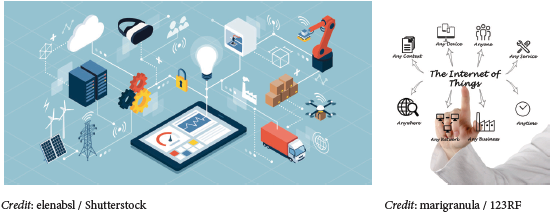
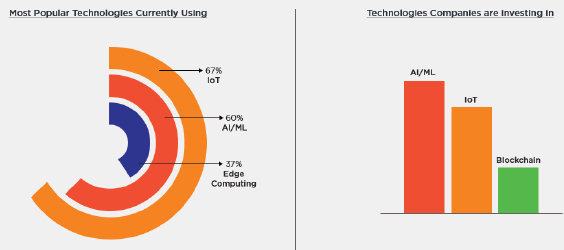
FIGURE 9.15 Visualization of emerging trends
It is surprising to note that every day, around one billion gigabytes of data is being generate by IoT devices. By 2025, it is estimated that 42 billion IoT-connected devices will be present globally and with growth in number of devices and network, the data generated is set to rise exponentially. With more data, there will be more challenges than opportunities.
With AI, IoT networks and devices can learn from past decisions, predict future activity, and continuously improve their decision-making capabilities and thus performance. AI allows the devices to ‘think for themselves’ by interpreting data without the delays and congestion that occur from data transfers.
Leave a Reply