
A generic qubit could have a non-definite state expressed as a superposition
|ψi = α|0i + β|1i, |α|
2
+ |β|
2
= 1.
How do we picture a qubit? As a vector in Hilbert space, the description
is abstract. The 2-d Hilbert space is a space with 4 dimensions. To get a
better feel for the sort of vector a quantum state is, we look at a geometrical
visualization of a qubit.
The space of all possible single qubits is spanned by all values of the four
real numbers defined by α and β but subject to the constraint of normalization:
|α|
2
+ |β|
2
= 1. We have an additional constraint in the form of equivalence
of all states differing by an overall phase. The four parameters thus reduce to
two, which determine the surface of a unit sphere in the space of parameters.
Let’s see how.
Recall the representation of |ψi in polar form (Equation 3.5):
|ψi = r
1
|0i + r
2
e
iφ
|1i,
where we’ve written φ = θ
2
−θ
1
, the relative phase between the basis vectors.
We can further parametrize r
1
and r
2
in terms of a single angle θ
0
r
2
1
+ r
2
2
= 1 =⇒ r
1
= cos θ
0
, r
2
= sin θ
0
.
63
64 Introduction to Quantum Physics and Information Processing
We now have
|ψi = cos θ
0
|0i + sin θ
0
e
iφ
|1i,
which is the standard representation of a point on the unit sphere by spherical
polar coordinates θ
0
∈ [0, π] and φ ∈ [0, 2π].
But we still have one further condition, which is often not intuitively ob-
vious. For a given state at (θ
0
, φ), consider the point on this sphere that is
diametrically opposite: i.e., at (π − θ, π + φ) :
|ψi
antipode
= −cos θ
0
|0i − sin θ
0
e
iφ
|1i = −|ψi,
which is physically indistinguishable from |ψi. Thus the upper hemisphere of
the sphere is sufficient to represent the states of a qubit, i.e., θ
0
∈ [0, π/2].
It is useful to regard this space as still a sphere by replacing the parameter
θ
0
by θ/2, θ ∈ [0, π]. Geometrically this is visualized as “folding” the lower
hemisphere on the upper, to obtain the Bloch sphere. The usual sphere is
a “double cover” of the Bloch sphere. We finally have a representation of the
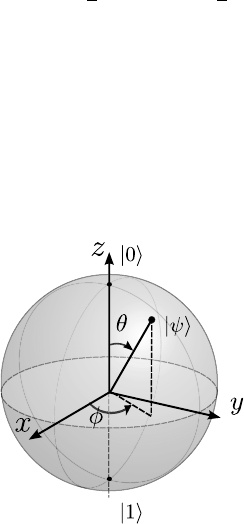
qubit as a unique point on this sphere (Figure 4.1):
|ψi = cos
θ
2
|0i + e
iφ
sin
θ
2
|1i; (4.1)
0 ≤ θ ≤ π, 0 ≤ φ ≤ 2π.
The vector
~p ≡ (cos φ sin θ, sin φ sin θ, cos θ) (4.2)
is called the Bloch vector, after a notation invented by Felix Bloch in 1943
to depict the polarization states of light. Note that this sphere is not to be
regarded as one in 3-d coordinate space.
FIGURE 4.1: The Bloch sphere.
On this sphere, the north pole represents |0i and the south pole, |1i. In
general, antipodal points on the Bloch sphere represent orthogonal state.
Properties of Qubits 65
This picture is useful for visualizing the effects of single qubit transforma-
tions, which would take a point on this sphere to another.
There is no known simple generalization of this idea for multiple qubits,
but it is useful for testing out ideas on gates and transformations for single
qubits.
Exercise 4.1. Using the polar representation for complex numbers α and β, ob-
tain the relationship between the angles θ and φ and the magnitude and
phase of α and β.
Exercise 4.2. Figure out the location on the Bloch sphere of the states
1
√
2
(|0i + |1i) and
1
√
2
(|0i − |1i).
Exercise 4.3. Show that antipodal states on the Bloch sphere (i.e., those at
(θ, φ) and at (π − θ, π + φ) are orthogonal
Leave a Reply