
A famous 1936 paper by Einstein, Podolsky, and Rosen [31] brought the
whole matter to a head. Popularly known as EPR, they examined a thought
experiment with entangled particles
1
and concluded that the quantum me-
chanical description of nature is incomplete, or else a paradox arises. Niels
Bohr countered their claim in a paper of the same title with his pragmatic
view that there is no more to nature than what quantum mechanics says about
it.
It is insightful to examine a simplified version of the EPR thought exper-
iment (due to Bohm [13], and sometimes referred to as “EPRB”) to see what
they meant. This version of the experiment actually can be, and has been
performed subsequently in the laboratory, so we have a concrete handle on
the issue.
Consider a source that produces pairs of qubits in the anticorrelated Bell
state
|β
11
i =
1
√
2
(|0
1
1
2
i − |1
1
0
2
i). (4.13)
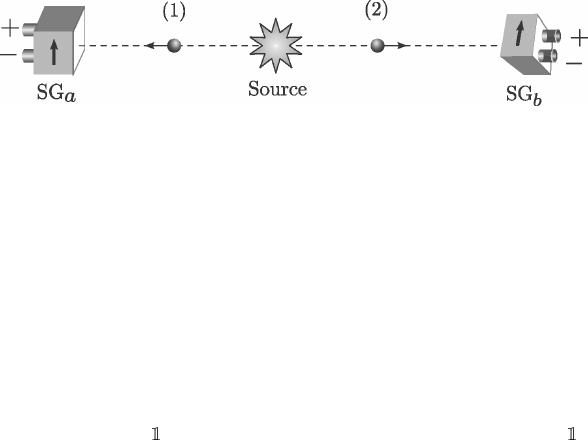
Suppose these particles fly off in two different directions and Alice captures
one of them while Bob gets the other. Our two experimenters can measure
the spin of their particle using SG machines oriented along any desired axis.
The source emits many entangled pairs, and the measurements are repeated a
large number of times, recorded, and then compared. Let’s label the direction
along which Alice’s detector (SG
a
) is oriented as ˆa and that of Bob (SG
b
) as
ˆ
b (Figure 4.2).
Suppose Alice and Bob decided to align their detectors along the same
direction, ˆa =
ˆ
b = ˆz, and recorded their measurements. A selection is made
of those pairs for which Alice measured +1. The entanglement in the state
(Equation 4.13) implies that for each of those pairs, Bob must have measured
1
It is after this work that Bell states come to be known as EPR pairs.
72 Introduction to Quantum Physics and Information Processing
FIGURE 4.2: Spin measurement on an entangled pair of particles.
−1. But this is true even if ˆa =
ˆ
b = ˆx or ˆy. If we try to explain the correla-
tions by saying that the values were pre-existing before measurement, then we
run into problems with the indeterminacy principle! The spins of the individ-
ual particles in the pair have fixed (anticorrelated) values in all directions in
this scenario, contradicting the quantum mechanical fact that spins in three
mutually perpendicular directions are incompatible observables.
EPR has another objection to the quantum dictum that the particles do
not have definite values of spin until a measurement is made. Assume at the
beginning, a state in which neither qubit has a definite spin. When Alice
makes an SG
a
measurement, then the combined state collapses to one that is
an eigenstate of σ
a
⊗ . The collapsed state is also an eigenstate of ⊗ σ
a
with the opposite eigenvalue. This conveying of information about the collapse
from one qubit to the other is mystifying, particularly if we recall that the two
detections are taking place at spatially separated points, and could be really
really far from each other! Is this even compatible with Einstein’s special
relativity, which claims that information cannot travel faster than the speed
of light? In such a scenario, it wouldn’t even make sense to decide which
measurement was made first!
Einstein, Podolsky and Rosen summarized their conclusions as follows: The
assumption that the quantum system possesses certain properties, viz. spin,
independent of whether it is measured or not, is known as realism. Also, the
value of this property cannot be altered by measurements made at spatially
separate locations. This tenet is known as locality. The EPR experiment
shows that quantum mechanics violates local realism. In order to sort out
the paradox, they concluded that
I. There is some instantaneous mechanism by which the measurement re-
sult of the particle at A is conveyed to the experiment at B, meaning
that quantum mechanics is non-local
OR
II. The quantum mechanical description of the initial entangled state by the
vector |β
11
i is incomplete, since it does not provide a full specification
of the actual system, i.e., it is not realistic.
Since non-locality was counter to relativity, EPR were inclined to choose
the latter option in claiming that quantum mechanics was incomplete,
Leave a Reply