
Often the density operator is the primary descriptor of a state. The de-
composition in terms of component states
ρ =
X
i
p
i
|iihi|,
is not always unique.
For a pure state, it must be obvious that there is only one such decompo-
sition, and this can be proved from the definitions:
Theorem 5.1. For a pure state, there is a unique decomposition of ˆρ in the
form of Equation 5.4, and in fact that decomposition consists of only one term
Proof. We can see this by invoking the convexity property (Equation 5.16).
Suppose our pure state density matrix admits such a decomposition
ˆρ
pure
= λ|ψ
1
ihψ
1
| + (1 − λ)|ψ
2
ihψ
2
|
= λρ
1
+ (1 − λ)ρ
2
.
Now since the state is pure, there exists some vector |ui such that
ˆρ
pure
= |uihu|.
Consider an orthogonal vector |vi : hu|vi = 0.
=⇒ hv|ˆρ
pure
|vi = hv|uihu|vi = 0.
=⇒ λhv| ˆρ
1
|vi + (1 − λ)hv| ˆρ
2
|vi = 0.
Since λ and (1−λ) are positive, this equation can only be satisfied if hv| ˆρ
1
|vi =
0 = hv| ˆρ
2
|vi. This means ˆρ
1
and ˆρ
2
are orthogonal to |vi. But |vi can be any
vector orthogonal to |ui. So we must have
ρ
1
= ρ
2
= ˆρ.
On the other hand, a mixed state ρ has no unique decomposition in terms
of pure states! This is easiest to see in our example of an unpolarized beam
with density matrix
1
2
: on subjecting this beam to SG tests along z or x or
y or any other direction ˆn, it yields equal proportions of |↑i and |↓i states.
This means that it can equally well be represented as equal parts of |0i and
|1i, or |↑
x
i and |↓
x
i or even |↑
n
i and |↓
n
i!
Exercise 5.8. Show that the density matrix
1
2
can be expressed as
1
2
(|↑ih↑| +
|↓ih↓|) in any basis.
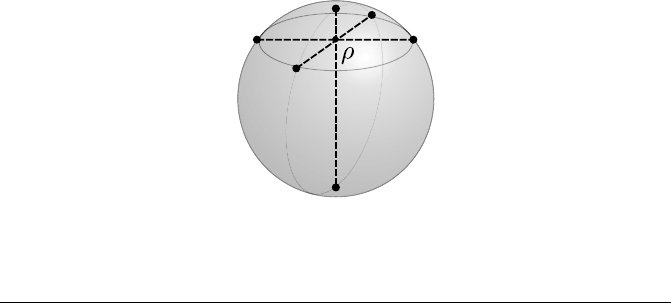
In fact we can see from the convexity property of density matrices (5.16)
that a given density operator ρ can be expressed in infinitely many ways in
that form, so that it is impossible to identify any unique component density
operators ρ
1
and ρ
2
. For example, in the case of a single qubit state, three
different decompositions in terms of pure states that sit on the surface of the
Bloch sphere, are shown in Figure 5.3. An infinite number of such decompo-
sitions is possible by choosing different chords.
Suppose that we prepare a mixed state ρ with pure states |ψ
n
i in certain
proportions p
n
, of the form in Equation 5.4. The p
n
’s in the density matrix
represent the probability of finding the state in |ψ
n
i. However, when this state
is passed on to someone who doesn’t know how it was prepared, there is no
way they can tell which states were used to prepare the system. Therefore,
the p
n
’s can no longer be interpreted as probability of being in state |ψ
n
i,
since the decomposition is not unique. For this reason, it is not possible to
interpret the eigenvalues of a density matrix as physical probabilities of the
system being in particular states.
88 Introduction to Quantum Physics and Information Processing
FIGURE 5.3: Density matrix ρ allowing three different decompositions
Leave a Reply