
The most successful practical applications of quantum mechanics in informa-
tion theory have been in the field of communication. This is a very old field that
has taken inputs from engineering, pure mathematics and computer science
apart from physics. It is only natural that application of quantum techniques
here should be among the first to be considered and implemented. Modern
technology in optical communication using laser light and optical fiber cables
is sufficiently advanced that it can quickly be adapted to using photons as the
quantum carriers of information.
In analyzing information communication, we normally consider the follow-
ing areas:
1. Coding: representing information accurately in terms of physical vari-
ables and the removal of redundancy leading to more efficiency, which
is known as compression;
2. Transmission: the information-carrying capacity of a channel and the
possible errors introduced into the data, and how to analyze and correct
them; and
3. Secure communication: including data encryption techniques, especially
sharing of secret keys for encryption.
Before we look into the nature and characterization of information in quan-
tum systems, we need some terminology commonly used in this subject. The
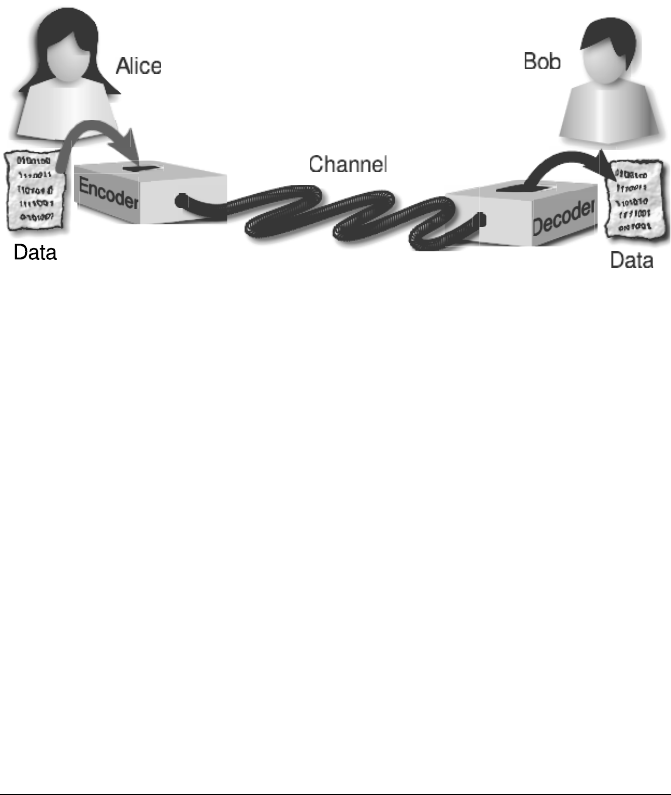
classic paradigm of information and communication is indicated in the cartoon
in Figure 9.1.
Two parties that may be in separate locations (we call them Alice and
Bob after the tradition in communication theory) need to communicate some
data. The term data refers to information converted into a form suitable for
the physical protocol being used for transfer. Data is produced from informa-
tion by a process called encoding. This process is essentially a mathematical
function executed by a computing machine. At this stage, we are concerned
with the quantification of information present in the data, the efficiency of
encoding and how much the data can be compressed. If the security of the
data is of importance, then this is the stage where secrecy is built into the
message, a process called encryption.
Alice, the sender, then transmits the encoded data by physical means
known as the channel. At this stage, we are concerned about the efficiency of
177
178 Introduction to Quantum Physics and Information Processing
FIGURE 9.1: Communication of information
the channel, quantified by the rate at which data can be transmitted by the
channel. Another important factor at this stage is noise. Data could get cor-
rupted by various means and an error-correcting scheme like those we looked
at in Chapter 10 has to be built into the communication protocol. If the data
needs to be securely transmitted, then at this stage an eavesdropper (Eve)
can tap into the channel and check how much it can be compromised.
When the data reaches its destination with Bob, it needs to be decoded
to be readable by Bob. This process is essentially the reverse of encoding,
and the efficiency of the whole protocol can be computed at this stage. The
security of the protocol can also be checked if Alice and Bob now compare
some of their data through other means.
Quantum data processing can help us with making this process more effi-
cient as well as more secure, as we will see in this chapter. The chief properties
of quantum systems that will be exploited here are entanglement and the in-
distinguishability of non-orthogonal states
Leave a Reply