
In sections 1 and 2, we looked at the evolution of marketing and the basics of digital marketing as a field of study. With Section 3, we understood the key underlying technologies behind internet marketing and how internet has reshaped business interactions across the ecosystem and the challenges it poses for implementation.
In this last section of the chapter, we will build upon our basic understanding of digital marketing as detailed in Section 2 to build a digital marketing framework which would form the basis of developing a digital marketing strategy and executing it to achieve the desired objectives. To reach there, we need to start developing the concept with the end goal in mind—which is ‘Enhancing Customer Value.’ But what is this value we talk about and how do we ascertain that we are deciphering it correctly for our intended customer segment?
The next two sub-sections will form a basic grounding to help us understand concepts like OVP (Online Value Proposition), Market Opportunity Analysis, and Digital Services Development, which would form the core pillars of the ASCOR Digital Marketing Framework (the core strategic framework for this text and ensuing chapters).
Delivering Enhanced Customer Value
The core of any marketing activity is to ascertain that the customer has a specific need and is looking to a solution to meet that need. That solution could be a product, a service, a piece of information and even an online advice forum. Meeting that need is the core job of marketing and in the same breadth, meeting that need through any of the digital channels provides the base for digital marketing.
Understanding Problem-Value Mapping
Before defining the terms Customer Value and OVP (Online value proposition), let us understand the root where all marketing and, in a larger sense, all business endeavors begin, and which explains the ‘customer problem.’ In simplest terms, a customer problem is a set of issues which a customer might face while performing any activity or going through a process. It could be even a simple act of buying grocery or requiring a house for rent. Every activity which is accomplished by a customer can typically have one or more problems associated with it. Each of these problems give rise to what we call in marketing terms as customer needs which translate into opportunities for marketers to service through present products or create new product/service categories accordingly.
Philip Kotler, the marketing guru in his book (Marketing Management, 14th edition), defines needs into multiple categories which can broadly be bucketed as ‘stated needs’ (those which the customer knows and expresses) and ‘unstated needs’ (those which a customer does not express and might not even know that they exist). From Kotler’s text, we have picked three other kinds of needs to be included in the unstated needs bucket—‘delight needs’ (those which offer the customer higher satisfaction than he would normally expect), ‘secret needs’ (those which the customer will never state but secretly wish for), and ‘efficiency needs’ (those which will help the customers execute any activity/task in a much quicker, convenient, and efficient manner) to bring to light the opportunities which marketers can capture if they are able to correctly identify a customer problem and service their arising needs.
With this understanding of customer problem and his needs, let us look at Fig. 1.9 to establish the mapping between customer problem and his needs with the OVP concept developed to respond to those needs. Fig. 1.9 showcases the two sides of marketing and product, service or brand—the Buy side and the Sell side. For each business transaction to occur, there has to be a mapping between the left and right sides and only when the Sell side is able to identify the right kind of needs and service them with an appropriate kind of product/service does a business transaction occur.
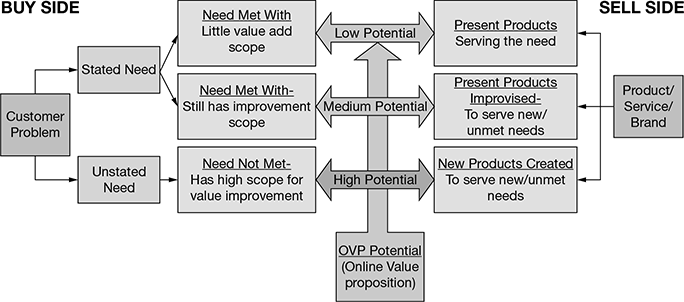
Figure 1.9 Mapping Customer Problem to Online Value Proposition (OVP) Potential
With a clear understanding of ‘customer problem,’ let us understand what we mean by ‘value’ which would lead us to define the concept of OVP. The term value for a customer would be any kind of tangible or intangible (or a mix of both) enhancement which a customer experiences while interacting with any product or service in comparison to similar products/services which he has used/interacted with earlier.
The term value is more experiential in nature and relates to the extent to which a customer finds any new additions worthwhile/differentiated or of an enhanced use for him which helps ease the present process/manner in which he deals with the specific problem at hand. Since the term value can mean differently to different clients in different circumstances, it is very important to know the potential for offering such a value online, which will finally decide whether the customer will pay for that additional value or not. This identification is termed as knowing the OVP which has to be created for each customer segment depending upon the known/unknown ‘customer problem’ at hand and helping them solve it.
Let us go back to the earlier definition of the two kinds of needs (stated and unstated) to map them to ultimate fulfillment which will help clarify the concept. Any need stated or unstated by a customer will typically lead to three conditions:
- Need met with: When customers’ needs are met with at a more or less satisfactory to good level and there is little scope of a value add
- Need met with but still has improvement scope: When customers’ needs are being met but there is a clear and stated improvement scope which marketers can decipher through customer connect/feedback or dedicated focus group
- Need not met and has high scope for value improvement: When customer typically does not even know of his needs and resulting problems
If we try and map the above three situations with what the ‘Sell Side’ has to offer, we can identify the areas where there is more potential to develop a distinct and serviceable OVP and differentiate them from those which only have a little scope for value-add, thus helping in the identification, validation, and subsequent creation of new products/services or enhancement of the present products/services at hand.
The problem–value mapping also helps entrepreneurs and business owners launch new products to test the feasibility of product launches in the market. Many entrepreneurial frameworks have also been developed for this mapping exercise referred to as ‘lean start-up’ where marketers and new product creators test a ‘minimum viable product’ (MVP) in the market to validate its differentiated value before they jump into the product development exercise.
With a clear understanding of the customer problem identification and OVP concepts, let us also understand two other key concepts—market opportunity analysis and digital services development as they are the next two key steps before any customer would logically move ahead in the value chain.
Market Opportunity Analysis and Digital Services Development
With an understanding of the concepts of customer problem and OVP, we have already been able to identify digital opportunity. But for large businesses investing into new product development or entrepreneurs choosing a new area to enter, this opportunity needs to be refined and developed further before companies understand the overall revenue potential and market-share they can tap into.
Before firms even start to think of executing a digital marketing strategy (to be discussed in greater detail through the next section on ASCOR Digital Marketing Framework), it is essential for companies to conduct a Market Opportunity Analysis to clearly identify a market segment (which is ready to consume their products/services) and a viable revenue mode towards adoption of those products/services. Digital Services Development has also become an important step as products and services need to be oriented or developed from scratch to suit the digital marketplace and its consumption pattern. A round-up of the strategies needed for Market Opportunity Analysis will be explained when we detail the Assessment Phase of the ASCOR Digital Marketing Framework.
The Digital Services Development concept has recently become quite important (and also relates to the Digital Transformation exercise most of the firms are getting involved with) to support creation and implementation of traditional and digital products for selling on newer platforms. Few important strategies which companies need to take care of include:
- Converting present traditional products to digital formats for digital consumption
- Looking at avenues to create new digital/virtual avatars of present physical products
- Understanding the impact and pressure digital marketing is placing on the whole backend value chain to help provide efficiencies which have actually differentiated digital services in the first place. (This will also be covered in detail in Chapter 2 when we will discuss the impact of digital on the product value chain.)
- Defining strategies for procurement, production, fulfillment, and channel digitization, all of which are integral to creation of new digital offerings. (This has been covered earlier in detail in the section on digital transformation.)
- It is also important to realize aspects related to storing of digital products on cloud platforms, the way they are searched and retrieved, how their metadata is managed, and how they are rendered onto multiple platforms, devices, applications (all of this would be covered in multiple chapters later).
With this understanding, we are now in a better position to discuss the ASCOR Digital Marketing Framework and recognize the key aspects and their application to multiple digital marketing use-cases.
ASCOR Digital Marketing Framework
For any type of company to move into digital marketing, be it a traditional firm with more physical products and services mix or one that has transformed itself to a large degree to tweak its products for the internet generation, there needs to be an underlying framework which helps to map the process and its progress. To help large and SMB firms, as well as individual marketers, we have devised a methodical phase-wise plan which we call the ‘ASCOR’ Digital Marketing Framework where ASCOR is an acronym standing for the five phases:
- Assessment phase
- Strategy phase
- Channel and communication plan
- Digital marketing operations
- Refinement phase
Let us understand each of the phases with the help of Fig.1.10. We would go through an in-depth understanding of each of the phases and execution activities involved in the subsequent chapters of the book.
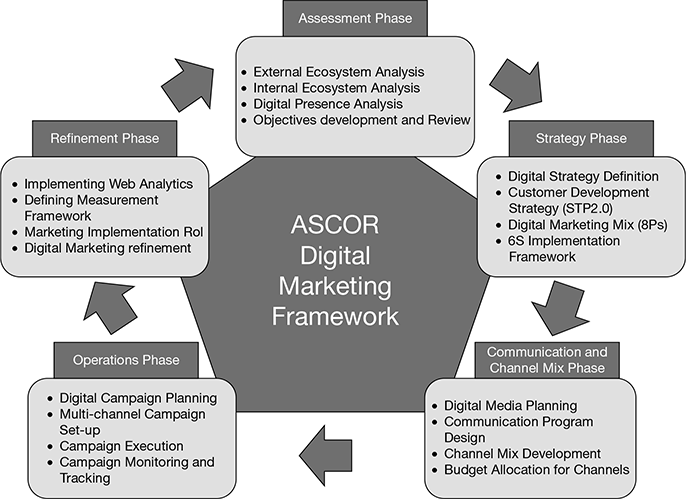
Figure 1.10 ASCOR Digital Marketing Framework Phases
- Phase 1-Assessment: The first phase involves any firm’s or individual’s assessment and analysis of their present external/internal marketplace environment to ascertain that they have clearly assessed their current digital presence to develop high-level digital marketing objectives and review criteria. This stage involves executing all the necessary market research to assess present market trends impacting them.Key activities involved in the assessment stage include-
- External analysis: It refers to the analysis of macro-micro environment (entities which surround and influence the firm, its products, operations, and opportunities) and market situation analysis (includes market and competition analysis, specific to the industry where the firm and its product are operating).
- Internal analysis: It involves an analysis of factors which are internal to a company and within their control to influence their goal setting and create successful and realistic digital marketing objectives. It includes four main areas of analysis- offerings mix, marketing mix, resources mix and competencies mix.
- Digital presence analysis: It is a 2 × 2 matrix which helps firms identify their present digital state through a combined analysis of external and internal factors. There are four key digital presence states depending upon the present ‘extent of digital presence’ of any firm and its ‘market standing’ with respect to direct competition in their specific industry segment and market category.
- Objectives development and review: It involves setting of high-level digital marketing objectives based upon the specific digital state in which the firm is present. The review stage consists of activities that involve monitoring, evaluating, and controlling marketing activities continuously.
- Phase 2-Strategy: The second phase involves creating the digital marketing strategy roadmap in line with traditional marketing strategy and objectives. Key stages include-
- Digital strategy definition: It defines business strategy for firms going digital, their impact factors and emerging business structures. It also involves alignment of firm’s core competencies to changing value function shifts to develop appropriate OVPs.
- Customer development strategy (STP2.0): It includes revisions to classic STP (Segmenting, Targeting and Positioning) activities to develop a revised STP2.0 version for digital. This helps to form the base for creating the customer development strategy.
- Digital marketing mix (8Ps): It involves looking at the classic 4Ps (Product, Price, Place, Promotion) with a digital view and also developing the new set of 4Ps for modern marketing (People, Process, Programs, and Performance).
- 6S Digital marketing implementation framework: The final stage involves developing the 6S (Scoping, Shadow, Set-up, Stability, Scale-up, and Spectrum) digital marketing implementation framework for executing the strategy elements.
- Phase 3-Communication and Channel Mix: This stage involves a more in-depth communication and channel mix plan creation for each of the marketing objectives Key activities include
- Digital media planning: It involves developing the strategy towards creating a digital media plan post the digital strategy definition exercise from the last phase to determine the communication and channel mix for specific brand offerings, taking into consideration the present product lifecycle and digital presence stage.
- Communication program design: It details out seven steps to create an overall communications strategy and helps create an implementation plan towards developing the communication message and its orientation for specific end objectives.
- Channel mix development: It lays out the nature of each channel and the type of communication which can be targeted through the particular channel to meet a specific communication objective. It also involves looking at the positives of one channel over the other for specific marketing objectives and strategies.
- Budget allocation for channel mix: It involves utilizing the four key methods commonly used for budget allocation to ensure that appropriate emphasis is given to each channel depending on the communication objectives and the nature of returns expected from each of the channels in the overall mix.
- Phase 4-Digital Marketing Operations: This is the deployment stage for digital operations and involves the actual planning, implementation, monitoring, and optimization of campaigns during the media flight dates so that marketers obtain the maximum impact for their investments during the campaign run period.Key activities include
- Digital campaign planning: It involves activities performed towards planning the campaign before it starts and aligning the resources, tools, and key activities. It starts with developing the campaign objectives which would include developing a high-level brief of the product, the type of segments to be targeted, targeted message, overall flight dates (run-time), and the final tangible output desired in terms of response rates, website visits/leads, or conversions.
- Multi-channel campaign set-up: It refers to the actual operations work for setting up the campaign across multiple channels and begins with developing a campaign calendar and getting it approved internally before sharing with execution teams for implementation.
- Campaign execution: It involves all the activities performed by campaign managers right from the time they make the campaign ‘Go-Live.’ Typical representative parameters (which we would learn more in the upcoming chapters too) include Bid, Geo, Targeting, Networks, Devices, Languages, Ad Extensions, Advanced Settings, etc.
- Campaign monitoring and tracking: During the implementation of the campaign, marketers start receiving daily and weekly data points and extensive metrics so that all data captured can be effectively analyzed and monitored.
- Phase 5-Refinement: This is the final stage of digital marketing wherein marketers and the campaign team analyze overall RoI for the effort and investments, create reports and analytics dashboard, and refine present strategies for further digital marketing activities, based on customer response and collated data.Key activities include
- Implementing web analytics: Traditionally, web analytics helped evaluate website performance, but the emerging Web 2.0 world involves analytics activities like multiple-outcome analysis, site testing, understanding customer and competition, etc.
- Defining measurement framework: It involves developing a marketing measurement framework that helps generate quantitative and qualitative analytics for all three digital media types (owned, earned, and paid).
- Marketing implementation RoI: It involves developing a RoI model which calculates key expense areas for spend across all marketing channels and overall marketing impact for the firm.
- Digital marketing refinement: As a final step, the overall digital marketing strategy is refined using a five-step model of Define, Measure, Analyze, Action, and Improve or Eliminate to ensure that the campaigns are run most effectively in future executions.
Application of Digital Marketing
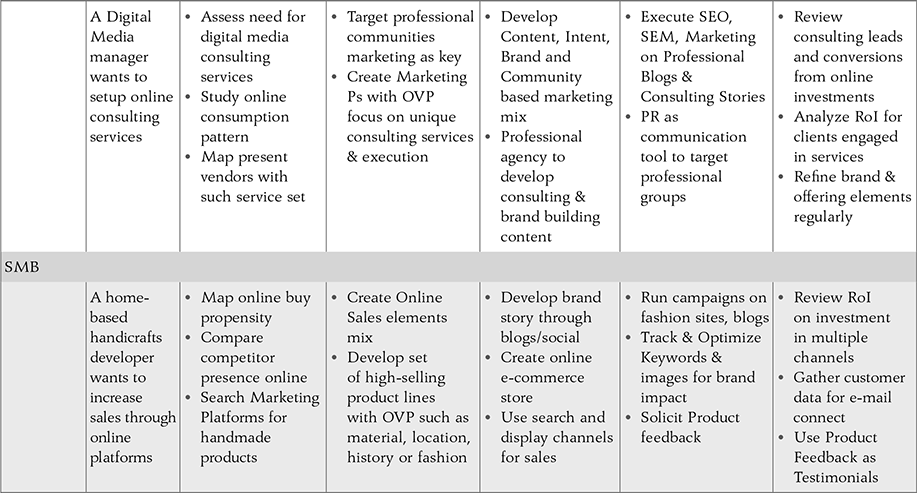
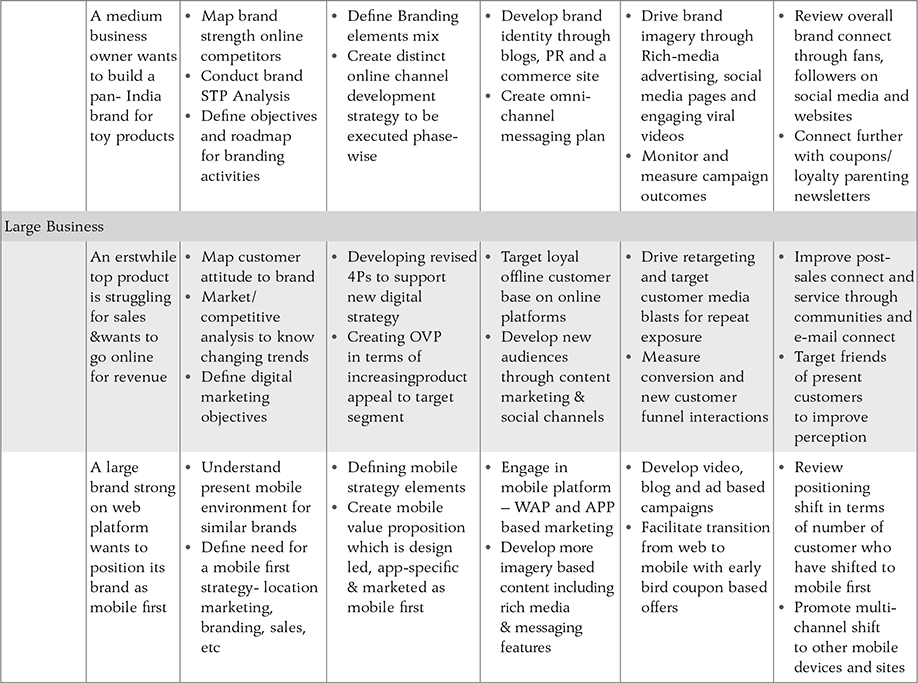
With a deeper understanding of the ASCOR Digital Marketing Framework, it would make it much clearer to apply specific stakeholder-based scenarios to understand how digital marketing can be applied by individuals, SMB (small and medium businesses), and large companies as per their needs and end outcomes. The examples here are representative of situations and projects which digital marketing companies face and execute on a daily basis. All the scenarios have been run across the ASCOR stages and a quick view of Table 1.5 will give a basic grounding in the first chapter itself of the kind of cases we will go through in the rest of the book to apply our knowledge to real-life digital marketing situations.
Table 1.5 Application Examples of ASCOR Framework Applied to Multiple Stakeholders Cases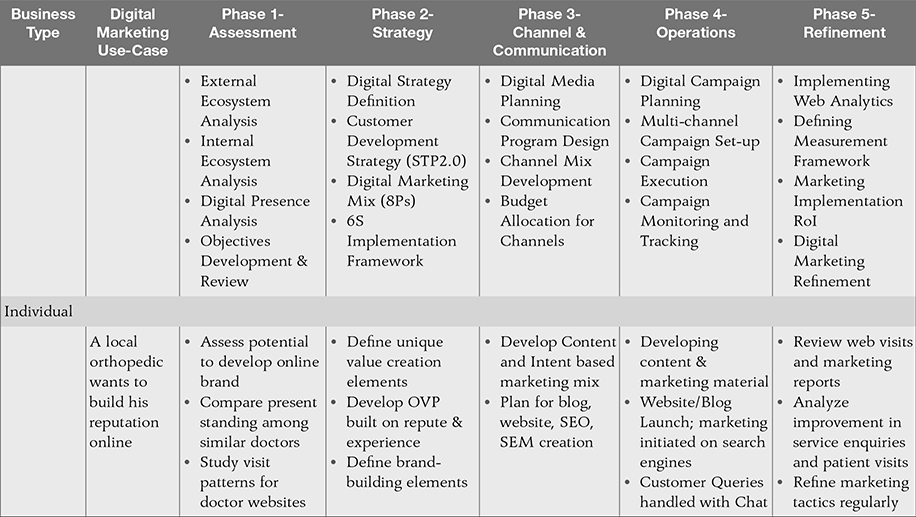
Leave a Reply