
Value elements essentially are the set of key differentiators which when used individually or in conjunction with each other provide a unique compelling proposition for any customer to buy a product from online rather than physical channels. In Fig. 2.8, we will showcase how a combination of physical goods and services along with the value elements (discussed in detail) provide an unique ‘Digital Value.’
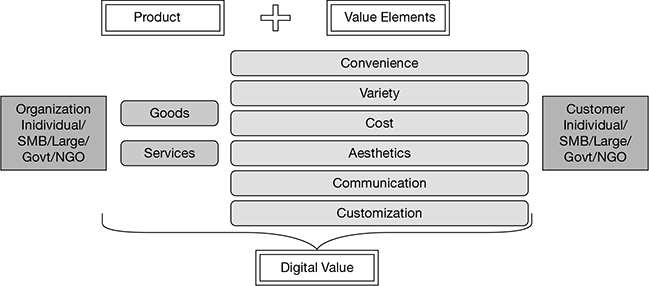
Figure 2.8 Digital Value Elements
Let us go through each of the value elements in detail.
- Convenience: The foremost value which any digital business will provide a customer is to make it more convenient for the him/her to search, catalogue, select, order, and receive goods or services than to do the same in the physical environment. This applies both to B2B and B2C types of businesses. In B2B, investments made by the organization towards a procurement automation tool or process digitization or a collaboration platform for delivery would be part of initiatives to help develop products and services in a more efficient and convenient manner for the customer.
- Variety: The next important factor is the variety of products and services which can be put on display across dedicated websites and commerce portals, and the sheer amount of information which can be shared for each of the available elements. On the services side, this capability becomes even more pronounced as organizations have the capability of creating a variety of sub-services using modules of high-level services. The key feature here is the quick computational power of online medium, which is able to pre-classify products and services and provide customers the ability to quickly search across multiple offerings and pick and choose the best one suited to their needs.Here we should also mention the striking advantages of the ‘Long-Tail’ concept wherein physical stores lack the warehousing capabilities to store the large per cent of stock keeping units (SKUs) that are not bestsellers, while online platform provides the best medium to sell SKUs which are not bought as regularly but might fetch heavy premiums when sold. This concept was coined by Chris Anderson in 2004 and since then has widely been looked at as a differentiator for products sold online.
- Cost: Involves the ability to manage costs by either utilizing efficient expert intermediaries (as seen in the last section) or bypassing multiple levels of middlemen who add to the costs of the final products. The biggest example is cost efficiencies shared by e-commerce companies which are setting up their own procurement and logistics arms to bring costs down for customers.Another related concept is how multiple pricing models can be built across products and services depending upon customer proximity, loyalty, buying propensity, purchase frequency, etc., and how these models can be developed utilizing vast amounts of customer interaction data available across all digital touchpoints including websites, mobile applications, CRM, salesforce data, etc. Also, with multiple price-comparison sites springing up, cost arbitrage, and the knowledge of products available at discount helps customers get a much better deal especially on the B2C side where they have low influencing power.
- Aesthetics: It is one of the most novel differentiators which is not given much attention during online value creation discussions. Aesthetics include an array of tangible and intangible value-enhancing components like product design, overall styling of medium, channel and message, impact of subtle imagery, etc., all of which contribute a great extent towards the packaging of even average products and showcasing them online in a highly stylized manner. Popular examples would include Instagram and Pinterest platforms both of which have been curated in a compelling manner with high design factors which tremendously influence present-day urban values, seeking customers for whom packaging matters as much as, if not more than the product and content itself.
- Communication: A broad value differentiator, communication can go on a long way to provide digital value which normally cannot be generated for a product sold offline. Communication these days would not only include the message shared with the customer while marketing but also includes ways in which online marketers can track the customer across all stages of their online purchase and influence them with the right kind of messaging. For example, at the stage where a customer is about to decide on buying a particular product but is not sure, an expert discussion if provided by the brand might relieve customers of any doubts. Another example would be the integration of positive social comments or customer success stories, which if communicated at the right time and in the right manner, go a long way to develop customer trust and propel them towards making the final purchase.
- Customization: Out of the six digital value addition elements, customization is probably the one which is being largely discussed and still has a lot of room for improvement. Customization typically means identifying key customer segments, developing their personas (key traits, buying patterns, goals, skills, attitudes, etc.), and being able to deliver the exact experience which even a single customer might be looking out for, provided it makes investment sense.The present level of customization possibilities reached by marketers are focused only around retargeting online advertisements to visitors who might have checked out specific products on certain sites so that they are enticed to click those advertisements and finish their purchase. With high amount of investments going towards developing tools across areas like advertisement technology, consumer data management, sentiment analysis, etc., there is still a long way to go before a company is rightly able to identify the customer’s needs for a specific product, service, and is able to offer him/her a compelling proposition based on initial intent itself, to provide a product which would be most suited to his/her needs.
Leave a Reply