
With an understanding of consumer demand, the impact of its patterns on product development, and the basics of web tracking, we move towards the final section of this chapter which discusses integration and application of consistent brand messaging across both traditional and non-traditional marketing channels through an understanding of the fundamentals of Integrated Marketing Communications (IMC).
Basics of Integrated Marketing Communications (IMC)
In 1989, IMC was formally conceptualized and introduced in Northwestern University. The first definition of IMC (according to Schultz and Kitchen Schultz et al, 1993) was used in a survey conducted in 1991 by Northwestern University in cooperation with the American Association of Advertising Agencies (4As) and the Association of National Advertisers in the United States. The definition of IMC used in this research was: “IMC is a concept of marketing communications planning that recognizes the added value of a comprehensive plan that evaluates the strategic roles of a variety of communications disciplines (for example, general advertising, direct response, sales promotion, and public relations) and combines these disciplines to provide clarity, consistency, and maximum communications impact.”
The Journal of Integrated Marketing Communication from the Medill School of Journalism at Northwestern University which is dedicated to research in this area describes IMC as “a strategic marketing process specifically designed to ensure that all messaging and communication strategies are unified across all channels and are centered around the customer.” The concept involves leveraging the strength of each separate communication channel to achieve a stronger combined impact than is possible by a single channel. The concept is closely related to consumer’s ability to absorb messaging from each medium and takes into account limitations of each medium to cover them up with others.
The concept of IMC evolved in the 1980s, when most companies in US were set up as departments that conducted their operations as separate profit centers. With a need to go global and still manage the communication, branding, and cultural elements, it became important to integrate messaging across all channels to make them consistent so that the customer across all countries could see one view and image of the product and there could be better synergies not only in promotion but also in the manner distinct product features are built.
Historically, communication elements like advertising, public relations, sales promotion, etc., were planned and developed, as well as implemented and measured separately. The key issue in implementing IMC was how to bring across key elements in a coherent manner which not only leverages synergies but also makes communication comprehensible to the customer as a whole. With new digital channels coming forth and with the changing forms and technology developments behind them, Mulhern, in 2009, suggested using a set of axioms about relevance, exposure, timing, behavioral response, and other precepts of media planning. But these are still not as developed and this field keeps on evolving even to this day.
According to Tom, Duncan; Caywood, Clarke (1996), the following trends and changes have been the key factors behind the adoption of integrated marketing communication:
- Decreasing message impact and credibility: Consumers are becoming callous to commercial messages to the extent that it is increasingly difficult for a single message to have an effect.
- Decreasing cost of using databases: The dramatic reduction of storage and retrieval costs, coupled with the increased sophistication of audience segmentation has provided marketers with more effective ways to reach target audiences.
- Increasing client expertise: Clients now are not only pushing their agencies to be more cost effective, but are also realizing that television might not be always the primary advertising medium for consumers.
- Increasing mergers and acquisitions of agencies: Many top public relations firms and advertising agencies became partners or were partnered with other communication firms. These mergers allowed for more creativity and the expansion of communication from advertising to other disciplines, such as event planning and promotion.
- Increasing mass media costs: While database costs were falling, increases in mass media cost per thousand impressions (CPMs), especially television, prompted marketers to look at a mix of other channels too which would be relatively less expensive.
- Increasing media and audience fragmentation: With increase in radio, television stations (especially cable), and magazines, media was getting fragmented, thus increasing the competition for consumer’s attention. Also, with the use of computers and sophisticated research methods, companies were able to target specific segments and geographic audiences more accurately.
- Increasing global marketing: There was a rapid influx in advertising competition from foreign countries. Companies quickly realized that even if they did not conduct business outside their own country, they were now competing in a global marketplace.
- Increased number of competitive products: With increasing number of new products being launched in the market, marketers needed to look at newer communication models to strengthen their brands against competition.
With an understanding of the factors that led to the rise of IMC, let us now understand the key channels for Integrated Marketing Communications.
Channels for Integrated Marketing Communications
The key difference between traditional marketing and the integrated marketing concept as discussed in the definitions in last section relates to IMC being an audience-driven business process. This essentially means while firms develop business plans, the audience or targeted consumer becomes central to the planning process and the main driving force for all key decisions.
The difference between traditional marketing communication approaches and the IMC audience-driven approach has been summarized in the paper on ‘Revisiting the IMC Construct’ by Jerry Kliatchko (see Table 3.2).
Table 3.2 Difference between Traditional Communication and IMC Approaches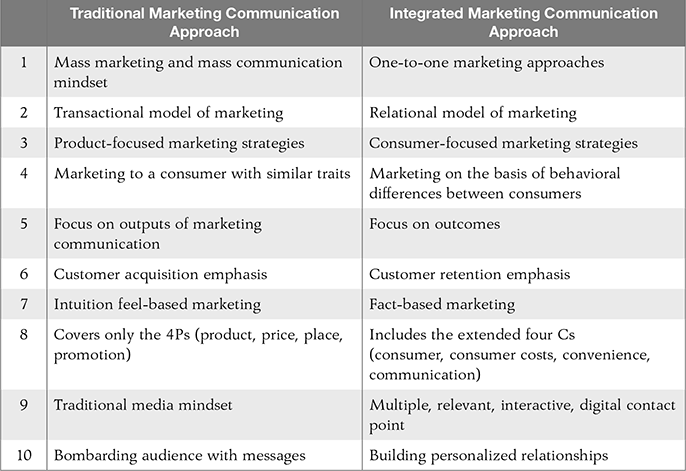
With an understanding of these differences, let us now look at the key channels which can be included as a part of IMC depending upon how firms want to develop their marketing communications strategy:
- Advertising: It includes broadcasting/mass advertising (print, internet advertising, radio, television commercials) and outdoor advertising (billboards, street furniture, stadiums, rest areas, subway advertising, taxis, transit).
- Sales promotion: Contests, coupons, product samples (freebies), premiums, prizes, refunds/rebates, special events, bonus packs, loyalty programs, sales materials (sell sheets, brochures, presentations), installation, customer help, returns and repairs, billing. On the trade side they include trade allowances, POP displays, training programs, trade shows, co-op advertising, etc.
- Public relations: includes special events, interviews, conference speeches, industry awards, press conferences, testimonials, news releases, publicity stunts, community involvement, charity involvement, and events.
- Direct marketing: refers to direct mail, telemarketing, catalogs, shopping channels, inter-net sales, emails, text messaging, websites, online display ads, fliers, catalog distribution, promotional letters, outdoor advertising, telemarketing, coupons, direct mail, direct selling, grassroots/community marketing, mobile.
- Digital/internet marketing: This being the latest addition to IMC includes all the digital marketing and communication channels which we would be looking at in this book. These include all the channels as shared in Chapter 1 (Section ‘Digital Marketing Applications and Benefits’):
- Intent-based marketing (search marketing)
- Brand marketing (display/digital advertising—banner ads, rich media ads, online classified ads, email ads, mobile advertising)
- Content marketing (website, blog, native content)
- Community-based marketing (social media, business platforms)
- Partner marketing (affiliate marketing, sponsorships, PR)
- Communication channel marketing (e-mail, messaging, sms)
- Platform-based marketing (mobile, video, out-of-home, media platforms (Surface), kiosks, In-apps)
It is primarily the addition of digital/internet marketing and communication channels which has brought about the value differentiators of customer centricity and audience-driven inputs to the overall IMC process. Since this textbook is about digital marketing, we would be looking at multiple examples of integration of digital components to the overall communication mix in the subsequent chapters which would help understand how these elements cover up the limitations of traditional media and provide avenues for a stronger one-to-one consumer connect.
Since IMC primarily deals with leveraging the strong characteristics of each key communication medium and strengthening the limitations with newer communication channels, it would be important to know the key advantages and limitations of major media types (see Table 3.3) as shared by Philip Kotler in Marketing Management (Millennium Edition). This would also help us realize the need to for additional digital channels to upend the traditional ones for enhanced communication impact.
Table 3.3 Profiles of Major Media Types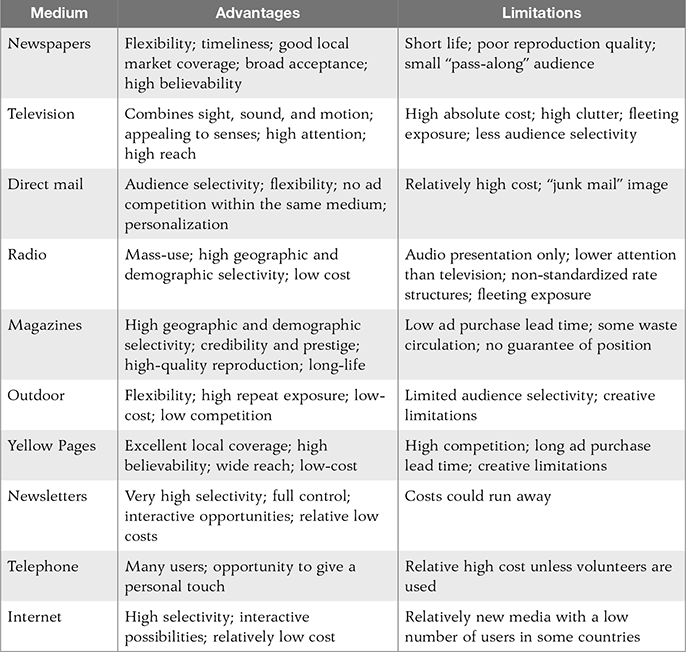
Four Pillars of the IMC Construct
IMC as an emerging paradigm has been studied in a number of ways and through multiple approaches. One of the first consolidated studies was done by Jerry Kliatchko in 2005 (further revisions made to it in 2008) wherein he proposed the four pillars of IMC and viewed IMC as an evolving developmental process. His work is important as it provides the much-needed understanding and a theoretical context to this otherwise applied process. The four elements of IMC as defined by Kliatchko (2008) include stakeholders, content, channels, and results. Let us understand them in more detail through content aggregated from multiple papers by Kliatchko (the text below has been picked up as direct excerpts from those papers):
- Stakeholders: The term ‘stakeholders’ refers to all relevant publics or multiple markets with which the firm interacts. The term ‘publics’ include both external and internal audiences. External audiences may refer to customers, consumers, prospects, intermediaries, and other entities outside the organization, while internal audiences consist of those within the organization, such as employees, managers, etc.Managing the external markets in IMC pre-supposes that the entire process of developing an integrated brand communication program places the target market at the core of the business process so as to effectively address their needs and wants and establish long-term and profitable relationships with them (Kliatchko 2005).
- Content: The development of content in IMC flows from a deep knowledge and understanding of multiple markets that an IMC program is intended to address. Understanding consumers beyond traditional marketing descriptors, such as demographic and psychographic data is essential (Schulz and Schulz 2004). An appreciation of consumer understanding gives rise to consumer insights and the discovery of the consumer “sweet spot”—the perfect connection between the brand and the customer (Fortini Campbell 1992)—that ultimately leads to the creation of compelling content.Content in IMC may be differentiated between messages and incentives. Messages refer to brand concepts, ideas or associations, and all other values or perceptions that marketers transmit to customers, while incentives are short-term offers or rewards to consumers for having done something of value to the firm and consumer (Schultz and Schultz 2004).
- Channel: There are two main determinants to consider in deciding which marketing or brand communication channel to utilize in preparing an integrated media plan: relevance and preference (Schultz and Schultz 2004). Contrary to a common misconception that media planning in the era of IMC implies ‘ambushing’ consumers at all possible points of contact for maximum exposure, the IMC planning approach deliberately takes on the consumer’s perspective in deciding which channels would be the most effective in reaching target audiences.By conducting a brand contact audit of consumers, as well as examining the consumer’s ‘path to purchase,’ marketers could determine which contact points or channels are relevant to them and which they prefer as sources of information about a company and its brands. The brand contact audit may also aid marketers in determining how consumers would want to communicate and interact with the company in return.
- Results: Measuring results of marketing communications programs against set objectives has always been the norm for business organizations. However, unlike the traditional attitudinally-based models of measuring effectiveness that focus on evaluating communication effects (for example, brand recall or awareness) and outputs (for example, what media placements were bought), the IMC approach measures behavorial responses (for example, actual purchases made by consumers and prospects) and outcomes (for example, financial returns in terms of income flows from consumers) (Schultz and Walters 1997).
At the heart of IMC, therefore, is the drive for accountability, that is, IMC programs must be accountable for business results. This is done through a process of customer valuation and by estimating return-on-customer-investments, or ROCI (that is predicted incremental sales achieved by investing in specific customers), which are then verified and evaluated at certain points over time, to track the effectiveness of IMC programs (Kliatchko 2005). Schultz and Schultz (2005) further explain that measuring IMC programs follows the predictive modeling approach that focuses on customers that generate returns for the brand, and estimating the impact and effect that a variety of brand marketing investments might have on the program.
Leave a Reply