
The outcome of external assessment as elaborated in the previous section is for any digital marketer to gather market research data relating to how the four key external environment factors—macro, micro, industry, and competition, impact initial assessment. As we move forward to understand internal assessment elements, we should keep in mind that any assessment related to internal strengths and competencies in the upcoming internal assessment section should be made comparative to the external environment elements, as an analysis in isolation might not help marketers gain a complete and accurate perspective of their internal situation and strengths.
Analyzing Present Offerings Mix
Internal analysis involves looking at key elements which are typically in control of the firm and which they can improve/alter to suit to changing external circumstances and macro–micro factors. For our present understanding, we have divided this section on lines of these four elements to have a detailed look at how each of them can be assessed through the use of common industry frameworks unique to each element (see Fig. 4.5).
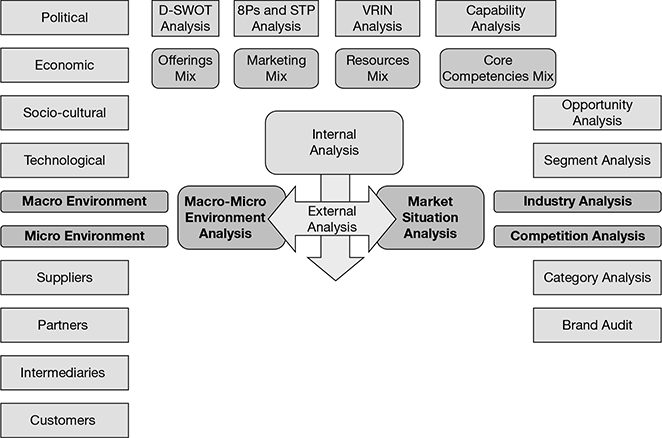
Figure 4.5 Elaborating Internal Analysis Elements
Offerings and Marketing Mix
The first two of the four elements, relate to any firm’s analysis of present offerings at hand and how well they are able to analyze and compare the marketing mix of segmentation, targeting, and positioning (STP) to establish themselves online. Offerings here refer to the mix of product and services as a cohesive set rather than as segregated units. A firm would first need to assess the key attributes and marketability of its products and services before deciding who and how to market it.
Typically, most of this analysis is done before even developing the product as a part of the product strategy. But here we would be looking at it more in the context of marketing to gather enough market research and information to develop a product strategy as part of the next ASCOR marketing stage.
When we talk about analyzing the offerings mix from the perspective of a product and marketing mix, we would typically come across a scenario wherein a set of products are already present and well known in the offline world. So how does it differ when we plan to market the same in the online world? A few pointers are listed below.
- Products are virtual in the digital world: The way products are marketed and presented in the digital world lends itself far more virtual elements than when compared to the same products in the real world dangling from the shelves. So even a bar of normal soap has to have those subtle intangible elements to it, since the real positives of the offline world, the touch, smell, and experience are missing.
- Nature of target audience differs: Audiences buying the same product online would typically be more aware and open to checking our product features and elements. With such an audience set, the way brand imagery has to be built has to have unique online elements which marketers need to master.
- Brand switching is quite high: A unique characteristic of online marketing is the easy availability of information and product variety which make it much easier to offset brand loyalty and encourage switching even on the basis of a few price points.
- Digital requires different communication elements: Although communication developed for TVCs (Television Commercials) still rules the integrated communications mix, marketers have realized the impact of developing digital/social/e-mail based campaigns which have to be much different for the product to standout for this unique audience.
- Products in control of intermediaries/aggregators: With customers online buying a lot more from top e-commerce/aggregation sites and even low-cost intermediaries, product manufacturers and brand owners sometimes have little influence on packing, delivery, and branding aspects which is a unique challenge.
To ensure that marketers are able to understand these differences and make them count, both during the first stage of setting up the offerings mix and second stage of deciding the STP, we have shared below the concept of a D-SWOT which means a Digital SWOT.
Traditionally, a SWOT (Strengths, Weaknesses, Opportunities, and Threats) framework is used to analyze the market position of a product/service in relation to its direct competition. With an addition of the letter D, we have tried to improvize on the base framework to make sure that all of the four analyses on Strengths, Weaknesses, Opportunities, and Threats are done with a digital lens and should include only those traditional elements which actually are a strength in the online space and not generic strengths pertaining only to offline presence.
To take an example, there might be a case where an established offline brand does not have any presence online, so its strengths against competition should be weighed on a scale which gives due importance of this fact. Also, for executing a D- SWOT, we should also consider and include key transferable attributes from offline to online, which should not be ignored as they add to the strengths of a product being marketed online. The biggest example of this would be intangible elements like brand recognition or trust, which an offline brand carries with it when it goes online. Similarly, a brand with a bad reputation offline would carry its spin-off to the online world, which should be a part of the enlisted Weaknesses in D-SWOT.
Understanding D-SWOT Analysis
A SWOT analysis is the most commonly used planning method to evaluate strengths, weaknesses, opportunities, and threats for a product, place, industry, or person and also forms the perfect bridge between comparing internal factors (strengths and weaknesses) to external factors (opportunities and threats), which is also the reason why this simple 2 by 2 matrix has been used so extensively and to great effect (see Fig. 4.6).
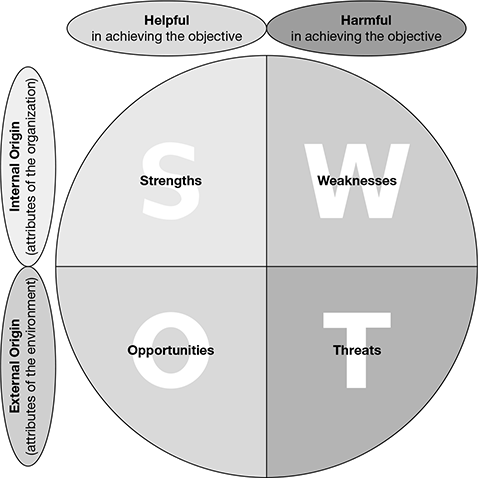
Figure 4.6 The D-SWOT Model
Source: Adapted from Wikipedia
The key elements of the D-SWOT model include:
- Strengths: Key characteristics or attributes which give a firm and its digital offerings an advantage over competition. Depending upon the product, industry, and earlier inroads into the digital space, strengths would vary not only across product lines but also for each product individually, and should be studied accordingly. Given below are the most common examples of areas which would be termed as strengths for any firm looking to compete and grow on digital platforms.
- Strong and stable media presence: highly visited website, social media page, well-admired blog, a micro-blogging strategy, etc.
- Well-etched brands with high recall
- Strong customer satisfaction and feedback on social media
- Trust among partners and intermediaries, strategic tie-ups
- Intellectual capability to build unique products in line with changing trends
- Strong execution and leadership teams
- Consumer-centric design and communication
- Ability to influence policy and attention of internal and external investors
- High adoption of technology as an intrinsic differentiator
- History of profitable collaborations and online acquisitions
- Well set-up revenue models and regular identification of new growth models
- Increasing geographic presence and a wide affiliate network
- Weaknesses: Characteristics or attributes that place the business and its product portfolio at a disadvantage relative to others. Similar to strengths identification, as above, it is crucial to get as many data points to identify and term a characteristic as a weakness since a lot of future decisions of the company would depend on this analysis.
- Low or very negligible historical online presence
- Online Value Proposition not uniquely defined
- A product/brand portfolio which is not among the top three in their segments
- Low margins as compared to peers
- Lack of integration to mobile and other growing online platforms and channels
- Content, website structure, and communication which is not customer-centric
- Not looked at as a genuine and trusted partner by other online intermediaries
- Poor on-service delivery and execution strategy
- Low advocacy and public relations skills
- Resource planning and internal process organization not optimally managed
- Opportunities: These are the market-facing elements which companies can internally plan for and exploit once they understand key digital market trends and landscape changes which would impact their specific industry and products. The timing of opportunity assessment and its modelling is typically quite crucial so that the company can differentiate between fads (short term trends) and changes which are going to shape the industry in the long term. We have identified a few of them below.
- Consumer adoption of mobile communications and increased online penetration
- Increasing per capita income and improving economic indicators
- Adoption of new technologies which increase user experience
- Rise of multilingual technologies and content publishing in native languages
- Availability of expert technology workforce at affordable salaries
- Threats: These are again external environment-driven elements which can impact the functioning and growth of a firm. Companies need to anticipate key threats on a regular basis since without it, emerging disruptions in the market could cause firms and even specific brands to lose their allure and slip away from customer recall altogether. Key threats which should be taken care of (specifically relating to digital growth) include:
- Presence in a highly competitive segment with slow growth rate
- Declining average selling prices due to impact of innovation and technology
- Firm not attuned to changing industry and segment trends and losing initiative
- Inability to scale up in a sector through acquisitions and inorganic growth
- New laws or regulations in the market inhibiting growth
Apart from the general examples shared above, there would be specific Digital SWOT areas (depending upon the industry, sector, nature of competition, prior digital inroads, company’s financial strength, online growth propensity), which the company needs to think through for a complete assessment of its offerings and their suitability for a digital launch and growth. Marketers would be advised to thoroughly scan each element of their external interaction with a focus on internal strengths and weaknesses to assess feasible growth potential and develop the right target offerings mix specific to digital.
Leave a Reply