
According to the Content Marketing Institute’s Video & Visual Storytelling Survey, which was published November 10, 2021, 83 percent of marketers say video has become more important in the last two years.
Videos were always a powerful tool in the storytelling arsenal. But maybe it’s time to reexamine our content marketing matrix.
What is a content marketing matrix and do we need one now? Well, a content marketing matrix is a planning tool to help marketers generate ideas for the most engaging content types for their audiences.
A number of them have been created over the past decade, including one that I contributed to Guy Kawasaki’s book, Enchantment: The Art of Changing Hearts, Minds, and Actions (2012).
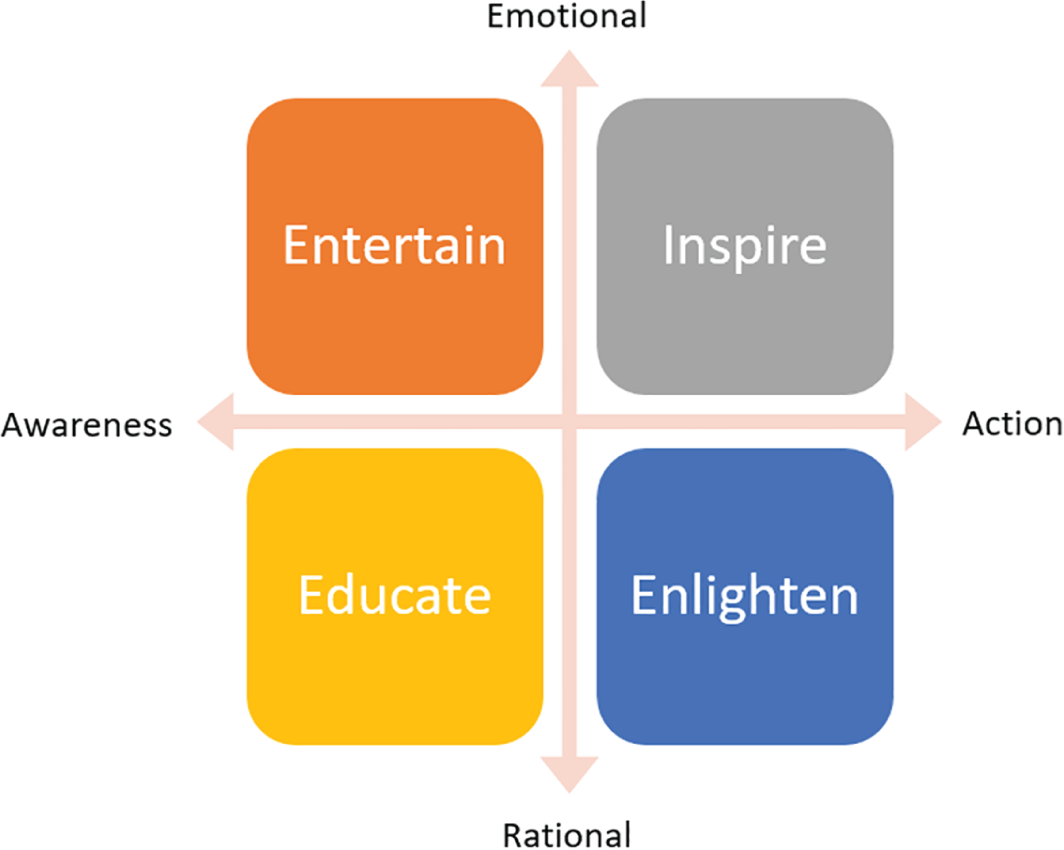
Figure 5.2 shows what it looks like.
As you can see, my content marketing matrix has two dimensions:
- Awareness through to action on the horizontal axis
- Rational through emotional on the vertical axis
Content marketers are supposed to use the four quadrants—entertain, inspire, educate, and convince—“as a starting point” to review how their content can support the goals of their B2B, B2C, or not‐for‐profit organizations.
Do We Need a Content Marketing Matrix in 2023? A decade later, I don’t have a problem with using a 2 × 2 matrix “as a starting point.”
But it reminds me of the scene in Star Trek II: The Wrath of Kahn (1982) when Captain Spock (Leonard Nimoy) analyzes the tactics of Khan Noonien Singh (Ricardo Montalbán) and observes, “He is intelligent, but not experienced. His pattern indicates two‐dimensional thinking.”
That’s why I believe experienced content marketers need a three‐dimensional matrix to compete successfully in a world where
- YouTube has more than 2 billion monthly logged‐in users,
- 500 hours of video are uploaded to YouTube every minute, and
- video content is playing a starring role in all four quadrants.
I don’t have a problem with putting “branded stories” (e.g., short films, series, documentaries, and inspirational videos) in the upper‐left quadrant of the matrix. I’ve seen some entertaining short films “go viral.”
I’ve also seen some inspiring, educational, and enlightening videos go viral too. In Chapter 1, we looked at how several major brands in the United Kingdom use nostalgic Christmas ads to build brand awareness and connect with customers on a deeper level.
(Note: This column is republished in Chapter 1.)
Viral Marketing: The Science of Sharing Maybe it’s time to share the secret of how to create branded video content that is more likely to go viral.
Actually, it isn’t a secret. It is the subject of Karen Nelson‐Field’s book, Viral Marketing: The Science of Sharing, which was published in October 2013.
Back then, Dr. Nelson‐Field was a senior research associate at the University of South Australia’s Ehrenberg‐Bass Institute for Marketing Science.
Today, she’s the founder and chief executive officer at Amplified Intelligence.
Her book used original research from more than 2 years of work, five different data sets, around 1,000 videos, nine individual studies, and a large team of researchers from Ehrenberg‐Bass Institute for Marketing Science.
Her research found that “an emotional response is important in driving further cognitive or behavioral responses. Reactions to advertising—or anything for that matter—are rarely purely rational.”
The data she shared show the most engaging content types for your audiences are branded videos that can elicit intense, positive, emotional responses, using the following:
- Exhilaration
- Inspiration
- Astonishment
- Hilarity
Dr. Nelson‐Field’s book also reveals the following:
- On average, videos that elicit intense emotions are shared twice as much as those that evoke moderate emotions, yet more than 70 percent of all branded videos evoke moderate emotions.
- Branded videos that evoke feelings of exhilaration are shared more than any other intense positive emotion.
- While professional video creators may be aiming to create hilarious branded content, most are falling well short of the amateurs.
The most engaging holiday ads of 2021 indicate that Dr. Nelson‐Field’s findings are still valid today.
Unruly Reveals Top Emotionally Engaging Holiday Ads of 2021 Each year, Unruly tests holiday ads and measures the intensity of emotions, brand favorability, authenticity, and purchase intent that viewers felt while watching an ad, which all contribute to an overall “EQ Score.”
Unruly is a global video and Connected TV (CTV) advertising platform. Content marketers can learn some important lessons from them about how to generate ideas for the most engaging content types for their audiences.
(It’s worth noting that Dr. Nelson‐Field worked with Unruly a decade ago to develop an earlier version of their methodology.)
In 2021, Unruly analyzed the emotional responses of approximately 9,700 consumers around the world to more than 50 holiday ads.
Carol Gillard, the vice president of marketing and communications at Unruly, observed several interesting trends:
- “As December 2020 approached, brands went out of their way to relate to the uncertainty of holidays amidst a global pandemic. Messages last year reflected the change in storied traditions and adaptability of consumers as they still attempted to bring cheer into their holiday season.
- “By comparison, many in the 2021 crop of holiday ads do not reference or allude to Covid‐19, and instead seek to create nostalgia for Christmases past, and excite consumers about gathering and celebrating with their nearest and dearest.”
- “Top‐performing ads have high EQ scores (above 6 or 7) and demonstrate a combination of intense emotional response, brand favorability, and purchase intent by viewers.”
Let’s start with Wegmans Holiday Commercial 2021, which was ranked number 1 in the United States (Figure 5.3).
The video’s description says, “The holidays are about sharing, caring, and enjoying great food. Watch as a little boy shows us that you don’t have to be all grown up to be a big helper. Let’s get back to happy, together.”
The ad from Wegmans Food Markets scored 61 percent in Emotional Intensity, 53 percent in Brand Favorability, and 38 percent in Happiness, to get an overall EQ Score of 7.3.
Leave a Reply