
Search engine optimization (SEO) is the practice of optimizing the code and content of a website to be more accessible to search engines and more relevant to searchers. By creating and developing content that is more relevant to searchers, search engines rank a website higher in the search results. This increases a web page’s visibility and potential for gaining visitors from the search engine results page (SERP). In less eloquent terms, you optimize websites to get higher rankings. Why? To increase visits, which will increase business.
One look at the SERP and you’ll realize that this is no easy task. There is a lot of competition. And to make matters even more interesting, the results change based on what you are searching for and where you are.
In this example search for a mechanical keyboard shown in Figure 4.1, it provides several different results. First, there are Shopping Ads. These are developed from ecommerce feeds directly into Google for product display.
Next is search engine advertising results. Advertisers create text‐based ads that appear based on the search terms entered by the searcher. This is notated by the small “Ad” next to the URL of the result. As you can see, most of the prime space on the results page is advertising.
Next are Top Stories, which come from Google News and highlight recent news stories that are relevant to the search.
Finally, we get to the “organic” results. They are called organic because they are produced by the search engine algorithm without any financial consideration. The algorithm bases the rankings on credibility, authority, relevance, and many other factors. (I’m not sure why people call what is produced by a computer “organic,” but it was an early term that stuck.)
Search engine optimization is concerned with influencing the organic results. They are not influenced by paid or human intervention. They are produced by the relevancy calculations of an algorithm, which you can influence but not control.

The Value of SEO
Regardless of the organization, being found for information that is relevant to you increases your credibility, visibility, and visits.
For any business, being found in the results can mean an instant boost in website visits or walk‐in traffic, both of which contribute to increased sales or leads. As the world uses search to find information, being found in those searches contributes greatly to a business’s profitability.
Being found in the search results is one of the most reliable channels for gaining new customers. SEO is also one of the highest ROI activities that a business can develop because once rankings are attained, they continue to bring in visitors for many years afterward, even years after a long‐term SEO campaign is ended.
For many, search engine visitors are the most active and the most qualified visits to the business because they were searching to solve a problem or find information, and when they find the solution, they convert. Conversion is the action that fulfills a goal of the website, such as a purchase on an ecommerce website, a registration, subscription, or a completed lead form for a B2B business. When someone searches, they are taking an active step to solve a problem or find information, and they are more likely to complete the task when they find the best result.
Search is an in‐the‐moment answer to a need or task. People are actively searching, which makes them more qualified, more motivated, and more loyal to the solutions they find. Time and time again, search visitors tend to be the most profitable, most loyal, and produce the highest customer lifetime value compared to other channels. This is from the power of intent, timing, and relevance provided by search engines.
For any business model that relies on being found by searchers with questions or informational needs, search is critical to their operations. Publishers, nonprofits, and content producers all rely on being found for their work and information, making search engines an indispensable part of the world’s economy.
How Search Engines Work
To understand how to do search engine optimization, you must first know how search engines work. For starters, when you search, you are not searching the real‐time results of live websites. What you actually search is the database, or index, of the search engine.
To apply their ranking algorithm to billions of web pages, they must first download these pages to their servers. This retrieval process is carried out through a spider, also called a bot, or crawler. This software program “crawls” the links from page to page. It searches for and follows links and downloads the content of pages.
The search engine creates a map of the linking between pages and websites and the content that is contained on each page. This is where websites are assessed for credibility and authority. It is also where Google changed the game. Prior to Google, search engines ranked websites mainly based on the on‐page content and how well the keywords in the content matched the keyword in the search phrase.
Of course, this led to abuse, mainly through the practice of “keyword stuffing,” which attempted to place as many keywords on the page as possible to appear more relevant. This also led to a theory called “keyword density,” where the keyword should be a certain percentage of the words on a page. The SEO tactics of the 1990s were a wild and word‐of‐mouth game of reverse engineering the search engine algorithms and competing with other webmasters for the same keywords.
PageRank: Google’s Game Changer
Google started as a small search engine that quickly gained attention among SEOs and the tech industry. The results were fast and distinctly relevant compared to other search engines. The difference was that Google did not just evaluate on‐page keywords but also relied on its first algorithm, called PageRank. Developed by founders Larry Page and Sergey Brin, PageRank evaluated the links between websites. Not just the link between your site and another site, but also the links to that site and beyond. PageRank changed relevancy by examining the relationships between websites. While it has since been deprecated, it served as the basis for ongoing development and evaluating influence factors.
What PageRank and future algorithms added was a mathematical method of assessing credibility and authority as humans do. When people make decisions, they not only rely on information, but on the credibility of that information. For example, I trust information from friends and family as they hold high influence on my decisions. However, for a medical issue they may have influence, but not expertise and credibility. In that case, I would seek a doctor who has expertise in a specialty, thereby gaining a more credible source.
SEO Is Not an Exact Science
When you search, remember that you are searching pages and information contained in the database, or the index of the search engine. This is important because it sets the stage for many of the technical and optimization tasks in SEO. Your efforts in SEO will influence the results, and the more factors that you optimize, the more influence your website may gain in the form of rankings.
However, this is not an exact science. I like to say that SEO is a combination of art, science, and weather forecasting. You can create the ideal conditions for good rankings and a great user experience, but that work never guarantees results.
SEO’s Three Primary Areas
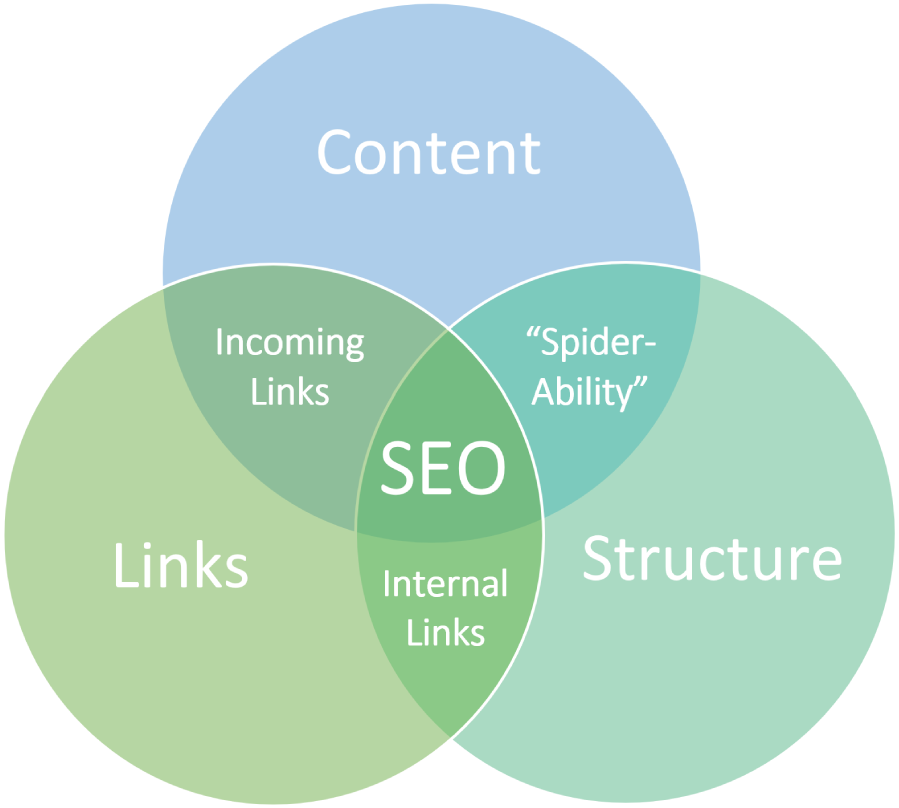
Content Content is the information that people see on the page. This is where on‐page SEO tactics, such as keyword optimization, HTML mark‐up, and content structure, take place. The content that you publish on your website will also drive the incoming links from other websites, as people link to content that they like, trust, and recommend.
Links Links are the primary navigational device. External links from other websites make your site more visible and provide credibility. Incoming links from other websites are one of the most important factors for increasing your rankings. Internal links are helpful for website visitors because they direct people to the information they need. Your navigation is the backbone of your website’s information, enabling people and search engines to navigate the pages of content.
Structure The structure, or architecture, of the website focuses on how the website is built, such as the organization of the content, the hierarchy of the content structure, the programming code, and server settings that make the website fast, accessible, and “spiderable” by search engines. Spiderable or spiderability is the how accessible and crawlable your website is for the search engine spiders.
These three areas, working in concert with each other, create the ideal conditions for search engines to find, assess, and rank your website. Optimizing a website involves each of these three areas. However, many times the tactics that you need to work on aren’t clear. Experience is a wise teacher in SEO, as you develop a combination of an artist’s eye, a scientists’ framework, and a weatherperson’s ability to predict the weather (and still get it wrong).
Leave a Reply