
In constructing and occupying buildings, we expend vast quantities of the earth’s resources and generate a significant portion of the earth’s environmental pollution: The U.S. Green Building Council reported in 2008 that buildings account for 30 to 40 percent of the world’s energy use and associated greenhouse gas emissions. Construction and operation of buildings in the United States accounted for more than one-third of this country’s total energy use and the consumption of more than two-thirds of its electricity, 30 percent of its raw materials, a quarter of its harvested wood, and 12 percent of its fresh water. Building construction and operation is responsible for nearly half of this country’s total greenhouse gas emissions and close to a third of its solid waste stream. Buildings are also significant emitters of particulates and other air pollutants. In short, building construction and operation cause many forms of environmental degradation that place an increasing burden on the earth’s resources and jeopardize the future of the building industry and societal health and welfare.
Sustainability may be defined as meeting the needs of the present generation without compromising the ability of future generations to meet their needs. By consuming irreplaceable fossil fuels and other nonrenewable resources, by building in sprawling urban patterns that cover extensive areas of prime agricultural land, by using destructive forestry practices that degrade natural ecosystems, by allowing topsoil to be eroded by wind and water, and by generating substances that pollute water, soil, and air, we have been building in a manner that will make it increasingly difficult for our children and grandchildren to meet their needs for communities, buildings, and healthy lives.
On the other hand, if we reduce building energy usage and utilize sunlight and wind as energy sources for our buildings, we reduce depletion of fossil fuels. If we reuse existing buildings imaginatively and arrange our new buildings in compact patterns on land of marginal value, we minimize the waste of valuable, productive land. If we harvest wood from forests that are managed in such a way that they can supply wood at a sustained level for the foreseeable future, we maintain wood construction as a viable option for centuries to come and protect the ecosystems that these forests support. If we protect soil and water through sound design and construction practices, we retain these resources for our successors. If we systematically reduce the various forms of pollution emitted in the processes of constructing and operating buildings, we keep the future environment cleaner. And as the industry becomes more experienced and committed to designing and building sustainably, it becomes increasingly possible to do these things with little or no increase in construction cost while creating buildings that are less expensive to operate and more healthful for their occupants for decades to come.
Realization of these goals is dependent on our awareness of the environmental problems created by building activities, knowledge of how to overcome these problems, and skill in designing and constructing buildings that harness this knowledge. While the practice of sustainable design and construction, also called green building, remains a relatively recent development in the design and construction industry, its acceptance and support continue to broaden among public agencies, private developers, building operators and users, architectural and engineering firms, contractors, and materials producers. With each passing year, green building techniques are becoming less a design specialty and more a part of mainstream practice.
The Building Life Cycle
Sustainability must be addressed on a life-cycle basis, from the origins of the materials for a building, through the manufacture and installation of these materials and their useful lifetime in the building, to their eventual disposal when the building’s life is ended. Each step in this so-called cradle-to-grave cycle raises questions of sustainability.
Origin and Manufacture of Materials for a Building
Are the raw materials for a building plentiful or rare? Are they renewable or nonrenewable? How much of the content of a material is recycled from other uses? How much embodied energy is expended in obtaining and manufacturing the material, and how much water? What pollutants are discharged into air, water, and soil as a result of these acts? What wastes are created? Can these wastes be converted to useful products?
Construction of the Building
How much energy is expended in transporting a material from its origins to the building site, and what pollutants are generated? How much energy and water are consumed on the building site to put the material in place? What pollutants are associated with the installation of this material in the building? What wastes are generated, and how much of them can be recycled?
Use and Maintenance of the Building
How much energy and water does the building use over its lifetime as a consequence of the materials used in its construction and finishes? What problems of indoor air quality are caused by these materials? How much maintenance do these materials require, and how long will they last? Can they be recycled? How much energy and time are consumed in maintaining these materials? Does this maintenance involve use of toxic chemicals?
Demolition of the Building
What planning and design strategies can be used to extend the useful life of buildings, thereby forestalling resource-intensive demolition and construction of new buildings? When demolition is inevitable, how will the building be demolished and disposed of, and will any part of this process cause pollution of air, water, or soil? Can demolished materials be recycled into new construction or diverted for other uses rather than disposed of as wastes?
One model for sustainable design is nature itself. Nature works in cyclical processes that are self-sustaining and waste nothing. More and more building professionals are learning to create buildings that work more nearly as nature does, helping to leave to our descendants a stock of healthful buildings, a sustainable supply of natural resources, and a clean environment that will enable them to live comfortably and responsibly and to pass these riches on to their descendants in a never-ending succession.
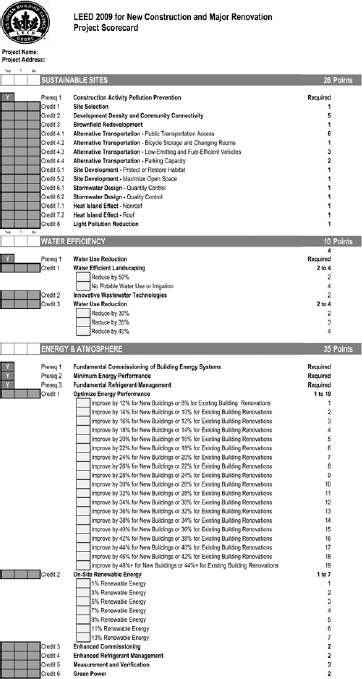
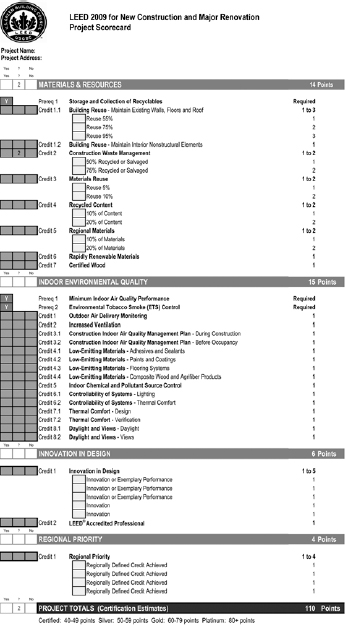
FIGURE 1.1 The LEED-NC 2009 Project Scorecard. (Courtesy of U.S. Green Building Council)
Assessing Green Buildings
In the United States, the most widely adopted method for rating the environmental sustainability of a building’s design and construction is the U.S. Green Building Council’s Leadership in Energy and Environmental Design, or LEED, rating system. LEED for New Construction and Major Renovation projects, termed LEED-NC, groups sustainability goals into categories including site selection and development, efficiency in water use, reductions in energy consumption and in the production of atmospheric ozone-depleting gases, minimizing construction waste and the depletion of nonrenewable resources, improving the quality of the indoor environment, and encouraging innovation in sustainable design and construction practices (Figure 1.1). Within each category are specific credits that contribute points toward a building’s overall assessment of sustainability. Depending on the total number of points accumulated, four levels of sustainable design are recognized, including, in order of increasing performance, Certified, Silver, Gold, and Platinum.
The process of achieving LEED certification for a proposed new building begins at the earliest stages of project conception, continues throughout the design and construction of the project, and involves the combined efforts of the owner, designer, and builder. During this process, the successful achievement of individual credits is documented and submitted to the Green Building Council, which then makes the final certification of the project’s LEED compliance.
The U.S. Green Building Council continues to refine and improve upon LEED-NC and is expanding its family of rating systems to include existing buildings (LEED-EB), commercial interiors (LEED-CI), building core and shell construction (LEED-CS), homes (LEED-H), and other categories of construction and development. Through international sister organizations, LEED is being implemented in Canada and other countries. Other green building programs, such as the Green Building Initiative’s Green Globes, the National Association of Home Builders’ Green Home Building Guidelines, and the International Code Council and National Association of Home Builders’ jointly developed National Green Building Standard, offer alternative assessment schemes.
Some green building efforts focus more narrowly on reducing building energy consumption, a measure of building performance that frequently correlates closely with the generation of greenhouse gas emissions and global warming trends. The American Society of Heating, Refrigerating and Air-Conditioning Engineers’ Advanced Energy Design Guides and the U.S. Environmental Protection Agency’s Energy Star program both set goals for reductions in energy consumption in new buildings that exceed current national standards. These standards can be applied either as stand-alone programs or as part of a more comprehensive effort to achieve certification through LEED or some other green building assessment program.
Buildings can also be designed with the goal of zero energy use or carbon neutrality. A net zero energy building is one that consumes no more energy than it produces, usually when measured on an annual basis to account for seasonal differences in building energy consumption and on-site energy production. Net zero energy use can be achieved using current technology combining on-site renewable energy generation (such as wind or solar power), passive heating and cooling strategies, a thermally efficient building enclosure, and highly efficient mechanical systems and appliances.
A carbon-neutral building is one that causes no net increase in the emission of carbon dioxide, the most prevalent atmospheric greenhouse gas. If emissions due only to building operation are considered, the calculation is similar to that for a net zero energy building. If, however, the embodied carbon in the building’s full life cycle—from materials extraction and manufacturing, through building construction and operations, to demolition, disposal, and recycling—is considered, the calculation becomes more complex. Carbon-neutral calculations may also consider the site on which the building resides. For example, what is the carbon footprint of a fully developed building site, including both its buildings and unbuilt areas, in comparison to that of the site prior to construction or in comparison to its natural state prior to human development of any kind? Another possible consideration is, what role, if any, should carbon offsetting (funding of offsite activities that reduce global carbon emissions, such as planting of trees), play in such calculations? Questions such as these and the concepts of sustainability and how they relate to building construction will continue to evolve for the foreseeable future.
Considerations of sustainability are included throughout this book. In addition, a sidebar in nearly every chapter describes the major issues of sustainability related to the materials and methods discussed in that chapter. These will be helpful in weighing the environmental costs of one material against those of another, and in learning how to build in such a way that we preserve for future generations the ability to meet their building needs in a reasonable and economical manner. For more information on organizations whose mission is to raise our awareness and provide the knowledge that we need to build sustainably, see the references listed at the end of this chapter.
Leave a Reply