
A building begins as an idea in someone’s mind, a desire for new and ample accommodations for a family, many families, an organization, or an enterprise. For any but the smallest buildings, the next step for the owner of the prospective building is to engage, either directly or through a hired construction manager, the services of building design professionals. An architect helps to organize the owner’s ideas about the new building, develops the form of the building, and assembles a group of engineering specialists to help work out concepts and details of foundations, structural support, and mechanical, electrical, and communications services.
. . . the architect should have construction at least as much at his fingers’ ends as a thinker his grammar.
Le Corbusier, Towards a New Architecture, 1927
This team of designers, working with the owner, then develops the scheme for the building in progressively finer degrees of detail. Drawings and written specifications are produced by the architect–engineer team to document how the building is to be made and of what. The drawings and specifications are submitted to the local government building authorities, where they are checked for conformance with zoning ordinances and building codes before a permit is issued to build. A general contractor is selected, either by negotiation or by competitive bidding, who then hires subcontractors to carry out many specialized portions of the work. Once construction begins, the general contractor oversees the construction process while the building inspector, architect, and engineering consultants observe the work at frequent intervals to be sure that it is carried out according to plan. Finally, construction is finished, the building is made ready for occupancy, and that original idea, often initiated years earlier, is realized.
Although a building begins as an abstraction, it is built in a world of material realities. The designers of a building—the architects and engineers—work constantly from a knowledge of what is possible and what is not. They are able, on the one hand, to employ a seemingly limitless palette of building materials and any of a number of structural systems to produce a building of almost any desired form and texture. On the other hand, they are inescapably bound by certain physical limitations: how much land there is with which to work; how heavy a building the soil can support; how long a structural span is feasible; what sorts of materials will perform well in the given environment. They are also constrained by a construction budget and by a complex web of legal restrictions.
Those who work in the building professions need a broad understanding of many things, including people and culture, the environment, the physical principles by which buildings work, the technologies available for utilization in buildings, the legal restrictions on building design and use, the economics of building, and the contractual and practical arrangements under which buildings are constructed. This book is concerned primarily with the technologies of construction—what the materials are, how they are produced, what their properties are, and how they are crafted into buildings. These must be studied, however, with reference to many other factors that bear on the design of buildings, some of which require explanation here.
Zoning Ordinances
The legal restrictions on buildings begin with local zoning ordinances, which govern the types of activities that may take place on a given piece of land, how much of the land may be covered by buildings, how far buildings must be set back from adjacent property lines, how many parking spaces must be provided, how large a total floor area may be constructed, and how tall the buildings may be. In larger cities, zoning ordinances may include fire zones with special fire-protection requirements, neighborhood enterprise districts with economic incentives for new construction or revitalization of existing buildings, or other special conditions.
Building Codes
In addition to its zoning ordinances, local governments regulate building activity by means of building codes. Building codes protect public health and safety by setting minimum standards for construction quality, structural integrity, durability, livability, accessibility, and especially fire safety.
Most building codes in North America are based on one of several model building codes, standardized codes that local jurisdictions may adopt for their own use as an alternative to writing their own. In Canada, the National Building Code of Canada is published by the Canadian Commission on Building and Fire Codes. It is the basis for most of that country’s provincial and municipal building codes. In the United States, the International Building Code® is the predominant model code. This code is published by the International Code Council, a private, nonprofit organization whose membership consists of local code officials from throughout the country. It is the basis for most U.S. building codes enacted at the state, county, and municipal levels. The International Building Code (IBC) is the first unified model building code in U.S. history. First published in March 2000, it was a welcome consolidation of a number of previous competing regional model codes.
Building-code-related information in this book is based on the IBC. The IBC begins by defining occupancy groups for buildings as follows:
• Groups A-1 through A-5 are public Assembly occupancies: theaters, auditoriums, lecture halls, nightclubs, restaurants, houses of worship, libraries, museums, sports arenas, and so on.
• Group B is Business occupancies: banks, administrative offices, higher-education facilities, post offices, banks, professional offices, and the like.
• Group E is Educational occupancies: schools for grades K through 12 and day-care facilities.
• Groups F-1 and F-2 comprise industrial processes using moderate-flammability or noncombustible materials, respectively.
• Groups H-1 through H-5 include various types of High Hazard occupancies in which toxic, corrosive, highly flammable, or explosive materials are present.
• Groups I-1 through I-4 are Institutional occupancies in which occupants under the care of others may not be able to save themselves during a fire or other building emergency, such as health care facilities, custodial care facilities, and prisons.
• Group M is Mercantile occupancies: stores, markets, service stations, and salesrooms.
• Groups R-1 through R-4 are Residential occupancies, including apartment buildings, dormitories, fraternity and sorority houses, hotels, one- and two-family dwellings, and assisted-living facilities.
• Groups S-1 and S-2 include buildings for Storage of moderate- and low-hazard materials, respectively.
• Group U is Utility buildings. It comprises agricultural buildings, carports, greenhouses, sheds, stables, fences, tanks, towers, and other secondary buildings.
The IBC’s purpose in establishing occupancy groups is to distinguish various degrees of need for safety in buildings. A hospital, in which many patients are bedridden and cannot escape a fire without assistance from others, must be built to a higher standard of safety than a hotel or motel. A warehouse storing noncombustible masonry materials, which is likely to be occupied by only a few people, all of them able-bodied, can be constructed to a lower standard than a large retail mall building, which will house large quantities of combustible materials and will be occupied by many users varying in age and physical capability. An elementary school requires more protection for its occupants than a university building. A theater needs special egress provisions to allow its many patrons to escape quickly, without stampeding, in an emergency.
These definitions of occupancy groups are followed by a set of definitions of construction types. At the head of this list is Type I construction, made with highly fire-resistant, noncombustible materials. At the foot of it is Type V construction, which is built from combustible wood framing—the least fire-resistant of all construction types. In between are Types II, III, and IV, with levels of resistance to fire falling between these two extremes.
With occupancy groups and construction types defined, the IBC proceeds to match the two, stating which occupancy groups may be housed in which types of construction, and under what limitations of building height and area. Figure 1.2 is reproduced from the IBC. This table gives values for the maximum building height, in both feet and number of stories above grade, and the maximum area per floor for every possible combination of occupancy group and construction type. Once these base values are adjusted according to other provisions of the code, the maximum permitted size for a building of any particular use and type of construction can be determined.
This table concentrates a great deal of important information into a very small space. A designer may refer to it with a particular building type in mind and find out what types of construction will be permitted and what shape the building may take. Consider, for example, an office building. Under the IBC, a building of this type belongs to Occupancy Group B, Business. Reading across the table from left to right, we find immediately that this building may be built to any desired size, without limit, using Type I-A construction.
Type I-A construction is defined in the IBC as consisting of only noncombustible materials—masonry, concrete, or steel, for example, but not wood—and meeting minimum requirements for resistance to the heat of fire. Looking at the upper table in Figure 1.3, also reproduced from the IBC, we find under Type I-A construction a listing of the required fire resistance ratings, measured in hours, for various parts of our proposed office building. For example, the first line states that the structural frame, including such elements as columns, beams, and trusses, must be rated at 3 hours. The second line also mandates a 3-hour resistance for bearing walls, which serve to carry floors or roofs above. Nonbearing walls or partitions, which carry no load from above, are listed in the third line, referring to Table 602, which gives fire resistance rating requirements for exterior walls of a building based on their proximity to adjacent buildings. (Table 602 is included in the lower portion of Figure 1.3.) Requirements for floor and roof construction are defined in the last two lines of Table 601.
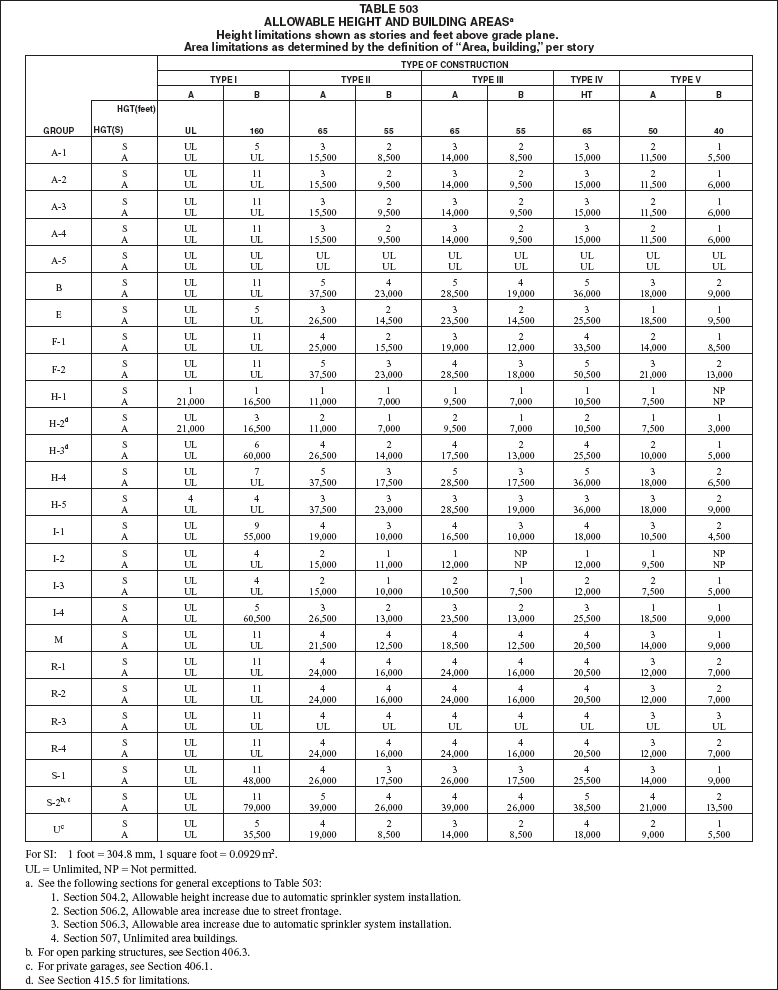
FIGURE 1.2 Height and area limitations of buildings of various types of construction, as defined in the 2006 IBC. (Portions of this piublication reproduce tables from the 2006 International Building Code, International Code Council, Inc., Washington, D.C. Reproduced with Permission. All rights reserved.)
FIGURE 1.3 Fire resistance of building elements as required by the 2006 IBC. (Portions of this publication reproduce tables from the 2006 International Building Code, International Code Council, Inc., Washington, D.C. Reproduced with Permission. All rights reserved.)
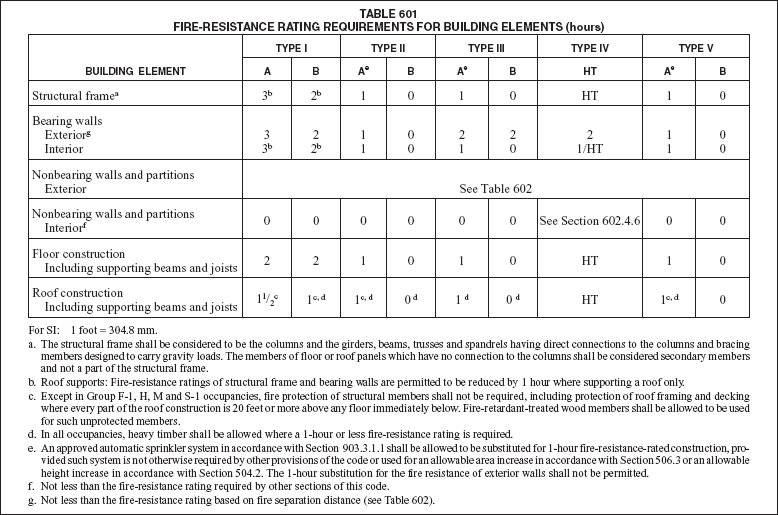
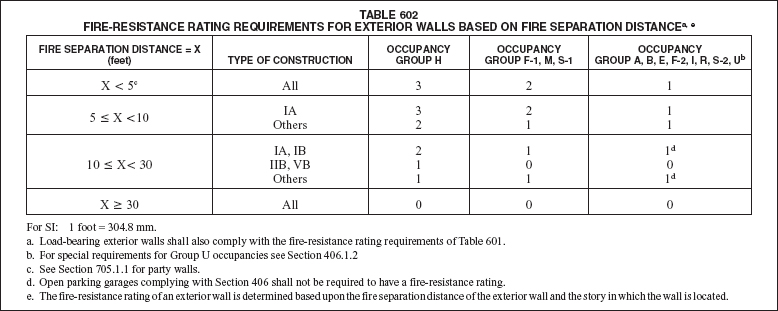
Looking across Table 601 in Figure 1.3, we can see that fire resistance rating requirements are highest for Type I-A construction, decrease to 1 hour for various intermediate types, and fall to zero for Type V-B construction. In general, the lower the construction type numeral, the more fire-resistant the construction system is. (Type IV construction is somewhat of an anomaly, referring to Heavy Timber construction consisting of large wooden members that are relatively slow to catch fire and burn.)
Once fire resistance rating requirements for the major parts of a building have been determined the design of these parts can proceed, using building assemblies meeting these requirements. Tabulated fire resistance ratings for common building materials and assemblies may come from a variety of sources, including the IBC itself, as well as a from catalogs and handbooks issued by building material manufacturers, construction trade associations, and organizations concerned with fire protection of buildings. In each case, the ratings are derived from full-scale laboratory tests of building components carried out in accordance with an accepted standard fire test protocol to ensure uniformity of results. (This test, ASTM E119, is described more fully in Chapter 22 of this book.) Figures 1.4 to 1.6 show sections of tables from catalogs and handbooks to illustrate how such fire resistance ratings are commonly presented.
In general, when determining the level of fire resistance required for a building, the greater the degree of fire resistance, the higher the cost. Most frequently, therefore, buildings are designed with the lowest level of fire resistance permitted by the building code. Our hypothetical office building could be built using Type IA construction, but does it really need to be constructed to this high standard?
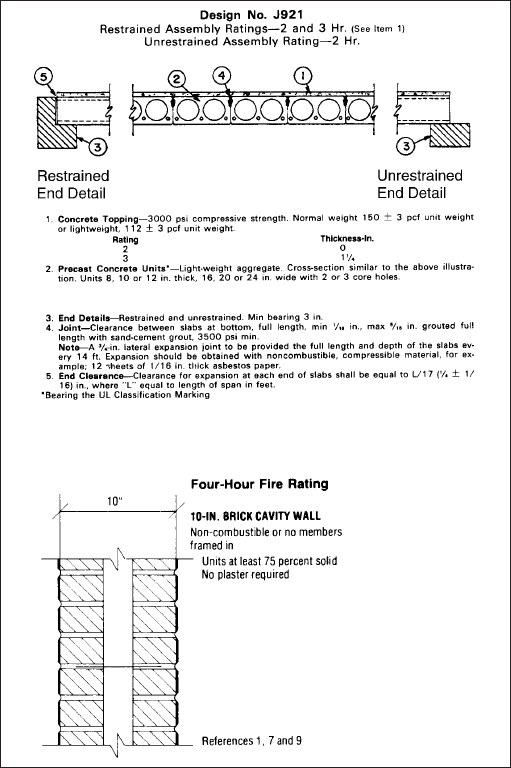
FIGURE 1.4 Examples of fire resistance ratings for concrete and masonry structural elements. The upper detail, taken from the Underwriters Laboratories Fire Resistance Directory, is for a precast concrete hollow-core plank floor with a poured concrete topping. Restrained and unrestrained refer to whether or not the floor is prevented from expanding longitudinally when exposed to the heat of a fire. The lower detail is from literature published by the Brick Institute of America. (Reprinted with permission of Underwriters Laboratories Inc. and the Brick Institute of America, respectively.)
FIGURE 1.5 Fire resistance ratings for a steel floor structure and column, respectively, taken from the Underwriters Laboratories Fire Resistance Directory. (Reprinted with permission of Underwriters Laboratories Inc.)
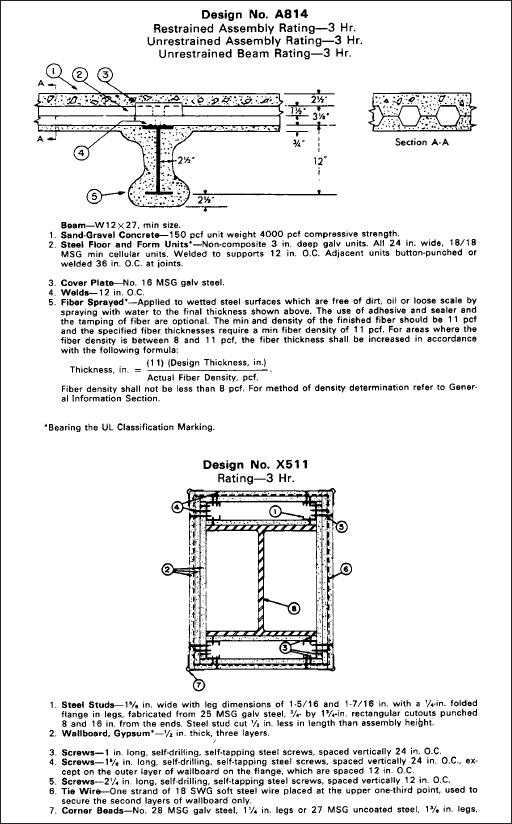
FIGURE 1.6 A sample of fire resistance ratings published by the Gypsum Association, in this case for an interior partition. (Courtesy of the Gypsum Association)

Let us suppose that the owner desires a five-story building with 30,000 square feet per floor. Reading across the table in Figure 1.2, we can see that in addition to Type I-A construction, the building can be of Type I-B construction, which permits a building of eleven stories and unlimited floor area, or of Type II-A construction, which permits a building of five stories and 37,500 square feet per floor. But it cannot be of Type II-B construction, which allows a building of only four stories and 23,000 square feet per floor. It can also be built of Type IV construction but not of Type III or Type V.
Other factors also come into play in these determinations. If a building is protected throughout by an approved, fully automatic sprinkler system for suppression of fire, the IBC provides that the tabulated area per floor may be quadrupled for a singlestory building or as much as tripled for a multistory building (depending on additional considerations omitted here for the sake of simplicity). A one-story increase in allowable height is also granted under most circumstances if such a sprinkler system is installed. If the five-story, 30,000-square-foot office building that we have been considering is provided with such a sprinkler system, a bit of arithmetic will show that it can be built of any construction type shown in Figure 1.2 except Type V.
If more than a quarter of the building’s perimeter walls face public ways or open spaces accessible to firefighting equipment, an additional increase of up to 75 percent in allowable area is granted in accordance with another formula. Furthermore, if a building is divided by fire walls having the fire resistance ratings specified in another table (Figure 1.7), each divided portion may be considered a separate building for purposes of computing its allowable area, which effectively permits the creation of a building many times larger than Figure 1.2 would, at first glance, indicate.
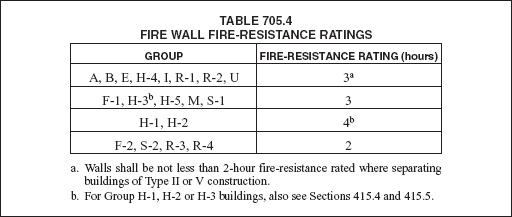
FIGURE 1.7 Fire resistance requirements for fire walls, according to the 2006 IBC. (Portions of this publication reproduce tables from the 2006 International Building Code, International Code Council, Inc., Washington, D.C. Reproduced with Permission. All rights reserved.)
The IBC also establishes standards for natural light, ventilation, means of emergency egress, structural design, construction of floors, walls, and ceilings, chimney construction, fire protection systems, accessibility for disabled persons, and many other important factors. The International Code Council also publishes the International Residential Code (IRC), a simplified model code specifically addressing the construction of detached one- and two-family homes and townhouses of limited size. Within any particular building agency, buildings of these types may fall under the requirements of either the IBC or the IRC, depending on the code adoption policies of that jurisdiction.
The building code is not the only code with which a new building must comply. Health codes regulate aspects of design and operation related to sanitation in public facilities such as swimming pools, food-service operations, schools, or health care facilities. Energy codes establish standards of energy efficiency for buildings affecting a designer’s choices of windows, heating and cooling systems, and many aspects of the construction of a building’s enclosing walls and roofs. Fire codes regulate the operation and maintenance of buildings to ensure that egress pathways, fire protection systems, emergency power, and other life-safety systems are properly maintained. Electrical and mechanical codes regulate the design and installation of building electrical, plumbing, and heating and cooling systems. Some of these codes may be locally written. But like the building codes discussed above, most are based on national models. In fact, an important task in the early design of any major building is determining what agencies have jurisdiction over the project and what codes and regulations apply.
Other Constraints
Other types of legal restrictions must also be observed in the design and construction of buildings. The Americans with Disabilities Act (ADA) makes accessibility to public buildings a civil right of all Americans, and the Fair Housing Act does the same for much multifamily housing. These access standards regulate the design of entrances, stairs, doorways, elevators, toilet facilities, public areas, living spaces, and other parts of affected buildings to ensure that they are accessible and usable by physically handicapped members of the population.
The U.S. Occupational Safety and Health Administration (OSHA) controls the design of workplaces to minimize hazards to the health and safety of workers. OSHA sets safety standards under which a building must be constructed and also has an important effect on the design of industrial and commercial buildings.
An increasing number of states have limitations on the amount of volatile organic compounds (VOCs) that building products can release into the atmosphere. VOCs are organic chemical compounds that evaporate readily. They can act as irritants to building occupants, they contribute to air pollution, and some are greenhouse gases. Typical sources of VOCs are paints, stains, adhesives, and binders used in the manufacture of wood panel products.
States and localities have conservation laws that protect wetlands and other environmentally sensitive areas from encroachment by buildings. Fire insurance companies exert a major influence on construction standards through their testing and certification organizations (Underwriters Laboratories and Factory Mutual, for example) and through their rate structures for building insurance coverage, which offer strong financial incentives to building owners for more hazard-resistant construction. Building contractors and construction labor unions have standards, both formal and informal, that affect the ways in which buildings are built. Unions have work rules and safety rules that must be observed; contractors have particular types of equipment, certain kinds of skills, and customary ways of going about things. All of these vary significantly from one place to another.
Leave a Reply