
The tasks of the architect and the engineer would be impossible to carry out without the support of dozens of standards-setting agencies, trade associations, professional organizations, and other groups that produce and disseminate information on materials and methods of construction, some of the most important of which are discussed in the sections that follow.
Standards-Setting Agencies
ASTM International (formerly the American Society for Testing and Materials) is a private organization that establishes specifications for materials and methods of construction accepted as standards throughout the United States. Numerical references to ASTM standards—for example, ASTM C150 for portland cement, used in making concrete—are found throughout building codes and construction specifications, where they are used as a precise shorthand for describing the quality of materials or the requirements of their installation. Throughout this book, references to ASTM standards are provided for the major building materials presented. Should you wish to examine the contents of the standards themselves, they can be found in the ASTM references listed at the end of this chapter. In Canada, corresponding standards are set by the Canadian Standards Association (CSA).
The American National Standards Institute (ANSI) is another private organization that develops and certifies North American standards for a broad range of products, such as exterior windows, mechanical components of buildings, and even the accessibility requirements referenced within the IBC itself (ICC/ANSI A117.1). Government agencies, most notably the U.S. Department of Commerce’s National Institute of Science and Technology (NIST) and the National Research Council Canada’s Institute for Research in Construction (NRC-IRC), also sponsor research and establish standards for building products and systems.
Construction Trade and Professional Associations
Design professionals, building materials manufacturers, and construction trade groups have formed a large number of organizations that work to develop technical standards and disseminate information related to their respective fields of interest. The Construction Specifications Institute, whose MasterFormat™ standard is described in the following section, is one example. This organization is composed both of independent building professionals, such as architects and engineers, and of industry members. The Western Wood Products Association, to choose an example from among hundreds of trade associations, is made up of producers of lumber and wood products. It carries out research programs on wood products, establishes uniform standards of product quality, certifies mills and products that conform to its standards, and publishes authoritative technical literature concerning the use of lumber and related products. Associations with a similar range of activities exist for virtually every material and product used in building. All of them publish technical data relating to their fields of interest, and many of these publications are indispensable references for the architect or engineer. A considerable number of the standards published by these organizations are incorporated by reference into the building codes. Selected publications from professional and trade associations are identified in the references listed at the end of each chapter in this book. The reader is encouraged to obtain and explore these publications and others available from these various organizations.
MasterFormat
The Construction, Specifications Institute (CSI) of the United States and its Canadian counterpart, Construction Specifications Canada (CSC), have evolved over a period of many years a comprehensive outline called MasterFormat for organizing information about construction materials and systems. MasterFormat is used as the outline for construction specifications for the vast majority of large construction projects in these two countries, it is frequently used to organize construction cost data, and it forms the basis on which most trade associations’ and manufacturers’ technical literature is cataloged. In some cases, MasterFormat is used to cross-reference materials information on construction drawings as well.
MasterFormat is organized into 50 primary divisions intended to cover the broadest possible range of construction materials and buildings systems. The portions of MasterFormat relevant to the types of construction discussed in this book are as follows:
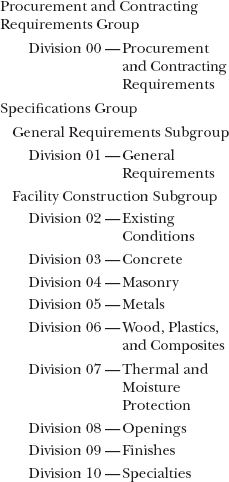
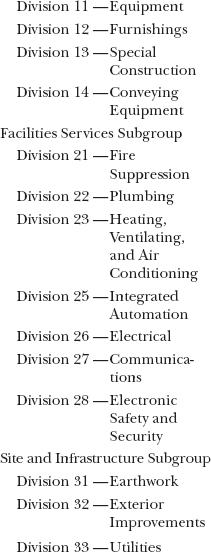
These broadly defined divisions are further subdivided into sections, each describing a discrete scope of work usually provided by a single construction trade or subcontractor. Individual sections are identified by sixdigit codes, in which the first two digits correspond to the division numbers above and the remaining four digits identify subcategories and individual units within the division. Within Division 05 – Metals, for example, some commonly referenced sections are:
Section 05 10 00 — Structural Steel Framing
Section 05 21 00 — Steel Joist Framing
Section 05 31 00 — Steel Decking
Section 05 40 00 — Cold-Formed Metal Framing
Section 05 50 00 — Metal Fabrications
Almost every chapter in this book gives MasterFormat designations for the information it presents to help the reader know where to look in construction specifications and other technical resources for further information. The full MasterFormat system is contained in the volume referenced at the end of this chapter.
MasterFormat organizes building systems information primarily according to work product, that is, the work of discrete building trades, making it especially well suited for use during the construction phase of building. Other organizational systems, such as Uniformat™ and OmmiClass™, offer a range of alternative organizational schemes suitable to other phases of the building life cycle and other aspects of building functionality. See the references at the end of this chapter for more information about these systems.
Leave a Reply