Modular Co-ordination
For prefab construction and for the precast elements, modular co-ordination has to be followed. In this case, some basic module has to be adopted for general application to buildings and their components. The value of the basic module chosen is 100 mm for maximum flexibility and convenience. The symbol used for the basic module is M.
Dimensions of Precast Elements
The preferred dimensions for different elements of a building considering the basic module are as follows:
1. Flooring and Roofing Scheme
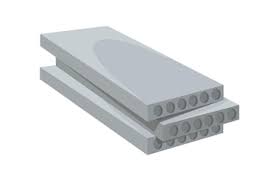
Precast slabs or other precast structural flooring units:
- Length – Normal length shall be in multiples of 3 M
- Width – Normal width shall be in multiples of 1 M and
- Overall thickness – Overall thickness shall be in multiples of M/4
2. Beams
- Length – Normal length shall be in multiple of 3 M
- Width – Normal width shall be in multiples of M/4 and
- Overall depth – Overall depth of the floor zone shall be in multiples of M/4
3. Columns
- Height – Overall depth (i.e., floor-to-floor or the clear height) shall be in multiples of 1 M for heights up to 2.8 M, and for heights above 2.8 M it shall be in multiples of 2 M
- Lateral dimension – Overall lateral dimension or diameter of columns shall be in multiples of M/4
4. Walls
- Thickness – Nominal thickness of walls shall be multiples of M/4
5. Staircase
Width – Nominal width shall be in multiples of 1 M
6. Lintels
- Length – Nominal length shall be in multiples of 1 M
- Width – Nominal width shall be in multiples of M/4 and
- Depth – Nominal depth shall be in multiples of M/4
7. Sunshades/Chajja Projections
- Length – Nominal length shall be in multiples of 1 M
- Projection – Nominal length shall be in multiples of 1 M
Normally acceptable methods of finishes for these components are:
- Moulded concrete surface to design.
- Laid-on finishing tiles fixed during casting.
- Finishes obtained by washing, tooling, grinding and grooming of hardened concrete.
- Exposed aggregates in-situ.
- Finishes added in-situ.
9.5 MANUFACTURE OF PRECAST CONCRETE ELEMENTS
Crucial factors that are to be considered for effective production and supply of precast concrete components are:
- Storage facilities
- Suitable transport facilities
- Erection equipment
- Availability of raw materials
Manufacture of precast concrete units can be done in a centrally located factory, or in a site where a precasting yard is set up at or near the site of work.
Factory Prefabrication
Factory prefabrication is adopted in a centrally located plant for the manufacture of standardized components on a long-term basis. The production unit has to work throughout the year preferably under a closed shed to avoid the effects of seasonal variations. The feasibility of the introduction of the latest manufacturing technique should be considered. Further, there should be some room for the possibility of introducing enhanced technology. To ensure continuous production, work has to be organized in a factory-like manner with support from a team of workmen.
The disadvantages of factory prefabrication are:
- Extra cost incurred while transportation.
- Limitation of the availability of transportation equipment for the size and shape of the prefabricated component and road contour.
- Employment of organized labour and their service benefits cause a huge establishment.
Site Prefabrication
In this case the components are manufactured at the site or as near to the site as possible. This type of manufacturing is employed for specific jobs that last for a short span of time. Locally available labour force is as for as possible used and the equipment and moulds are rented. Generally, the work is carried out in open space.
Although this has some economical benefits, there are a few disadvantages:
- There are no elaborate arrangements for quality control.
- Work may be disrupted due to weather conditions.
- High degree of mechanization can not be adopted.
Process of Manufacture
Processes of manufacture comprise a main process supplemented by an auxiliary process and a subsidiary process (Sharma, 1988).
1. Main Process
The activities involved in the main process are given below:
- Providing and assembling the mould.
- Placing a reinforcement cage in position on the reinforced concrete work and stressing the wires in the case of prestressed concrete elements.
- Fixing tubes and inserts wherever necessary.
- Placing the concrete in the moulds.
- Vibrating the concrete and finishing.
- Demoulding the forms, removing the units and stacking the products for curing.
- Curing is done. Preferably steam curing may be resorted to.
2. Auxiliary Process
The activities affecting the successful functioning of the main process are as follows:
- Mixing of proportionate ingredients and manufacture of fresh concrete which is done in a mixing station or by a batching plant.
- Prefabrication of reinforcement cage is done in a steel yard or workshop.
- Manufacturing of inserts and other finishing items needed for the precast units.
- Taking on the job of finishing the precast products.
- Arranging for the testing of these products.
3. Subsidiary Process
The activities that help to keep the main production unit functioning properly are as follows:
- Storage of all the ingredients for concrete and other materials.
- Arranging to transport cement, sand and aggregates.
- Transporting the green concrete and reinforcement cages to the moulding yard.
- Transporting the finished products to the stacking yard.
- Undertaking all repair works, maintenance of tools, machines, etc.
- Arranging to produce steam for curing.
4. Overall Management
For the successful running of the entire production unit, the following aspects should be properly exercised:
- To ensure speed and economy while manufacturing concrete, a cyclic technological method has to be employed.
- To improve quality and increase productivity, the mechanisation has to be improved.
- Optimum production has to be achieved with quality elements produced.
- To maintain speed to meet the supply.
- Working conditions should be improved for the people on the job.
- To minimize the interruption of production due to weather or other causes.
5. Methods of Manufacturing
There are two methods of manufacturing precast concrete units, viz., the Stand Method and the Flow Method.
In the Stand Method, the moulds are stationary and remain at one place, where the various processes involved are carried out in a cyclic order at the same place.
In the Flow Method, the precast units under consideration are in movement from one place to another in a cyclic order according to the various processes involved in the work.
Leave a Reply