
The alert reader will have noticed that most of the cladding systems shown in this chapter are detailed as barrier systems, not rainscreen systems (the notable exception being masonry veneer systems with drainage cavities and backup walls). This means that they are entirely dependent on good installation and careful maintenance if they are to remain watertight. If a sealant joint fails or a stone cracks in any of these systems, there is little to keep water from getting behind the cladding. There is also no well-organized system of secondary drainage in these systems: Although most have cavities behind their facings, the cavities are interrupted by framing and attachment components that are likely to splatter draining water onto the building frame and backup wall, where it can cause serious damage.
There have been many isolated efforts to design true rainscreen details for stone and concrete cladding systems, and a number of successful projects have been constructed. So far, however, no standard rainscreen details have emerged for these materials. This is an area to which trade associations and researchers should direct a great deal of effort, because reliably watertight details that are not heavily dependent on good workmanship and maintenance would save tens of millions of dollars each year in repair and reconstruction costs.
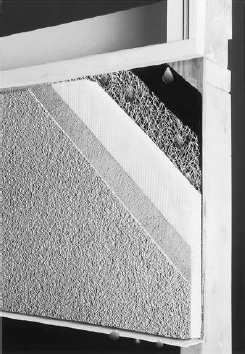
FIGURE 20.26 A mockup demonstrates the features of a proprietary EIFS system with internal drainage. From interior to exterior, the layers are an asphalt-saturated felt air and moisture barrier, a drainage mat composed of plastic fibers, plastic foam insulation, reinforcing mesh, a base coat, and a finish coat. A continuous plastic flashing under a gap at the bottom of the wall drains any leakage out to the face of the wall. (Photograph of Senergy CD System courtesy of Senergy, Cranston, Rhode Island)
Leave a Reply