
Aluminum framing and glass are used to construct enclosure systems of various types, including windows, entrances, storefronts, and curtain walls. Aluminum framed windows are discussed in Chapter 18. Entrances are systems of aluminum framed doors, hardware, aluminum framing, and glass typically used for commercial buildings. They may also include framing for vestibules, sidelights, transoms, and the like.
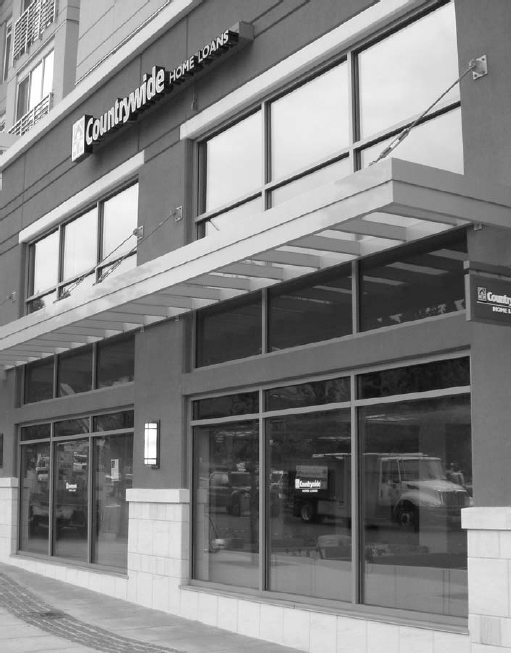
Aluminum storefronts, though often similar in appearance to curtain wall systems, are based on simplified, lighter framing elements that are less expensive and quicker to assemble. Most storefront systems span vertically no more than 10 to 12 feet (3.0–3.7 m), although some, with heavier framing members or internal reinforcing, can span farther. Rather than being hung off the face of the building, as is common with curtain wall systems, storefront framing is typically installed between floor slabs or within wall openings (Figure 21.9). Most importantly, the use of lighter framing elements and simplified internal construction makes storefront systems, in comparison to curtain wall systems, more limited in their ability to resist wind loads and water penetration. For these reasons, even improved storefront framing systems are not used more than three to four stories high on a building. Storefront framing is used not only for floor-to-ceiling glass enclosures but also sometimes as a substitute for conventional commercial aluminum window applications.
FIGURE 21.9 As the name implies, storefront systems are intended primarily for ground-level commercial glazing applications. These simple, field-assembled systems lack the greater capacity to resist wind loads and the more sophisticated water management features of curtain wall systems.
Aluminum curtain wall systems are the most high-performance, sophisticated, and costly of the aluminum and glass framing systems. Curtain wall systems can be readily applied to any number of stories. They use stronger, stiffer aluminum sections that can resist the higher wind pressures that act on taller buildings. Their methods of joining and attachment to the building structure can tolerate significant movements that arise from structural deflections as well as from thermal expansion and contraction of the aluminum itself. And they include more sophisticated internal construction and systems of sealing and water drainage that enable them to resist water leakage even under the much more severe conditions of wind-driven rain to which they are exposed in a tall building. It is to these types of systems that the remainder of this chapter is devoted.
Leave a Reply