
Cool Roofs
Roofs are exposed to solar radiation daily, and as that radiation is absorbed and converted to heat, the temperature of the roof covering rises. Depending on the intensity of the radiation and the portion of it retained by the covering, roof surfaces may routinely reach temperatures of 150 degrees Fahrenheit (65°C) or higher. High roof temperatures can lead to overheating of interior spaces, reduced comfort for building occupants, increased building energy consumption, the need for larger, more expensive cooling equipment, shortened lifespan of roofing materials, and an increased contribution to urban heat island effects through elevation of the surrounding air temperature. Selecting a cool roof covering that minimizes such heating can significantly reduce these effects.
Solar heating of roofs is principally affected by two properties of the roofing material. A material’s solar reflectance, or albedo, is a measure of its tendency to reflect solar radiation rather than absorb it. Solar reflectance is measured on a unitless scale from 0 to 1, where 1 represents a material that reflects all solar radiation and 0 represents one that absorbs all solar radiation. A higher solar reflectance corresponds to a cooler roof. Thermal emittance is a measure of a material’s capacity to radiate infrared heat energy and cool itself as its temperature rises. Like solar reflectance, thermal emittance is measured on a scale of 0 to 1 and a higher thermal emittance implies a cooler roof.
Cool roof criteria differ among energy conservation standards and green building programs. Requirements for the U.S. Environmental Protection Agency’s (EPA) Energy Star program are based solely on a roof covering’s solar reflectance, measured both when the covering is new and after it has weathered. Requirements for the U.S. Green Building Council’s LEED for New Buildings are based on a roof covering’s solar reflective index (SRI). SRI is a measure of solar heating potential, derived according to ASTM E1980, that accounts for a material’s reflective and emittive properties, as well as for its ability to lose heat through thermal conductance to the surrounding air. Two roofing materials with the same SRI are expected to achieve the same surface temperature under comparable exposures. Higher SRI values correspond to cooler roof coverings, with an SRI value of 0 corresponding to a standard reference black surface and a value of 100 corresponding to a standard reference white surface (Figure 16.55).
Comparative solar heating properties for common roofing materials are listed in Figure 16.56. Product-specific data can be obtained from the manufacturer’s product literature or from the Cool Roof Rating Council, an independent organization that maintains a roof material rating program and publishes the properties of tested products (see the list of web sites at the end of this chapter). In comparison to traditional dark-colored EPDM or bituminous membranes, highly reflective cool membranes on low-slope roofs can reduce roof surface temperatures by as much as 50 to 75 degrees Fahrenheit (25–40°C) and cut building cooling costs by an estimated 15 to 25 percent. Cool roofing materials on steep roofs have the potential to save an estimated 5 to 10 percent of building cooling costs.
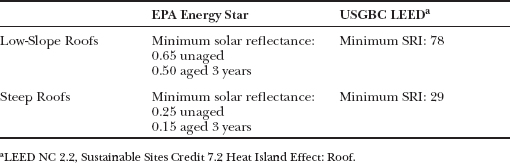
FIGURE 16.55 Cool roof requirements for low-slope and steep roofs. For EPA Energy Star programs, aged values are based on testing of material samples taken from installed, weathered roofs or from samples that have undergone accelerated aging to simulate natural weathering.
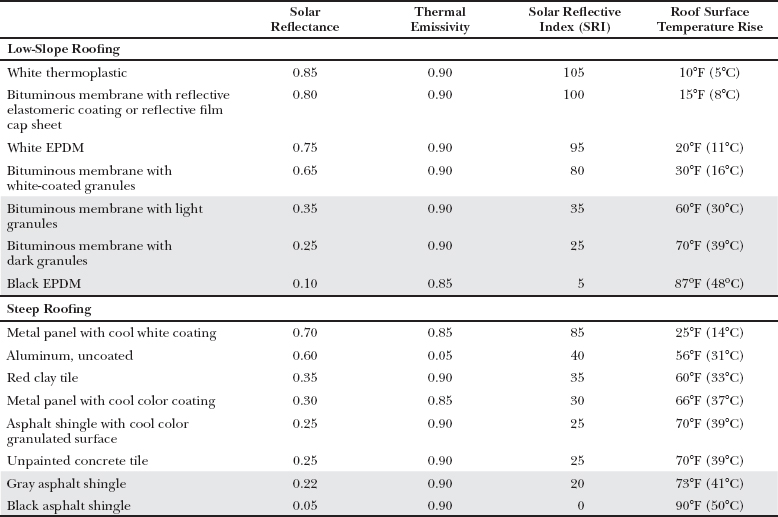
FIGURE 16.56 Solar heating properties for some example roof materials. Materials in shaded rows do not meet the criteria for cool roofs listed in the previous figure. (Figures are approximate and should not be used to document compliance with cool roof rating programs.)
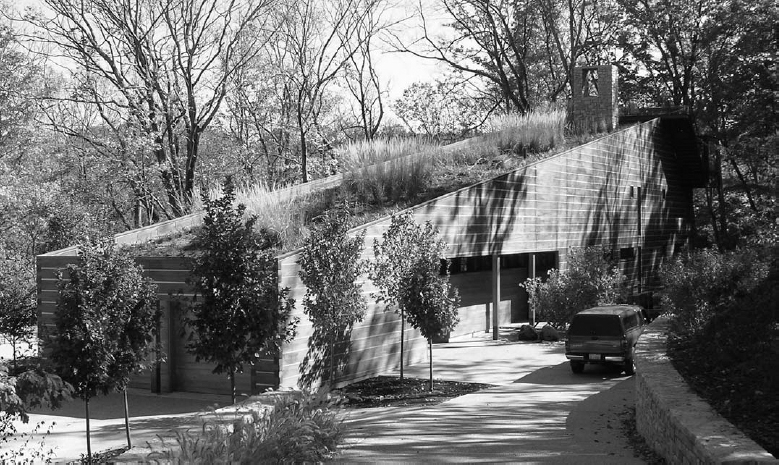
FIGURE 16.57 A green roof over a sloping roof deck. This extensive planted roof has a 6-inch (150-mm)-deep soil layer and supports native and ornamental of grasses. (Courtesy of Steve Grim)
Cool Color Roof Coverings
Cool color roofing materials are nonwhite in color but nevertheless reflect a significant portion of the sun’s radiation. Cool colors are formulated with pigments that are selectively reflective to different portions of the solar spectrum. They are highly reflective of near-infrared (NIR) radiation, an invisible component of solar radiation that accounts for over half of the total heat energy radiated by the sun, while they remain absorptive in the visible light spectrum, which accounts for their apparent color. Cool color pigments can be applied to aggregate granules used to coat asphalt shingles, as well as to sheet metal, clay or concrete tile, fiber-cement shingles, and other roofing materials to produce products meeting cool roof standards for steep roofs. As the formulation of cool color pigments continues to evolve, smooth-surfaced roofing materials with reflectance values as high as 0.45 and granule-surfaced materials with values as high as 0.30 are anticipated.
Green Roofs
Green roofs, also called eco roofs or vegetated roofs, are roofing systems covered with vegetation and additional materials needed to support plant growth. Like protected membrane roofs, green roofs extend the life of the roof membrane by shielding it from UV radiation and extremes of temperature. Green roofs also reduce heating and cooling costs by moderating temperature swings in the roof assembly. They reduce the transmission of noise through the roof system and decrease the reflection of exterior noise. They reduce stormwater runoff and provide habitat for birds. By supporting plant growth and reducing heat island effects, green roofs improve air quality. They provide aesthetic value and, in some cases, create pleasant, usable space.
Extensive green roofs are relatively shallow, with soil depths of 2 to 6 inches (25–150 mm). They are planted with herbs, grasses, mosses, sedums, or other drought-tolerant plants that do not require irrigation or frequent maintenance. Intensive green roofs may have soils as deep as 30 inches (750 mm) and are designed to support a broader variety of plant types and shrubs. Intensive roofs typically require irrigation and regular maintenance such as weeding, trimming, pest management, and fertilization. Planning for the structural loads of soil and plant materials is an important part of green roof design. Because of their lesser depth, extensive roofs are relatively light in weight, imposing loads, when saturated with water, ranging from 12 to 35 psf (0.57 to 1.7 kPa) on the supporting roof structure. Intensive roofs impose loads of 50 psf (2.4 kPa) or more. While most green roofs are essentially flat, with special soil retention measures, extensive roofs with slopes as great as 12:12 (100 percent) are technically feasible (Figure 16.57).
From the top down, typical components of a green roof system include the following:
• Plant materials may be selected on the basis of hardiness, climate, depth of soil, maintenance expectations, and appearance.
• The growth medium (soil) must provide long-lasting, optimal growing conditions. Particulars of its formulation vary with the depth of soil and the types of vegetation supported. Soil stability, drainage properties, and, in extensive roofs, drought resistance are important considerations.
• A geotextile filter fabric prevents soil particles from being washed out of the growth medium and clogging the drainage layer below.
• Soil restraints made from perforated plastic or metal allow the free flow of water while confining the growth medium at the roof perimeter and around drains or scuppers.
• Drainage layer materials such as a molded plastic panel or an entangled plastic filament mat are used to provide efficient drainage and aeration beneath the soil. Some products also provide water retention, benefiting the plants’ subsoil environment. Crushed rock or other aggregate material may also be used, although at the cost of added weight in comparison to the use of synthetic materials.
• Rigid foam insulation boards may be positioned above or below the roof membrane. Where insulation is placed above the membrane, extruded polystyrene is used because it retains its insulating value when wet.
• Depending on the membrane system, one or more protection layers to prevent root invasion and to relieve physical stress may be laid over the membrane.
• Since access to the waterproofing membrane becomes difficult once it is covered with the green roof components, it should be chosen with consideration of its long-term performance in a buried, continuously damp environment. Especially for intensive green roofs, robust waterproofing systems are recommended in place of lighter-duty, conventional roof membranes. Though many membrane materials may be used, hot rubberized asphalt, PVC, and multi-ply modified bitumen have the longest track records of successful installation. Where modular green roof systems are used (see below) and the membrane will remain more easily accessible, less expensive conventional roof membrane types may also be suitable. Prior to being covered, green roof membranes should be flood tested, that is, tested for watertightness by placing the membrane under continuously submerged conditions for a period of hours or days, to check for leaks prior to placing the overlying components.
• Requirements for the vapor retarder and air barrier are no different for green roofs than for conventional low-slope roof assemblies.
• The roof deck and supporting structure must be engineered to carry the additional loads imposed by green roof components.
With modular green roof systems, all the components of the green roof system above the membrane are preassembled in easily transported trays or modules. These trays, typically 2 to 4 feet (600–1200 mm) in plan dimension and 2 to 8 inches (50–200 mm) in depth, are preplanted and arrive on the construction site ready to be placed directly over the roof membrane. Modular green roof systems are lightweight, easy to specify, easy to assemble on site, and easy to remove or adjust at a later date.
Photovoltaic Roofing
Photovoltaic (PV) roofing materials are metal panels or shingles of asphalt, slate, fiber-cement, or metal laminated with thin-film semiconductor materials and capable of converting solar radiation into electrical energy. When they are installed as part of a building-integrated photovoltaic (BIPV) system, the electricity produced by these materials can be used to power a building’s own equipment and systems or, where permitted by the public power utility, can be sold back to the utility to offset power consumption charges. Electrical power from BIPV systems is produced without pollution or the depletion of natural resources.
The essential components of a BIPV system are an array of PV modules (the PV roofing material), controller equipment to regulate the current generated by the modules, and an inverter to convert the direct current (DC) output of the modules to alternating current (AC) compatible with conventional building power. Stand-alone or off-grid BIPV systems— systems not connected to the public utility power grid—also require a power storage system, usually in the form of rechargeable batteries, and often also include a backup power system, such as diesel generators.
Estimating the potential power contribution of a BIPV system and evaluating its potential economic payback for a particular project require an analysis of the project’s geographic location, solar exposure, projected power needs, utility costs, and additional factors. See the list of web sites at the end of this chapter for more information.
Leave a Reply