
The origins of glass are lost in prehistory. Initially a material for colored beads and small bottles, glass was first used in windows in Roman times. The largest known piece of Roman glass, a crudely cast sheet used for a window in a public bath at Pompeii, was nearly 3 by 4 feet (800 by 1100 mm) in size.
By the 10th century A.D., the Venetian island of Murano had become the major center of glassmaking, producing crown glass and cylinder glass for windows. Both the crown and cylinder processes began by blowing a large glass sphere. In the crown process, the heated glass sphere was adhered to an iron rod called a punty opposite the blowpipe. The blowpipe was then removed, leaving a hole opposite the punty. Next, the sphere was reheated, whereupon the glassworker spun the punty rapidly, causing centrifugal force to open the sphere into a large disk, or crown, 30 inches (750 mm) or more in diameter (Figure 17.2). When the crown was cut into panes, one pane always contained the “bullseye” where the punty was attached before being cracked off. In the cylinder process, the sphere, heated to a molten state, was swung back and forth, pendulum fashion, on the end of the blowpipe to elongate it into a cylinder. The hemispherical ends were cut off and the remaining cylinder was slit lengthwise, reheated, opened, and flattened into a rectangular sheet of glass that was later cut into panes of any desired size (Figure 17.3). Prior to the introduction of modern glassmaking techniques, crown glass was favored over cylinder glass for its surface finish, which was smooth and brilliant because it was formed without contacting another material. Cylinder glass, though more economical to produce, was limited in surface quality by the texture and cleanliness of the surface on which it was flattened.

FIGURE 17.1 An entire wall of the Baltimore Convention Center is made of low-emissivity double glazing supported by a tubular steel substructure. Adjustable stainless steel fittings with rubber washers connect the sheets of glass to the substructure. (Architects: Cochran, Stevenson, & Donkervoet. Photo of Pilkington Planar System courtesy of W&W Glass Systems, Inc.)
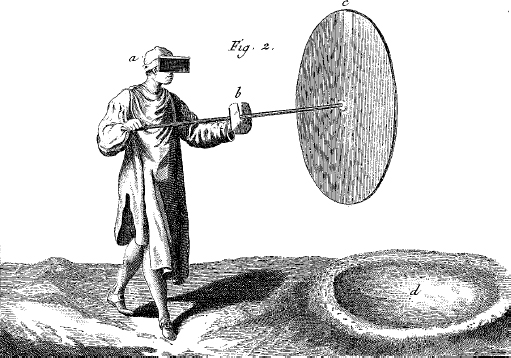
FIGURE 17.2 The glassworker in this old engraving wore a face shield (a) and hand shield (b) to protect against the heat of the large glass crown (c) that he had just spun on the end of a punty. After cooling, the crown was cut into small lights of window glass. (Courtesy of the Corning Museum of Glass, Corning, New York)
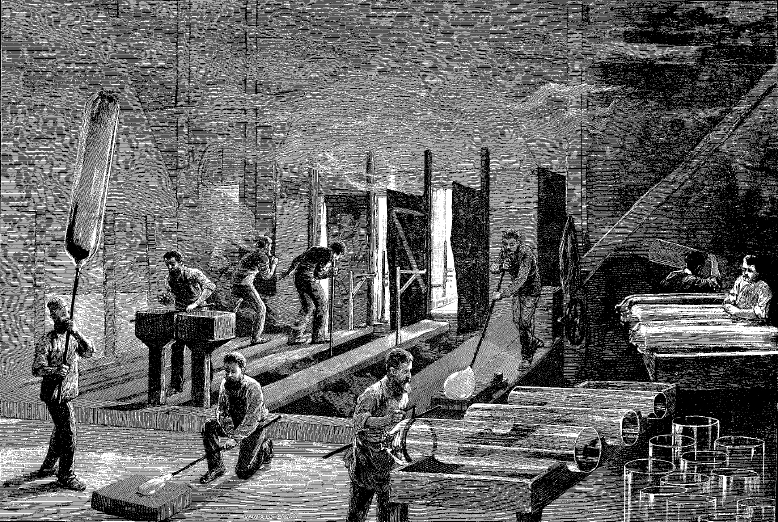
FIGURE 17.3 Making cylinder glass in the 19th century, Pittsburgh, Pennsylvania. Elongated glass bottles were blown by swinging the blowpipe back and forth in the pit in front of the furnace (center). As each bottle solidified (left), it was brought to another area where the ends were cut off to produce cylinders (right). The cylinders were reheated and flattened into sheets from which window glass was cut. (Courtesy of the Corning Museum of Glass, Corning, New York)
Neither crown glass nor cylinder glass was of sufficient optical quality for the fine mirrors desired by the 17th-century nobility. For this reason, plate glass was first produced, in France, in the late 17th century. Molten glass was cast into frames, spread into sheets by rollers, cooled, then ground flat and polished with abrasives, first on one side and then the other. The result was a costly glass of near-perfect optical quality in sheets of unprecedentedly large size. Mechanization of the grinding and polishing operations in the 19th century reduced the price of plate glass to a level that allowed it to be used for storefronts in both Europe and America.
In the 19th century, the cylinder process evolved into a method of drawing cylinders of molten glass vertically from a crucible. This made possible the routine, economical production of cylinders 40 to 50 feet (12–15 m) long. In 1851, the Crystal Palace in London (Figure 11.1) was glazed with 900,000 square feet (84,000 m2) of cylinder glass supported on a cast iron frame.
In the early years of the 20th century, cylinder glass production was gradually replaced by processes that pulled flat sheets of drawn glass directly from a container of molten glass. Highly mechanized production lines for the grinding and polishing of plate glass were established, with rough glass sheets entering the line continuously at one end and finished sheets emerging at the other.
In 1959, the English firm of Pilkington Brothers Ltd. started production of float glass, which has since been licensed to other glassmakers and has become the worldwide standard, replacing both drawn glass and plate glass. In this process, a ribbon of molten glass is floated across a bath of molten tin, where it hardens before touching a solid surface (Figures 17.4–17.6). The resulting sheets of glass have parallel surfaces, high optical quality (virtually indistinguishable from that of plate glass), and a brilliant surface finish. Float glass has been produced in America since 1963 and now accounts for nearly all of domestic flat glass production.
The terminology associated with glass developed early in this long history. The term glazing as it applies to building refers to the installing of glass in an opening or to the transparent material (usually glass) in a glazed opening. The installer of glass is known as a glazier. Individual pieces of glass are known as lights, or often, to avoid confusion with visible light, lites.
Leave a Reply