A concrete slab on grade is a level surface of concrete that lies directly on the ground. Slabs on grade are used for roads, sidewalks, patios, airport runways, and basements or ground floors of buildings. A slab-on-grade floor usually experiences little structural stress except a direct transmission of compression between its superimposed loads and the ground beneath, so it furnishes a simple example of the operations involved in the sitecasting of concrete (Figure 14.2).
To prepare for the placement of a slab on grade, the unstable topsoil is scraped away to expose the subsoil beneath. If the exposed subsoil is too soft, it is compacted or replaced with more stable material. Next, a layer of approximately ¾-inch-diameter (19-mm) crushed stone at least 4 inches (100 mm) deep, also referred to as a capillary break, is compacted over the subsoil as a drainage layer to keep water away from the underside of the slab. Where the slab is not being cast within surrounding walls, a simple edge form—a strip of wood or metal fastened to stakes driven into the ground—is constructed around the perimeter of the area to be poured and is coated with a form release compound to prevent the concrete from sticking (Figure 14.3). Where walls surround the slab to be poured, a compressible joint filler material is placed to create an isolation joint between the slab and the surrounding walls, as explained later in this chapter. The top edge of the form is carefully leveled. The thickness of the slab may range from 3 inches (100 mm) for a residential floor to 6 or 8 inches (150 or 200 mm) for an industrial floor. It may reach a foot or more (300 mm) for an airport runway, which must carry very large, concentrated loads from airplane wheels and diffuse them into the ground. For interior floor slabs on grade but not exterior slabs, a moisture barrier (also called a vapor retarder), usually consisting of a heavy plastic sheet, is laid over the crushed stone to prevent water vapor from rising through the slab from the ground beneath.
For some interior floor slab construction, a layer of fine crushed stone or sand, 2 to 4 inches (50 to 100 mm) thick, may be placed over the vapor retarder. Prior to placing concrete, this layer of fine aggregate protects the vapor retarder sheet from damage. Once concrete is placed, this layer absorbs excess water from the concrete, helping to prevent curling (warping) of the slab that can occur during curing when the top of the slab loses moisture more rapidly than the bottom. However, this practice also runs the risk of creating a reservoir for the storage of water under the slab that can lead to moisture-related problems after the slab is in service, especially when the slab is covered with floor coverings that are sensitive to moisture, such as resilient sheet flooring or vinyl composition tiles. Particularly with the advent of tougher vapor retarder sheets that are less vulnerable to damage during construction operations, the practice of placing an aggregate layer over the vapor retarder has become less prevalent.
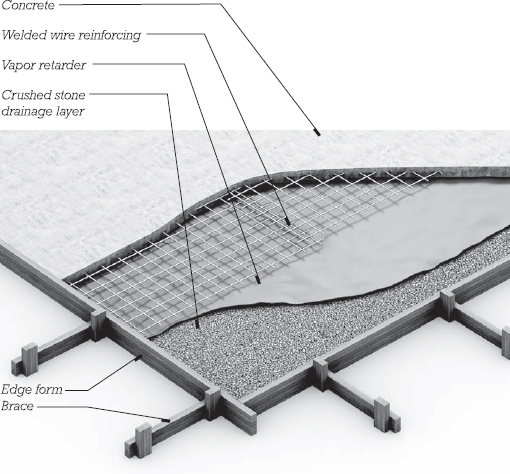
FIGURE 14.2 The construction of a concrete slab on grade. Notice how the wire reinforcing fabric is overlapped where two sheets of fabric join. As explained in the accompanying text, a layer of fine crushed stone or sand is sometimes added over the vapor retarder to protect the vapor retarder from damage before the concrete is poured and to promote uniform curing once the concrete is placed.
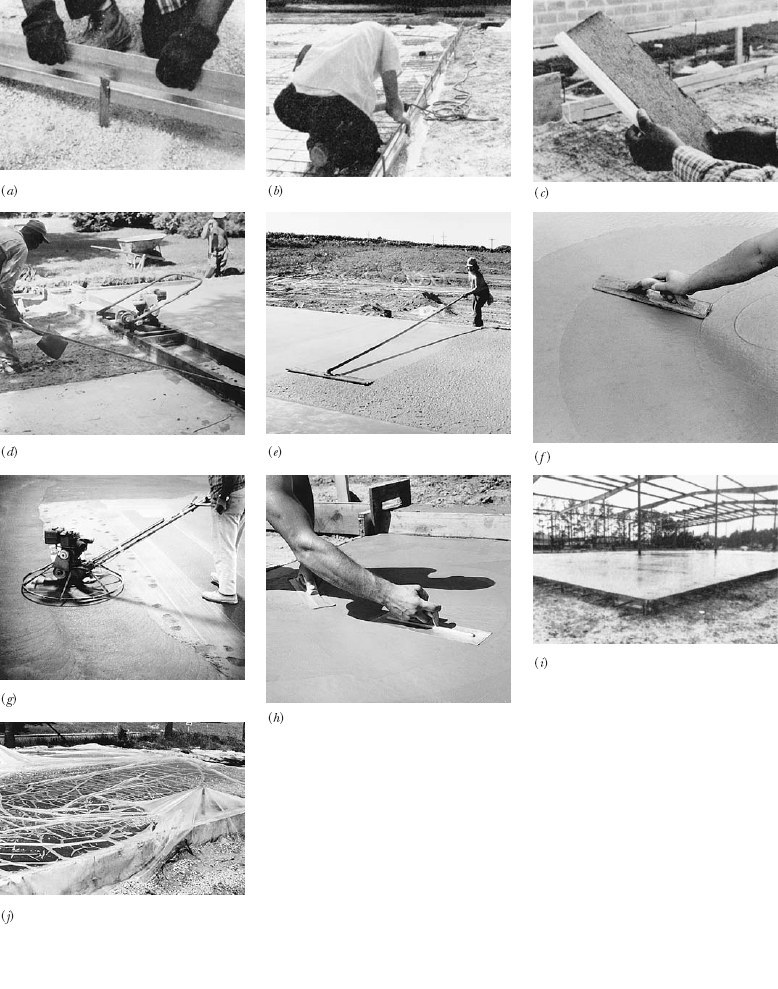
FIGURE 14.3 Constructing and finishing a concrete slab on grade. (a) Attaching a proprietary slab edge form to a supporting stake. The profile of the edge form causes adjacent pours to interlock. Hole knockouts in the metal form allow for the placement of horizontal steel dowels to tie the pours together. (b) To the right, a crushed-stone drainage layer for a slab on grade, and to the left, a slab section ready to pour, with moisture barrier, welded wire fabric reinforcing, and edge forms in place. (c) This asphalt-impregnated fiberboard forms an isolation joint when cast into the slab. The plastic cap is removed immediately after slab finishing to create a clean slot for the later insertion of an elastomeric joint sealant. (d) Striking off the surface of a concrete slab on grade just after pouring, using a motorized screed. The motor vibrates the screed from end to end to work the wet concrete into a level surface. (e) A bull float can be used for preliminary smoothing of the surface immediately after screeding. (f) Hand floating brings cement paste to the surface and produces a plane surface. (g) Floating can be done by machine instead of by hand. (h) Steel troweling after floating produces a dense, hard, smooth surface. (i) A section of concrete slab on grade finished and ready for curing. The dowels inserted through the edge form will connect to the sections of slab that will be poured next. (j) One method of damp curing a slab is to cover it with polyethylene sheet to retain moisture in the concrete. (Photos a, b, c, and i courtesy of Vulcan Metal Products, Inc., Birmingham, Alabama; photos d, e, f, g, h, and j reprinted with permission of the Portland Cement Association from Design and Control of Concrete Mixtures, 12th edition, Portland Cement Association, Skokie, IL)
A reinforcing mesh of welded wire reinforcing (also called “welded wire fabric”), cut to a size just a bit smaller than the dimensions of the slab, is laid over the moisture barrier or crushed stone. The reinforcing most commonly used for lightly loaded slabs, such as those in houses, is 6 × 6-W1.4 × W1.4, which has a wire spacing of 6 inches (150 mm) in each direction and a wire diameter of 0.135 inch (3.43 mm—see Figure 13.23 for more information on welded wire fabric). For slabs in factories, warehouses, and airports, a fabric made of heavier wires or a grid of reinforcing bars may be used instead. The grid of wires or bars helps protect the slab against cracking that might be caused by concrete shrinkage, temperature stresses, concentrated loads, frost heaving, or settlement of the ground beneath. Fibrous (macrofiber) reinforcing, discussed in the previous chapter, can also be used in place of wire reinforcing for general crack control in slabs.
Leave a Reply