
The cost of a concrete building frame can be broken down into the costs of the concrete, the reinforcing steel, and the formwork. Of the three, the cost of concrete is usually the least significant in North America and the cost of formwork is the most significant. Accordingly, simplification and standardization of formwork are the first requirements for an economical concrete frame. Repetitive, identical column spacings and bay sizes allow the same formwork to be used again and again without alterations. Flat plate construction is often the most economical, simply because its formwork is so straightforward. Joist band construction is usually more economical than joist construction that uses beams proportioned more efficiently for their structural requirements, because enough is saved on formwork costs to more than compensate for the added concrete and reinforcing steel in the beams. This same reasoning applies if column and beam dimensions are standardized throughout the building, even though loads may vary; the amount of reinforcing and the strengths of the concrete and reinforcing steel can be changed to meet the varying structural requirements (Figure 14.57).
SITECAST CONCRETE AND THE BUILDING CODES
Concrete structures are inherently fire resistant. When fire attacks concrete, the water of hydration is gradually driven out and the concrete loses strength, but this deterioration is slow because considerable heat is needed to raise the temperature of the mass of concrete to the point where dehydration begins, and a large additional quantity of heat is required to vaporize the water. The steel reinforcing bars or prestressing strands are buried beneath a concrete cover that protects them for an extended period of time. Except under unusual circumstances, such as a prolonged fire fueled by stored petroleum products, concrete structures usually survive fires with only cosmetic damage and are repaired with relative ease.
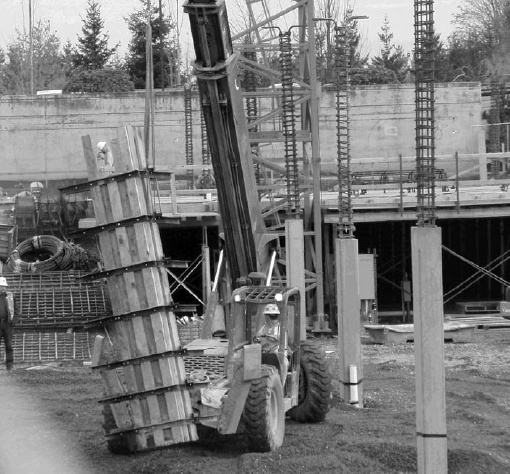
FIGURE 14.57 By keeping sizes of columns, beams, and other formed elements as consistent as possible, significant savings can be achieved in the cost of formwork for sitecast concrete construction. Here, a column form, having been stripped from a recently cast column, is being carried to a new location for reuse. (Photo by Joseph Iano)
Concrete structures with adequate cover over reinforcing and adequate slab thicknesses are classified as Type I buildings under the International Building Code. Slab thickness requirements for the several construction types are complex, depending on the type of aggregate used in the concrete and whether or not a given structural member is restrained from movement by surrounding construction. Fire resistance requirements for the highest construction types can be met in joist and waffle systems either by increasing their slab thickness beyond what is structurally necessary or by applying fireproofing materials to the lower surfaces of the floor structures.
Sitecast concrete buildings have rigid joints and in many cases need no additional structural elements to achieve the necessary resistance to wind and seismic forces. More restrictive seismic design provisions in the building codes have, however, increased the attention paid by structural engineers to column ties and beam stirrups, particularly in the zones where beams and columns meet, to be sure that vertical bars in columns and horizontal bars in beams are adequately restrained against the unusually strong forces that can occur in these zones under seismic loadings. The joints between flat plate floors and columns may not be sufficiently rigid to brace a building of more than modest height, unless drop panels or beams are added to stiffen the slab-to-column junction.
Leave a Reply