
Primary Functions of the Exterior Wall
The major purpose of the exterior wall is to separate the indoor environment of a building from the outdoors in such a way that indoor environmental conditions can be maintained at levels suitable for the building’s intended use. This translates into a number of separate and diverse functional requirements.
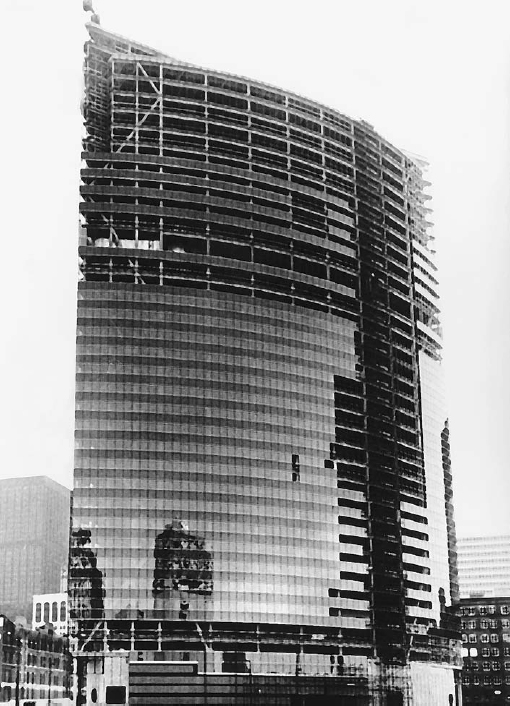
FIGURE 19.1 A steel-framed Chicago office building during the installation of its aluminum, stainless steel, and glass curtain wall cladding. Notice the diagonal wind braces in the steel frame. (Architects: Kohn Pedersen Fox/Perkins & Will. Photo by Architectural Camera. Permission of American Institute of Steel Construction)
Keeping Water Out
The exterior wall must prevent the entry of rain, snow, and ice into a building. This requirement is complicated by the fact that water on the face of a building is often driven by wind at high velocities and high air pressures, not just in a downward direction but in every direction, even upward. Water problems are especially acute on tall buildings, which present a large profile to the wind at altitudes where wind velocities are much higher than at ground level. Enormous amounts of water must be drained from the windward face of a tall building during a heavy rainstorm, and the water, pushed by wind, tends to accumulate in crevices and against projecting mullions, where it will readily penetrate the smallest crack or hole and enter the building. We will devote a considerable portion of this chapter to methods for keeping water out.
Preventing Air Leakage
The exterior wall of a building must prevent the unintended passage of air between indoors and outdoors. At a gross scale, this is necessary to regulate air velocities within the building. Smaller air leaks are harmful because they waste conditioned (heated or cooled) air, carry water through the wall, allow water vapor to condense inside the wall, and allow noise to penetrate the building from outside. Building code requirements for airtightness of building enclosures are growing more stringent. Sealants, gaskets, weatherstrips, and air barrier membranes of various types are all used to prevent air leakage through the exterior wall.
Controlling Light
The exterior wall of a building must control the passage of light, especially sunlight. Sunlight is heat that may be welcome or unwelcome. Sunlight is visible light, useful for illumination but bothersome if it causes glare within a building. It includes destructive ultraviolet wavelengths that must be kept off human skin and away from interior materials that will fade or deteriorate. Windows should be placed and proportioned with these considerations in mind. Exterior wall systems sometimes include external shading devices to keep light and solar heat away from windows. The glass in windows is often selected to control light and heat, as discussed in Chapter 17. Interior shades, blinds, and curtains may be added for further control.
Controlling the Radiation of Heat
Beyond its role in regulating the flow of radiant heat from the sun, the exterior wall of a building should also present interior surfaces at temperatures that will not cause radiant discomfort. A very cold interior surface will make people feel chilly when they are near the wall even if the air in the building is warmed to a comfortable level. A hot interior surface or direct sunlight in summer can cause overheating of the body despite the coolness of the interior air. External sun shading devices, adequate thermal insulation and thermal breaks, and appropriate selection of glass are potential strategies in controlling heat radiation.
Controlling the Conduction of Heat
The exterior wall of a building must resist the conduction of heat into and out of the building. This requires not merely satisfactory overall resistance of the wall to the passage of heat, but also avoidance of thermal bridges, wall components such as metal framing members that are highly conductive of heat and therefore likely to cause localized condensation on interior surfaces. Thermal insulation, appropriate glazing, and thermal breaks are used to control heat conduction through the exterior wall, as we will observe in the two chapters that follow. Building codes specify minimum values of thermal resistance of wall components as a way of limiting the conduction of heat and also as a way of controlling the condensation of moisture on cold interior surfaces.
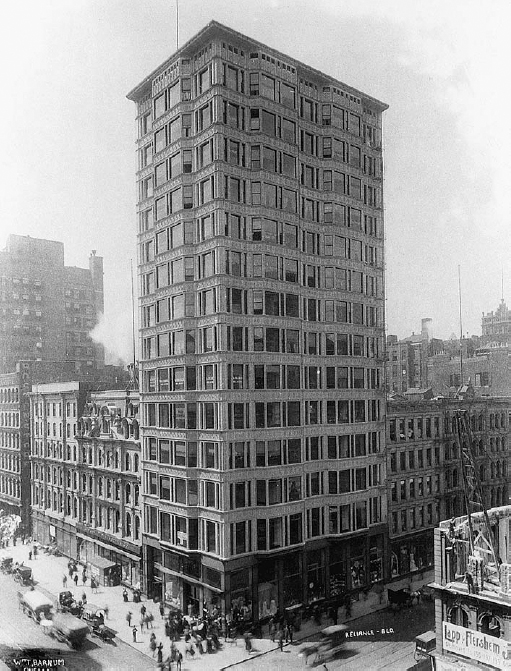
FIGURE 19.2 The curtain wall of Chicago’s Reliance Building, built in 1894–1895, has spandrels constructed of white terracotta tiles. (Architect: Charles Atwood, of Daniel H. Burnham and Company. Photo by Wm. T. Barnum. Courtesy of Chicago Historical Society ICHi-18294)
Controlling Sound
The exterior wall serves to isolate the inside of a building from noises outside and vice versa. Noise isolation is best achieved by walls that are airtight, massive, and resilient. The required degree of noise isolation varies from one building to another, depending on the noise levels and noise tolerances of the inside and outside environments. The exterior wall for a hospital near a major airport requires a high level of noise isolation. The exterior wall for a commercial office in a suburban office park need not perform to as high a standard.
Secondary Functions of the Exterior Wall
Fulfillment of the primary functional requirements of the exterior wall leads unavoidably to a secondary but equally important set of requirements.
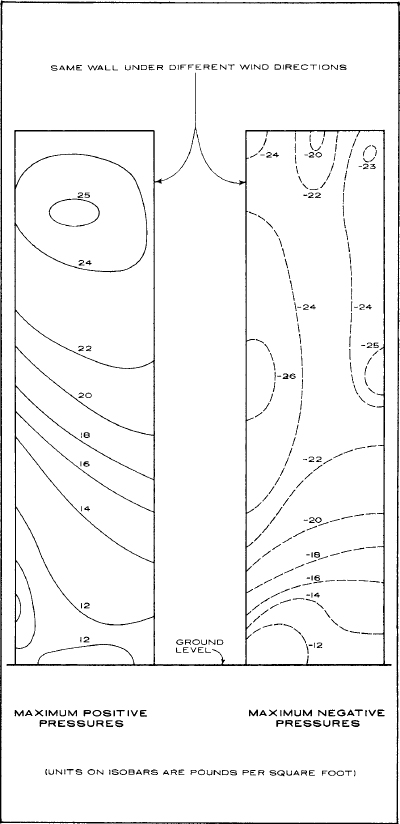
FIGURE 19.3 An example of expected positive and negative wind pressures on the cladding of a tall building, shown here in elevation, as predicted by wind tunnel testing. The building in this case is 64 stories tall and triangular in plan. Notice the high negative pressures (suctions) that can occur on the upper regions of the facade. The wind pressures on a building are dependent on many factors, including the shape of the building, its orientation, topography, wind direction, and surrounding buildings. Each building must be modeled and tested individually to determine the pressures it is expected to undergo. (Reprinted with permission from AAMA Aluminum Curtain Wall Design Guide Manual)
Resisting Wind Forces
The exterior wall of a building must be adequately strong and stiff to sustain the pressures and suctions that will be placed upon it by wind. For low buildings, which are exposed to relatively predictable winds, this requirement is fairly easily met. The upper reaches of taller buildings are beset by much faster winds whose directions and velocities are often determined by aerodynamic effects from surrounding buildings. High suction forces can occur on some portions of the exterior wall, especially near corners of the building (Figure 19.3).
Controlling Water Vapor
The exterior wall of a building must retard the passage of water vapor. In the heat of summer or the cold of winter, vapor moving through a wall assembly may condense inside the assembly and cause staining, loss of insulating value, corrosion of metals, and decay of wood. The exterior wall must be constructed to resist the diffusion of water vapor and to restrict the leakage of moisture-laden air in order to prevent the transfer of water vapor to parts of the wall where it may condense.
Adjusting to Movement
Several different kinds of forces are always at work throughout a building, tugging and pushing both the frame and the exterior wall: thermal expansion and contraction, moisture expansion and contraction, and structural deflections. These forces must be anticipated and allowed for in designing a system of building enclosure.
Thermal Expansion and Contraction
The exterior wall of a building has to accommodate movements due to changes in temperature at several levels: Indoor/outdoor temperature differences can cause warping of cladding panels due to differential expansion and contraction of their inside and outside faces (Figure 19.4a). The exterior wall as a whole, exposed to outdoor temperature variations, expands and shrinks constantly with respect to the frame of the building, which is usually protected by the exterior wall from temperature extremes. And the building frame itself expands and contracts to some extent, especially between the time the exterior wall is installed and the time the building is first occupied and its indoor temperature is controlled.
Moisture Expansion and Contraction
Masonry and concrete exterior wall materials must accommodate their own expansion and contraction that is caused by varying moisture content. Bricks and building stone generally expand slightly after they are installed. Concrete blocks and precast concrete shrink slightly after installation in a building as their curing is completed and excess moisture is given off. These movements are small but can accumulate to significant and potentially troublesome quantities in long or tall panels of masonry or concrete. In smaller buildings, wood cladding components are the types of components most susceptible to moisture movement, as discussed in Chapter 3.
Structural Movements
The exterior wall must adjust to structural movements in the frame of the building. Building foundations may settle unevenly, causing distortions of the frame. Gravity forces shorten columns and cause beams and girders to which the exterior wall system is attached to sag slightly. Wind and earthquake forces push laterally on building frames and wrack panels attached to the faces. Long-term creep causes significant shortening of concrete columns and sagging of concrete beams and slabs during the first year or two of a building’s life.
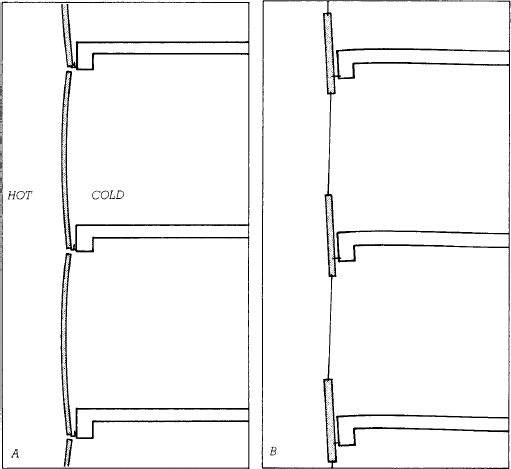
FIGURE 19.4 Distortions of curtain wall panels, illustrated in cross section. (a) Bowing caused in this case by greater thermal expansion of the outside skin of the panels than of the inside skin under hot summertime conditions. (b) Twisting of spandrel beams because of the weight of the curtain wall.
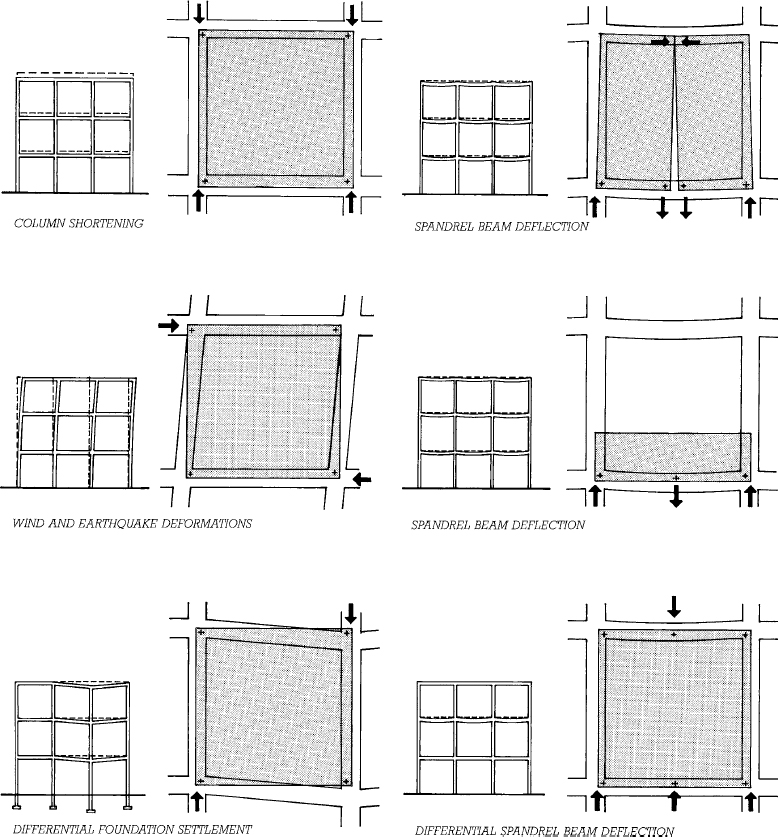
FIGURE 19.5 Forces on curtain wall panels caused by movements in the frame of the building, illustrated in elevation. In each of the six examples, the drawing to the left shows the movement in the overall frame of the building, and the larger-scale drawing to the right shows its consequences on the curtain wall panels (shaded in gray) covering one bay of the building. Points of attachment between the panels and the frame are shown as crosses. The black arrows indicate forces on the wall panels caused by the movement in the structure. The magnitude of the structural movements is exaggerated for clarity, and some inadvisable attachment schemes are shown to demonstrate their consequences. Forces such as these, if not taken into account in the design of the frame and cladding, can result in glass breakage, panel failures, and failure of the attachments between the panels and the frame.
CONSIDERATIONS OF SUSTAINABILITY IN EXTERIOR WALL SYSTEMS
For many if not most buildings, the design of the exterior wall has a greater effect on lifetime energy consumption than any other factor. A poorly designed all-glass box loses excessive amounts of heat in winter and gains excessive solar heat in summer. Its undifferentiated faces show no awareness on the part of the designer of the effects of orientation on energy transactions through the walls of a building.
• Glass should be used where it can supply daylighting and provide views. If it cannot be effectively shaded, it should be avoided where summertime overheating could otherwise occur or where occupants could be subject to excessive glare at times of the day when the sun is low in the sky.
• In many buildings, windows that can be opened and closed by the occupants can help reduce energy costs.
• Opaque areas of the exterior wall should be well insulated.
• Thermal bridges should be eliminated from the exterior wall.
• The entire building envelope should be detailed for airtightness. Fresh air should be provided by the building’s ventilation system, not by air leakage through the exterior wall.
• Where appropriate, south-facing glass can be used to provide solar heat to the building in winter, but care must be taken to avoid glare, local overheating, and ultraviolet deterioration of interior surfaces and furnishings that are exposed to sunlight.
• As photovoltaic cells become more economical, consideration should be given to using south-facing surfaces of the exterior wall to generate electrical energy.
If building movements due to temperature differences, moisture differences, structural stresses, and creep are allowed to be transmitted between the frame and the exterior wall, unexpected things may happen. Wall system components may be subjected to forces for which they were not designed, which can result in broken glass, buckled cladding, sealant failures, and broken cladding attachments (Figure 19.5). In extreme cases, the building frame may end up supported by the exterior wall, rather than the reverse, or pieces of cladding may fall off the building. A number of provisions for dealing with movement from all these causes are evident in the details of exterior wall systems presented in the two chapters that follow.
Resisting Fire
The exterior wall of a building can interact in several ways with building fires. This has resulted in a number of building code provisions relating to the construction of building exterior wall systems, as summarized at the end of this chapter.
Weathering Gracefully
To maintain the visual quality of a building, its cladding must weather gracefully. The inevitable dirt and grime should accumulate evenly, without streaking or splotching. Functional provisions must be made for maintenance operations such as glass and sealant replacement and for periodic cleaning, including scaffolding supports and safety equipment attachment points for window washers. The cladding must resist oxidation, ultraviolet degradation, breakdown of organic materials, corrosion of metallic components, chemical attack from air pollutants, and freeze-thaw damage of stone, brick, concrete, concrete block, and tile.
Installation Requirements for the Exterior Wall
The exterior wall system should be easy to install. There should be secure places for the installers to stand, preferably on the floors of the building rather than on scaffolding outside. There must be built-in adjustment mechanisms in all the fastenings of components of the wall system to the frame to allow for the inaccuracies that are normally present in the structural frame of the building and the wall components themselves. Dimensional clearances must be provided to allow the wall components to be inserted without binding against adjacent components. And most important, there must be forgiving features that allow for a lifetime of trouble-free enclosure function despite all the lapses in workmanship that inevitably occur—features such as air barriers and drainage channels to get rid of moisture that has leaked through a faulty sealant joint or generous edge clearances that keep a sheet of glass from contacting the hard material of the frame even if the glass is installed slightly askew.
Leave a Reply