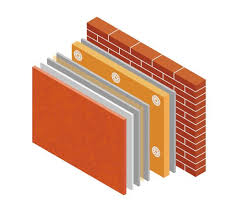
Most exterior wall systems require sealant joints, seams that are closed with rubberlike compounds. Systems that do not use sealants as water barriers in the face of the wall frequently use them to seal joints in the air barrier behind the face. The role of a sealant is to fill the joints between wall components, preventing the flow of air and/or water while still allowing reasonable dimensional tolerances for assembly and reasonable amounts of subsequent movement between the components. Sealant joint widths are usually ⅜ to ¾ inch (9–19 mm) but can be as small as ¼ inch (6 mm) and sometimes range up to 1 inch (25 mm) or more.
Sealants are often used to seal joints between panels of stone or precast concrete in a curtain wall (Figures 20.8 and 20.13), to seal the joint beneath the shelf angle in a brick curtain wall (Figure 20.3), and to seal joints between dissimilar materials, such as where a metal-and-glass cladding system ends against a masonry wall (Figure 21.12, details 6, 9, and 9A). Specially formulated sealants are used to seal between lights of glass and the frames that support them (Figure 17.17) and even to prevent the passage of sound around the edges of interior partitions (Figures 23.22, 23.23, 23.35, and 23.38).
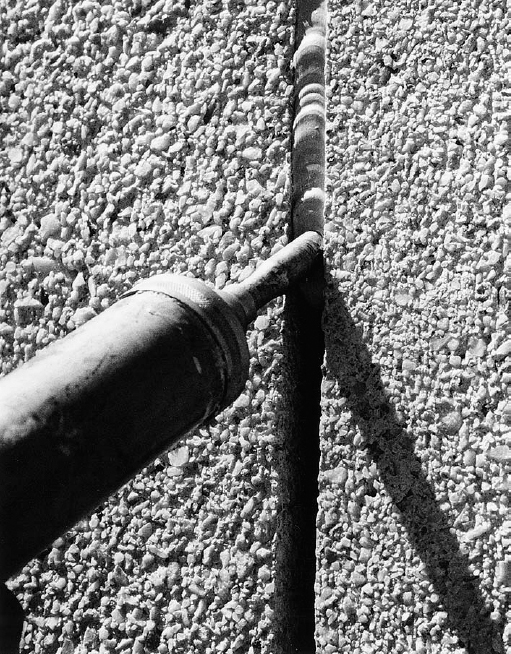
FIGURE 19.10 Applying polysulfide, a high-range gunnable sealant, to a joint between exposed-aggregate precast concrete curtain wall panels, using a sealant gun. The operator moves the gun slowly so that a bulge of sealant is maintained just ahead of the nozzle. This exerts enough pressure on the sealant so that it fully penetrates the joint. Following application, the operator will return to smooth and compress the wet sealant into the joint with a convex tool, much as a mason tools the mortar joints between masonry units. (Courtesy of Morton Thiokol, Inc., Morton Chemical Division)
Sealant Materials
Gunnable Sealant Materials
Gunnable sealant materials are viscous, sticky liquids that are injected into the joints of a building with a sealant gun (Figure 19.10). They cure within the joint to become rubberlike materials that adhere to the surrounding surfaces and seal the joint against the passage of air and water. Gunnable sealants can be grouped conveniently in three categories according to the amount of change in joint size that each can withstand safely after curing:
• Low-range sealants, also called caulks, are materials with very limited elongation (stretching and squeezing) capabilities, up to plus or minus 5 percent of the width of the joint. They are used mainly for filling minor cracks or nonmoving joints, especially in preparation for painting. Most caulks cure by evaporation of water or an organic solvent and shrink substantially as they do so. None are used for sealing of joints in building exterior wall systems. (Although the term “caulk” is properly applied only to low-range sealants, in common usage it is frequently applied more broadly to mean any type of sealant, regardless of elongation capability.)
• Medium-range sealants are materials such as butyl rubber or acrylic that have safe elongations in the plus or minus 5 to 10 percent range. They are used in the building exterior wall for sealing nonworking joints (joints that are fastened together mechanically as well as being filled with sealant, as shown in Figure 19.11). Because these sealants cure by the evaporation of water or an organic solvent, they undergo some shrinkage during curing.
• High-range sealants can safely sustain elongations up to plus or minus 50 to 100 percent. They include various polysulfides, which are usually site mixed from two components to effect a chemical cure; polyurethanes, which may also cure by a two-component reaction or by reacting with moisture vapor from the air, depending on the formulation; and silicones, which all cure by reacting with moisture vapor from the air. None of these sealants shrink upon curing because none relies on the evaporation of water or a solvent to effect a cure. All adhere tenaciously to the sides of properly prepared joints. All are highly resilient rubberlike materials that return to their original size and shape after being stretched or compressed, and all are durable for 20 years or more if properly formulated and installed. Sealants for the working joints in exterior wall systems are selected from among this group. Polysulfide sealants have the longest history of use in such applications. However, improved formulations of polyurethanes and silicones now account for 90 percent or more of the high-range construction sealant market, with silicones generally considered the longest-lasting and highest-performing of the three.
Gunnable joint sealants are specified according to ASTM standard C920, which defines designations for sealant Type, Grade, Class, and Use. Type S sealants are single-component and require no jobsite mixing. Type M sealants are multi-component and must be mixed on the job-site before installation. Multicomponent sealants generally cure faster than single-component sealants. They also allow a greater variety in color choice, as dye packs can be added during mixing. Grade P sealants, also called self-leveling, are pourable. They are easily installed in horizontal paving joints. But for vertical wall joints, Type NS, nonsag, sealants must be used. Class defines the elongation capability of a sealant. A Class 25 sealant can tolerate 25 percent expansion and contraction under normal usage. A Class 100/50 sealant (the highest Class designation in the current standard) can tolerate 100 percent expansion and 50 percent contraction. A Use T, traffic, sealant can tolerate wear and physical abuse of pedestrian or vehicular traffic (most pourable sealants are also Use T); a Use NT, nontraffic, sealant is not suitable for traffic exposure and is normally intended for use in vertical wall joints; a Use I, immersible, sealant is suitable for sealing applications that will be submerged once the sealant has cured. Sealants may also be classified as Use M, G, A, or O, meaning that they have passed a series of tests demonstrating satisfactory adherence to mortar, glass, aluminum, or other materials, respectively. As an example, a multi-component sealant intended for expansion joints between sections of aluminum curtain wall, which must be capable of 50 percent elongation, can be specified as Type M, Grade NS, Class 50, Uses NT and A.
Solid Sealant Materials
In addition to the gunnable sealants, several types of solid materials are used for sealing seams in the building exterior wall (Figure 19.11):
• Gaskets are strips of various fully cured elastomeric (rubberlike) materials manufactured in several different configurations and sizes for different purposes. They are either compressed into a joint to seal tightly against the surfaces on either side or inserted in the joint loose and then expanded with a lockstrip insert, as illustrated in Figures 17.17–17.19.
• Preformed cellular tape sealant is a strip of polyurethane sponge material that has been impregnated with a mastic sealant. It is delivered to the construction site in an airtight wrapper, compressed to one-fifth or one-sixth of its original volume. When a strip is unwrapped and inserted, it expands to fill the joint, and its sealant material cures with moisture from the air to form a watertight seam.
• Preformed solid tape sealants are used only in lap joints, as in mounting glass in a metal frame or overlapping two thin sheets of metal at a cladding seam. They are thick, sticky ribbons of polybutene or polyisobutylene that adhere to both sides of the joint to seal and cushion the junction. They are so sticky that they cannot be inserted into a joint, but must be applied to one side of the joint before it is assembled.
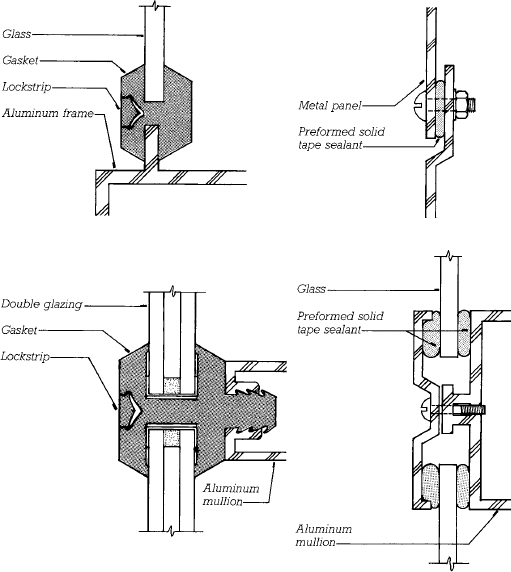
FIGURE 19.11 Some solid sealant materials. At the left, two examples of lockstrip gaskets. At the right, preformed solid tape sealants.
Sealant Joint Design
Figures 19.12–19.14 show the major principles that need to be kept in mind while designing a gunnable sealant joint. For a joint between materials with high coefficients of expansion, the time of year when the sealant is to be installed must be taken into account when specifying the size of the joint and the type of sealant. Sealant installed in cold weather will have to stretch less during its lifetime but will have to compress more in summer than the same sealant installed in hot weather, which will have to stretch more and compress less.
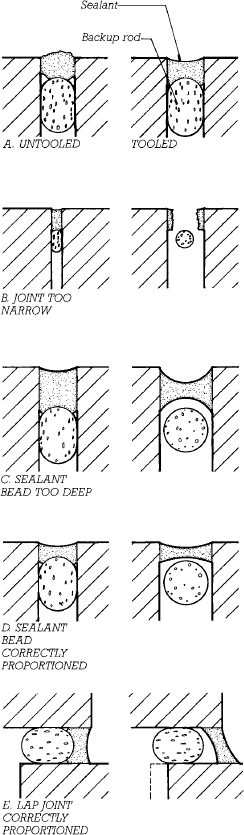
FIGURE 19.12 Good and bad examples of sealant joint design. (a) This properly proportioned joint is shown both untooled and tooled. The untooled sealant fails to penetrate completely around the backer rod and does not adhere fully to the sides of the joint. (b) A narrow joint may cause the sealant to elongate beyond its capacity when the panels on either side contract, as shown to the right. (c) If the sealant bead is too deep, sealant is wasted, and the four edges of the sealant bead are stressed excessively when the joint enlarges. (d) A correctly proportioned sealant bead. The backer rod, made of a spongy material that does not stick to the sealant, is inserted into the joint to maintain the desired depth. The width is calculated so that the expected elongation will not exceed the safe range of the sealant, and the depth is between ⅛ and ⅜ inch (3 and 9.5 mm). (e) A correctly proportioned lap joint. The width of the joint (the distance between the panels) should be twice the depth of the sealant bead and twice the expected movement in the joint.
Installation procedures are also critical to the success of gunnable sealant joints in an exterior wall system. Each joint must be carefully cleaned of oil, dirt, oxide, moisture, or concrete form release compound. If it is necessary to improve adhesion between the sealant and the substrate, the edges of the joint are primed with a suitable coating. Then the backer rod or backup rod is inserted. This is a cylindrical strip of highly compressible, very flexible plastic foam material that is just a bit larger in diameter than the width of the joint. It is pushed into the joint, where it holds its place by friction, to limit the depth to which the sealant will penetrate in order to maintain the optimum proportions of the sealant bead and avoid waste of sealant material. Backer rod material is available in a large range of diameters to fit every joint.
The sealant is extruded into the joint from the nozzle of a sealant gun, filling completely the portion of the joint outside the backer rod. Lastly, the sealant is mechanically tooled, much as a masonry mortar joint is tooled, to compress the sealant material firmly against the sides of the joint and the backer rod. The tooling also gives the desired surface profile to the sealant. (The backer rod’s role is now finished but, being inaccessible, the rod stays in the joint.)
Gasket sealants have generally proved to be less sensitive to installation problems than gunnable sealants. For this reason, they are widely used in proprietary cladding systems.
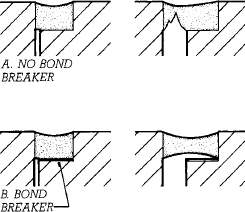
FIGURE 19.13 In three-sided joints, the sealant is likely to tear unless a nonadhering plastic bond breaker strip is placed in the joint before the sealant.
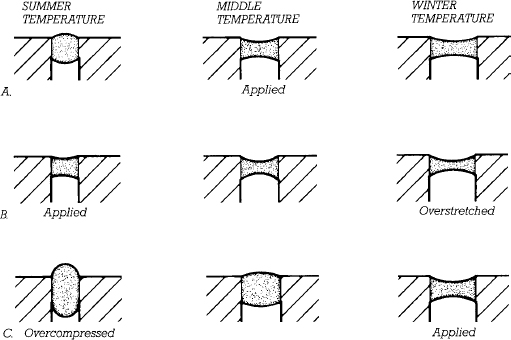
FIGURE 19.14 Sealants are best applied at temperatures that are neither excessively hot nor excessively cold. If cold- or hot-weather applications of sealants are anticipated, the joints should be proportioned to minimize overstretching or overcompression. Row A shows the behavior of a sealant applied at a medium temperature. Rows B and C show sealant applied at summer and winter temperatures, respectively.
Leave a Reply