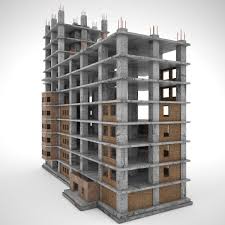
Concrete initially is in a plastic state and has to be kept within an closure of a desired shape by proper temporary supports till it gains adequate strength. This temporary enclosure is known as formwork or shuttering or simply as forms.
For circular works such as arches, doors, etc., the term centring is used generally instead of formwork or shuttering. Similarly the term moulds is used to indicate formwork of relatively small units such as lintels, cornices, cubes for testing, etc.
Requirements of Formwork
Irrespective of the type of material used the formwork should satisfy the following requirements:
- Adequate strength
- Smooth inner surface
- Enough rigidity
- Quality
- Less leakage
- Economy
- Easy removal
- Supports
1. Adequate Strength
As the formwork has to bear the weight of concrete which exerts a lot of pressure on all sides when it is wet, strength is an important and essential requirement. Resistance to outward push is achieved with the help of bracings and the wire fastened on the outer side of the formwork. Further the temporary load during placing of concrete by men and machinery should also be withstood by the formwork.
2. Smooth Inner Surface
It is an essential requirement that the inner surface of the formwork to have smooth surface on all concrete structures. This is specially desired, in case, the concrete is to be exposed without plastering. All the projections, if any, are to be smoothened before concreting. Steel sheet formworks give a smooth surface. Further it is the practice to apply crude oil or soft soap solution to the inside surface of the formwork. This also further makes the removal of formwork easy.
3. Enough Rigidity
The formwork should be rigid enough to retain the shape without undue deformation. For visible finished surfaces, the allowable deformation is 1/300 of span and 1/150 of span for hidden surface. In order to use the formworks repeatedly, they should be rigid, robust and stiff.
4. Quality
Formwork should be designed correctly such that the required size, shape and finish are obtained. Particularly the verticality of the side formwork should be made. In order to avoid leakages through the formwork, the timber used for formwork should not have any cracks or holes.
5. Less Leakage
Adequate care is taken to see that the formwork should be so placed that there is minimum joint. Sometimes joints open once some concrete is placed. This should be avoided and the leakage should be corrected by adjusting the vertical supporting poles of the formwork.
6. Economy
The cost of the formwork should be minimum as the formwork is only a temporary structure and not going to contribute to the stability of the structure. This demands a careful selection of formwork material and an optimum design.
7. Easy Removal
Formwork should be placed in such a manner that it can be removed easily without causing any damage to the structure. During removal of the formwork, the nails and screws should be removed with little hammering. Such a careful removal prevents the possibility of injury to the concrete. Further such smooth removal enables the formwork to be re-used with less expense.
8. Supports
In general formwork should rest on strong, hard and non-yielding supports. For this the ground should be hard or the supports should rest on cured base concrete. The vertical poles supporting the formwork should be strong and should not due to the weight of concrete.
Materials Used
Materials generally used are timber and steel. Sometimes plywood and aluminium are also used. The choice of material to be used for the preparation of formwork depends on the nature of the job and economy.
1. Steel Formwork
If it is intended to re-use the framework material for several times it is preferred to use steel or aluminium. The initial cost of steel is very high.
Based on the requirements, the sizes of steel section are decided. For example, if formworks are prefabricated into panels or sections it is to be done as big as the handling will permit or the size of concrete. It should be noted that individuals can carry a maximum load of 35 kg.
Steel formworks are preferred based on the following advantages:
- As it can be easily installed and dismantled, there is less labour cost.
- It is feasible to use several times.
- It is of high strength and hence durable.
- Precise design can be done.
- As it does not absorb water from concrete, the formation of honeycomb surface is avoided.
- Concrete surface exposed in uniform without any undulations.
- High degree of accuracy is possible, as it does not shrink or expand.
2. Timber Formwork
Timber formwork can not be used repeatedly as that of steel formwork. Timber intended to use as formwork should be well seasoned and should be neither too dry nor too wet. The components of timber formwork depend on the design load and the type of timber available. Number of nails used in the formwork should be less and the heads projecting out for easy removal.
Timber formwork claims the following advantages:
- Initial cost is less and hence cheap.
- With less modification it can be easily altered.
- It is used for small works requiring less repetitions.
- In buildings it is economical as the formwork can be used for some other building work with minimum variations.
3. Plywood Formwork
For light loads, plywood’s are used nowadays. Following are the advantages compared to timber formwork:
- Like steel it can be re-used for a few times.
- No finishing treatment is needed, as it gives surfaces which are plain and smooth.
- As large sizes of plywood are available, it is possible to cover large area and less labour cost is involved.
Typical formwork for columns and for beams and slab are shown in Figs. 22.1 to 22.3.

Figure 22.1 Formwork for different shapes of columns
Leave a Reply