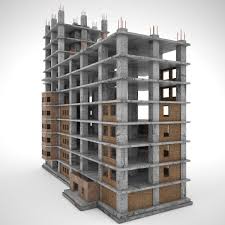
In the routine construction work, sometimes it is necessary to have some temporary structure or support to continue the work. When the height of construction exceeds about 1.5 m, temporary structures are needed. Temporary structure is erected close to the work so as to provide a safe working platform for the workers and to provide adequate space to keep the working materials. This temporary structure is known as scaffolding or simply a scaffold. Such temporary structures are used in construction, demolition, maintenance or repair work of buildings.
Components of Scaffolding
For a specific work of construction, a formwork is done using one or all of the following components.
1. Standards
These are the vertical members of a scaffold which are either supported on the ground or embedded in to the ground or rested on sand-filled bags.
2. Ledgers
These are the horizontal members of the scaffold.
3. Putlogs
These are transverse pieces which are placed on ledgers in perpendicular direction and supported on the wall.
4. Transoms
There are putlogs whose both ends are supported on the ledgers.
5. Bridges
These are used to bridge an opening in a wall and support one end of the putlog at the opening.
6. Braces
These are the cross or diagonal pieces fixed on the standards.
7. Guard Rail
This is a horizontal member provided like a ledger at the working level.
8. Toe Board
This is a board placed parallel to the ledgers and supported between the putlogs. This facility is made as a protective measure to work on the working platform.
9. Raker
This is an inclined support.
Requirements of Scaffolding
Scaffolding has to satisfy the following requirements irrespective of the material used:
- Method of erection should be easy with less wastage of material.
- As persons have to use the scaffolding at all heights, it should possess adequate strength.
- Materials needed for scaffolding should be available in all the required sizes and lengths.
- It should be feasible to interchange the material for other works with minimum wastage.
- Initial cost should be comparatively less and should have high scrap value.
- Fire-resistant scaffolding should be preferred.
- For erection purposes no skilled labour should be depended upon.
Types of Scaffolding
Following are the different types of scaffolding:
- Single scaffolding or bricklayer’s scaffolding
- Double scaffolding or mason’s scaffolding
- Cantilever or needle scaffolding
- Suspended scaffolding
- Trestle scaffolding
- Steel scaffolding
- Patented scaffolding
1. Single Scaffolding or Bricklayer’s Scaffolding
This type of scaffolding is commonly used and particularly in the construction of brickwork. It consists of a single row of standards placed at a distance of about 1.20 m from the wall. The spacing between the standards is about 2–2.5 m. The ledgers are fixed at a vertical distance of 1.20–1.80 m on the standards.
The putlogs are placed at a horizontal spacing of 1.20–1.80 m. The details of the scaffolding is shown in Fig. 22.4. This type of scaffolding is also called as putlog scaffolding.

Figure 22.4 Single Scaffolding
In order to extend the work vertically, the platform is raised by extending, the standards by adding extra pieces. The scaffolding is removed, generally, after the completion of plastering and pointing works. After the removal of the scaffolding, the holes in the walls used by putlogs are filled immediately.
2. Double Scaffolding or Mason’s Scaffolding
This type of scaffolding is stronger than the single scaffolding. This is similar to that of single scaffolding except two rows of standards are used. Out of these two standards, one is close to the wall and the other is 1.2–1.5 m away from the face of the wall, Fig. 22.5.
Here, no holes are made in the wall for putlogs and the putlogs are supported at both ends on ledgers. Sometimes diagonal bracings and inclined supports called rakers are provided. This type of scaffolding is particularly used for stone masonry construction.
3. Cantilever or Needle Scaffolding
In this type of scaffolding the general framework may be of single or double type of scaffolding. But the standards are supported by needles or ties. These ties are projected out at floor levels or through openings or through holes provided in the masonry. Two types cantilever scaffolding are shown in Fig. 22.6.

Figure 22.5 Double scaffolding

Figure 22.6 Cantilever scaffolding
This type of scaffolding is useful under the following conditions:
- In situations where it has to be provided on a busy street so as not to disturb the traffic.
- In situations where it is difficult to fix the standards on the ground.
- In construction of tall buildings.
4. Suspended Scaffolding
This is a light type of scaffolding used only for maintenance works like pointing, white washing, etc. The working platform is suspended from the roofs. Special arrangements are made with pulleys, ropes, etc., to suspend the platform from the roof and to raise or lower based on the need. As it does not create any obstruction on the ground and only a minimum space is required, this arrangement is preferred.
5. Trestle Scaffolding
In this type of scaffolding, the working platforms are supported on tripods, ladders, etc., which are mounted on boggies, wheels or lorries. This is suitable for minor repairs or painting work within a height of 5 m.
6. Steel Scaffolding
In this type of scaffolding steel tubes are used instead of timber. Further 40–50 mm diameter tubes of 5 mm thick are used. These tubes are commercially available in suitable lengths with special couplings and set screws. Although it is strong and suitable it can be used up to a specific height. Figure 22.7 shows a typical tubular steel scaffolding.

Figure 22.7 Tubular steel scaffolding
7. Patented Scaffolding
This type of scaffolding is also referred to as ladder scaffolding. This is a modified form of double scaffolding but steel is used instead of timber. There are patented scaffolds which are readily available in the market with special types of couplings and frames. Here, the working platform is supported on a bracket which can be adjusted to any suitable height. Such patented scaffoldings are used to light works like painting or decoration, Fig. 22.8.

Figure 22.8 Patented steel scaffolding
Leave a Reply