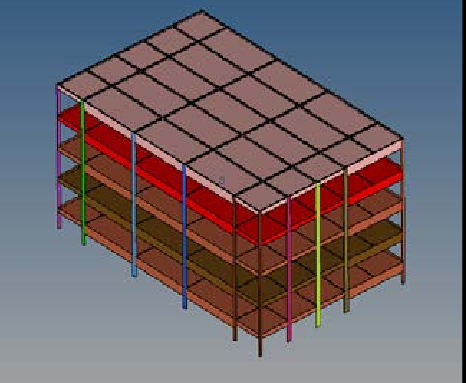
Upper floors should be strong to take heavy loads, should have sound insulation and fire resistance and also have a good wearing resistance. The upper floors are generally classified based on the materials of construction arrangement of beams and girders or materials used.
Commonly used floors are explained below.
Timber Floors
Timber floors are used only in areas where more timber is available at reasonable cost. Further they are used for residential buildings where the span is less and load on the floor is less.
The floors may be of single joist, double joist or triple joist. Joists of floors should be strong enough and not deflect too much causing any cracking of plaster of ceiling. Further long joists need strutting to avoid buckling. The planking consists of wooden boards of 4 cm thickness and 10–15 cm wide. Figure 23.6 shows the details of single joist timber floor, and the details of the joist’s joint is shown separately.

Figure 23.6 Details of single-joint timber floor
Jack Arch Brick Floors
Bricks and plain concrete can not be used directly as flooring system without proper strengthening. Either reinforcement can be provided or provision can be made so as to develop arch action.
Rolled steel joists (RSJ) are used to build arches so as to form jack arch floorings. The arches have spares varying from 1.25 to 2 m and the rise is 1/12th to 1/16th of the span. In order to accomplish the end thrusts the rods of 2–2.5 cm are run at 2–2.75m apart as shown in Fig. 23.7. The rods are encased in the wall along with a RSJ. The spandulus are filled with concrete.
Brick jack arches are constructed by bringing up the arches by laying the bricks on edges starting from the ends where the bottom of an RSJ is concreted. Lime or cement mortar is used. After laying the brick from ends, the key brick is introduced to set the arch action. Next layer is laid by pushing the centering ahead. This operation is continued till the work is completed.

Figure 23.7 Brick jack arch floor
RCC Slab Floors
All modern buildings are invariably constructed with reinforced cement concrete. For small spans a simple RCC slab floor is generally suitable. For rooms, with the ratio of length of the room to its width is greater than 1.5, slabs are designed to span along the shorter width. That is, the main reinforcements are placed to the shorter width. The thickness of the slab depends on the type of concrete used, the span, floor loads, etc. These slabs are considered along with a frame then it is made monolithically with the supporting frames (Fig. 23.8).

Figure 23.8 RCC slab floor
If the spans of rooms are approximately equal then the slab is designed as a two-way slab (i.e., main reinforcements are placed parallel to both the spans). At corners suitable reinforcement is provided at top and bottom to take the stresses due to partial fixity.
Reinforced concrete slabs are laid adopting the routine mixing, laying, finishing and curing. The slab provides a very smooth surface at the bottom and a pleasing appearance. It also accommodates all lighting arrangements. The RCC slabs are restricted up to 4 m span beyond which beam and slab construction has to be adopted.
The following is the construction procedure:
- A centring of steel or timber is erected to support its own weight and the super-imposed load.
- The reinforcement is placed on the centring before coating a thin layer (2–5 cm) of cement concrete.
- The required mix of cement concrete is then prepared and poured around the reinforcement up to the required thickness of the slab.
- The concrete is well consolidated by ramming or using a vibrator.
- The concrete is cured for a minimum period of 2 weeks to attain its full strength.
- After concrete has sufficiently hardened, the formwork is recovered.
- The upper and lower surfaces of the slab are plastered and required finish are given.
RCC Beam and Slab Floors
For larger spans and heavy loading conditions RCC beam and slab construction is generally resorted to. This type of construction is commonly used for most of the important buildings (Fig. 23.8).
RCC T-Beam Slab Floors
In this type of floor, beams and slabs are designed as rectangular sections and the slabs are supported on beams. It is a monolithic construction both the beams and slabs are cast together. The beam used in monolithic construction is called a T-beam (i.e., a part of slab acts as a flange of the T-beam).
The main reinforcement of the slab runs parallel to the short span. However, some reinforcement is provided on the other, as in RCC slab floor, as distributors. In case of equal spans two-way slabs may be constructed with reinforcement provided on both directions. Sometimes the projecting beams are covered by providing a false ceiling underneath it (Fig. 23.9).

Figure 23.9 RCC T-beam slab floor
The construction procedure is same as that of RCC slab floor, except for the type of centring or formwork required for the floor.
Flat Slab Floors
This type of floor is called as beamless slab floor. This flat slab floor is directly supported on columns without any intermediate beams. This type of floor is preferred where heavy loads are anticipated and where there is head room restriction. The columns supporting the floor are invariably circular in cross-section and tops of the column are flared or tapered, which is called as capital. Sometimes certain portion of the slab, symmetrical with the column, is thickened which is called drop panel (Fig. 23.10).

Figure 23.10 Flat slab floor
The flat slab floors have several advantages which are given below:
- As there is no projection of beam, there is no need for additional ceiling.
- More clean head room is available.
- Better ventilation and lighting is available.
- Even for heavier loads only thin slab thickness is needed.
- The construction is comparatively easier.
The flat slab floors are preferred under the following conditions:
- When large equal number of panels are required.
- Where clear large spans are required.
- Where there is limitation in head room.
- The ratio of length to breadth of panels is to be more than 4 : 3.
- The difference between the length and breadth of any two adjacent panels should not be more than 10% of the greater of the two.
The following two types of systems of reinforcement are in use: (i) two-way system and (ii) four-way system.
In the two-way system of reinforcement, the reinforcement is provided between the columns and perpendicular to the columns. The area left is considered as supported on four sides.
In the four-way system of reinforcement, the reinforcement is placed in four directions. That is two rows of main steel from column to column and other two rows placed diagonally across the panel from column to column.
Resilient Floors
Floors made from materials such as PVC, linoleum, rubber, etc., are called resilient floors. Resilient floors are sound proof and dust free and are used in libraries, offices, computer rooms, show room, etc. The three important resilient floors are: (i) PVC (Vinyl floors), Linoleum floor and Rubber floor, which are briefed below.
1. PVC Floor
The material in PVC floors is the thermoplastic binder which can be vinyl chloride polymer or vinyl chloride copolymer or both. The floor covering is backed with hessian or other woven fabric. Vinyl asbestos tiles have 40% of chrysotile asbestos fibre together with powdered mineral fillers and pigments. The thickness of normal PVC floor coverings are 1.5, 2.0, 2.5, 3.0 and 4.00 mm and the thickness of back floor coverings come in 2.0, 2.5, 3.0, 4.0 and 5.0 mm sizes. In roll form it is usually available in 1.0, 1.5 and 2.0 m and lengths of 10 m.
2. Linoleum Floor
Linoleum is a covering materials generally laid over wooden or concrete floors. Linoleum material is lubricated by mixing oxidised linseed oil with gum, resin, pigments, wood floor, cork dust and other filler materials. It is available as rolls of 2 or 4 m width with 2–2.5 m thick and both in plain and printed forms. Linoleum coverings are fixed to the sub-floor by means of suitable adhesive in order to have adequate bond and high durability. In some cases, it is nailed at the edges.
3. Rubber Floor
It is composed of natural rubber with various filling compounds. As the cost of rubber is high, their type of floor is expensive. They are produced in sheets and also in tile form. A sub-floor is essential.
23.5.8 Hollow Block and Rib Floors
In this type of floors, to reduce the total weight of the floor hollow blocks of clay or concrete are used. In one type, the blocks are placed at 10 cm apart and in this space, mild steel bars are placed (Fig. 23.11). Suitable flooring at top and ceiling finish are provided. In order to develop enough bond with the concrete, the blocks are provided with rough or grooved surface.

Figure 23.11 Hollow block and rib floor
The structural hollow clay floor tiles should be free from cracks and of uniform colour and texture. Projections of tiles are kept on one of the external face of such tiles so as to facilitate the application of plaster. The dimensions of length, 45–90 cm, width, 19–24 cm and height 70–90 mm. The weight per metre length of structural hollow clay tiles does not exceed 140 N.
Leave a Reply